
Coccus viridis
(Green, 1889)
green scale, green coffee scale, coffee green scale
Coccus viridis is a soft insect (Hemiptera: Coccidae) and major agricultural pest with a wide tropical and subtropical distribution. It reproduces parthenogenetically via thelytoky, with females producing 50-600 that hatch within minutes to hours beneath the mother's body. The completes its in 47-51 days at 25°C, with three nymphal instars before adulthood; first-instar nymphs actively disperse as '' while older instars and become . It is , feeding on phloem sap of over 200 plant in 72 , with primary economic damage to coffee, guava, and cacao crops.
Pronunciation
How to pronounce Coccus viridis: /ˈkɒk.kəs vɪˈraɪ.dɪs/
These audio files are automatically generated. While they are not always 100% accurate, they are a good starting point.
Identification
can be distinguished from other green-colored soft scales by the combination of pale green coloration with visible black internal markings through the body wall, the flattish elongated oval dome shape, and the distinctive groove at the end. The nymphal stages show progressive convexity with each . Parthenogenetic and absence of males in most may aid identification in laboratory settings.
Images
Appearance
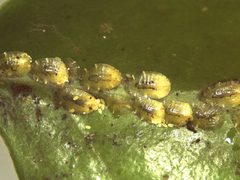
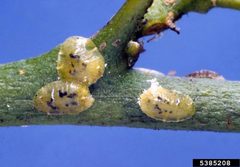
females are pale green with distinctive black internal markings visible through the chitinous body wall. The body is flattish, elongated oval, and dome-shaped, approximately 3 mm in width. The end is rounded, while the end has a distinctive groove. Adults retain legs and but are mostly sedentary. Nymphs are flattish oval, yellowish-green, with six short legs. Each successive instar is larger and more convex, with three before adulthood.
Habitat
Tropical and subtropical regions worldwide. In the European Union, restricted to Azores and Madeira Islands. Potential for establishment in southern and central EU countries outdoors, with greenhouse and indoor establishment possible in areas where outdoor survival is uncertain.
Distribution
Widespread in tropical and subtropical Americas, Africa, Asia, and Oceania. Specific records include: Asia (Bangladesh, Burma, Cambodia, India, Indonesia, Laos, Malaysia, Pakistan, Philippines, Sri Lanka, Taiwan, Thailand, Vietnam); Africa (Angola, Cameroon, Cape Verde, Ethiopia, Ghana, Guinea, Ivory Coast, Kenya, Madagascar, Madeira, Mali, Mauritius, Niger, Nigeria, Príncipe, Réunion, São Tomé, Senegal, Seychelles, Sierra Leone, South Africa, Tanzania, Togo, Uganda, Zambia, Zaire); Australasia and Pacific Islands (Australia, Caroline Islands, Fiji, Gilbert and Ellice Islands, Hawaii, Marianas Islands, New Caledonia, Papua New Guinea, Samoa, Society Islands, Tonga, Irian Jaya); North America (Mexico, USA); Central America and West Indies (El Salvador, Guatemala, Nicaragua, Panama, West Indies); South America (Bolivia, Brazil, Colombia, Guyana, Peru, Suriname, Venezuela).
Seasonality
Multiple overlapping annually; 3-4 generations per year in Queensland, 4-5 in Taiwan, with generation time of 50-70 days in South Florida summer. Seasonal peaks vary by region.
Diet
Phloem-feeding on plant sap. : documented from over 200 in 72 plant . Primary include Coffea arabica (coffee), Psidium guajava (guava), and Theobroma cacao (cacao). Other significant hosts: Anacardium occidentale (cashew), Manihot esculenta (cassava), Citrus spp., Cocos nucifera (coconut), Litchi chinensis (lychee), Eriobotrya japonica (loquat), Mangifera indica (mango), Carica papaya (papaya), Pyrus communis (pear), Cajanus cajan (pigeon pea), Ananas comosus (pineapple), Manilkara zapota (sapodilla), Camellia sinensis (tea). Also recorded on ornamentals including Camellia, Ficus, Gardenia, Ixora, Jasminum polyanthum, and Salacia crassifolia.
Host Associations
- Coffea arabica - primary Major economic impact; nursery seedlings and mature trees
- Psidium guajava - primary Major economic impact
- Theobroma cacao - primary Major economic impact
- Citrus sinensis - Recorded in Brazil study
- Salacia crassifolia - New record from Brazilian Cerrado, 2022
Life Cycle
, parthenogenetic via thelytoky (males extremely rare). Females lay 50-600 whitish oval beneath their body for protection. Eggs hatch within minutes to hours. Three nymphal instars precede adulthood. First instar ('') actively disperses to feeding sites on leaf undersides (midrib, lateral ), petioles, stems, young buds, and fruits. Second and third instars and become , remaining at selected feeding locations. Development times at 25°C: first instar 10-15 days, second instar 8-12 days, third instar 8-12 days; total egg-to-first-oviposition 47-51 days.
Behavior
First-instar nymphs actively search and select feeding locations, showing positive and capacity. Older nymphs and remain motionless at feeding sites, forming often aligned along leaf midribs and lateral . Adults and nymphs excrete honeydew, which attracts ants, , and bees; this mutualistic relationship with ants (particularly Pheidole in Hawaii) involves defense against in exchange for honeydew access. Ant presence significantly increases reproductive success and reduces mortality from natural enemies.
Ecological Role
Agricultural pest causing direct damage through phloem feeding and indirect damage via honeydew and development. Heavy cause leaf yellowing, premature leaf drop, loss of plant vigor, and reduced crop yield. Sooty mold growth on honeydew reduces photosynthetic area and marketability of fruits. Serves as prey for Coccinellidae beetles (notably Azya luteipes) and other natural enemies. Subject to natural regulation by fungi including Cephalosporium lecanii (= lecanii) and Lecanicillium lecanii.
Human Relevance
Major economic pest of coffee production worldwide, with historical regional crop failures attributed to this . Significant pest of guava, cacao, citrus, and many other tropical crops. Entry to new regions include plants for planting, fruits, vegetables, and cut flowers. Management approaches include inspection of planting material, chemical control (carbaryl, malathion, methomyl, Volck oil), using fungi, and colony suppression to disrupt mutualistic protection. Listed as potential pest for EU.
Similar Taxa
- Nipaecoccus viridisDifferent (Pseudococcidae vs. Coccidae); mealybug with white waxy covering rather than green ; produces ovisacs; field identification possible through KOH/NaOH color test (green ) unique to this
- Coccus hesperidumCongeneric soft ; brown coloration rather than green; lacks distinctive black internal markings visible through body wall
- Saissetia coffeaeBlack ; dark brown to black coloration; hemispherical shape rather than flattish oval dome
More Details
Climate Relationships
Field studies in Mexico and India demonstrate correlations between C. viridis and climatic factors. Pest show positive correlation with maximum and minimum temperatures, while fungal by Cephalosporium lecanii shows negative correlation with temperature and positive correlation with humidity and rainfall.
Spatial Distribution Pattern
Geostatistical analysis in Mexican coffee plantations reveals aggregated spatial distribution with high spatial association between C. viridis and fumagina (Capnodium spp. ), with correlation coefficient r = 0.70, indicating clustered foci suitable for targeted management.
Taxonomic History
Originally described as Lecanium viride Green, 1889; transferred to Coccus. The specific epithet 'viridis' refers to the green coloration of females.
Sources and further reading
- BugGuide
- Wikipedia
- GBIF taxonomy match
- iNaturalist taxon
- NCBI Taxonomy
- Catalogue of Life
- Snakeweed Grasshopper
- Cudweed Grasshopper
- Grasshoppers of Colorado
- Green Light: New ID Test Ready for Invasive Mealybug Pest
- Here We Go Again: Another Invasive Pest in Florida Citrus
- Small but Destructive: Hibiscus Mealybug Emerges as Concerning Pest of Florida Fruits, Ornamentals, Some Row Crops
- Pest categorisation of Coccus viridis
- Coccus viridis . [Distribution map].
- Morphological, behavioral and biological aspects of Azya luteipes Mulsant fed on Coccus viridis (Green)
- ANALYSIS OF THE SPATIAL ASSOCIATION OF FUMAGINA (Capnodium spp.) AND GREEN SCALE (Coccus viridis) IN COFFEE IN SULTEPEC, MEXICO
- Salacia crassifolia (Mart. ex Schult.) G. Don (Celastraceae) as a new host of the green scale insect [Coccus viridis (Green, 1889) (Hemiptera: Coccidae)] in the Brazilian Cerrado
- Ecology of Coffee Green Bug, Coccus viridis (Green) and its Entomopathogenic Fungus, Cephalosporium lecanii: Zimm.