
Saissetia coffeae
(Walker, 1852)
hemispherical scale, helmet scale, coffee brown scale
Saissetia coffeae is a soft insect (Coccidae) with a tropical and subtropical distribution. are , hemispherical, and helmet-shaped, ranging 2–4.5 mm in diameter depending on plant. The reproduces parthenogenetically; all individuals are female. It is a significant agricultural pest of coffee, citrus, avocado, fig, guava, and numerous ornamental plants, causing damage through phloem sap feeding and honeydew secretion that promotes growth. Multiple and predatory insects are associated with natural .
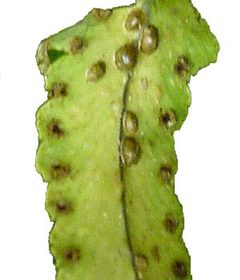

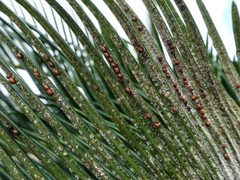
Pronunciation
How to pronounce Saissetia coffeae: //saɪˈsiːtiə ˈkɒfi.iː//
These audio files are automatically generated. While they are not always 100% accurate, they are a good starting point.
Identification
Distinguished from other Saissetia by the smooth, shiny, hemispherical covering lacking prominent wax ornamentation. The helmet-like shape and close appression to plant surfaces separate it from flatter species. The 'H'-pattern ridging on young scales is diagnostic when present. Differs from Saissetia oleae (black scale) by coloration and lack of ridge; from Ceroplastes species by absence of thick wax coating. Molecular confirmation may be required where morphological overlap occurs with related species.
Images
Appearance
females are convex, rounded, and helmet-shaped, smooth and shiny brown, closely appressed to stems or leaves. Diameter ranges 2–4.5 mm, varying with plant identity. Young often display a slightly ridged surface, sometimes forming an 'H' pattern. First-instar nymphs ('') possess short , functional legs, paired red eyespots, and two long setae; this is the only mobile life stage. Second and third instars and adults are , lacking visible limbs. are pinkish-beige, oblong, approximately 0.7 mm long.
Habitat
Tropical and subtropical agricultural and horticultural environments; nursery conditions; orchards; greenhouse . Found on stems, leaves, and fruits of plants.
Distribution
Pantropical and subtropical: West, Central, and East Africa; Madagascar; tropical and subtropical Asia; North, Central, and South America; Caribbean region; Middle East; India; Oceania (Galápagos, Azores). Documented in Morocco, Egypt, Palestinian Territories, and Assam, India with expanding range records.
Seasonality
vary regionally; in Egypt and Mediterranean climates, peak occur in warmer months with activity lagging. In Alexandria, Egypt, highest rates observed August–November. Development period from to requires 40+ days; multiple per year possible in favorable climates.
Diet
Phloem sap feeder; inserts mouthparts into plant vascular tissue and feeds on sap. across diverse plants.
Host Associations
- Coffea arabica - namesake , coffee
- Coffea - coffee plants
- Citrus - citrus spp.
- Persea americana - avocado
- Ficus carica - edible fig
- Ficus retusa - strangler fig
- Cycas revoluta - sago palm
- Psidium guajava - guava
- Meyna spinosa - new record from Assam
- Jasminum multiflorum - new record from Assam
- Camellia sinensis - tea
- Annona squamosa - sugar apple
- Cucurbita - pumpkin
- Gossypium - cotton
- Solanum melongena - eggplant
- Abelmoschus esculentus - okra
- Mangifera indica - mango
- Musa - banana
- Olea europaea - olive
- Cannabis sativa - hemp, reported in Florida
Life Cycle
Parthenogenetic; all individuals female. Female lays up to ~1000 pinkish-beige oblong (0.7 mm) beneath her covering, dying shortly after oviposition. Eggs hatch into first-instar ''—the only mobile stage—which disperse to locate feeding sites. Upon settling, crawlers insert mouthparts, to second instar, then third instar, finally becoming . Complete development requires 40+ days; multiple in suitable climates.
Behavior
as , settled nymphs, and ; only first-instar mobile. Secretes copious honeydew that accumulates on plant surfaces below . Frequently tended by ants that harvest honeydew and may protect from natural enemies. Capable of encapsulating eggs as immune defense, with rate increasing with age and temperature—reaching 88.8–100% in preovipositing females and 99.5–100% at 32°C regardless of age.
Ecological Role
Agricultural pest causing direct damage through sap extraction, leading to leaf fall, shoot stunting, and plant deformation. Honeydew secretion supports growth that impedes and reduces plant vigor. Serves as for diverse (Encyrtidae, Aphelinidae, Pteromalidae) and predatory insects (Coccinellidae, Anthocoridae, Chrysopidae), contributing to structure in managed .
Human Relevance
Significant economic pest of coffee, citrus, avocado, fig, and ornamental industries worldwide. Management relies on using introduced or (Metaphycus flavus, Scutellista cyanea, Coccophagus spp.) and ; chemical control when biological regulation insufficient. management often required to disrupt mutualism and expose to natural enemies. concern for nursery trade.
Similar Taxa
- Saissetia oleaeBoth are Saissetia soft scales, but S. oleae (black ) is darker, more convex with distinct ridge, and prefers olive and citrus; S. coffeae is smoother, helmet-shaped, lighter brown, and more .
- Ceroplastes floridensisBoth Coccidae pests on similar , but Ceroplastes produce thick waxy coverings; S. coffeae has smooth, shiny, wax-free helmet-shaped covering.
- Coccus hesperidumBoth soft brown , but C. hesperidum is flatter, more oval, and translucent brown; S. coffeae is distinctly hemispherical and helmet-like.
More Details
Temperature-Dependent Immune Response
of varies dramatically with temperature and age. At 16–28°C, encapsulation increases with host age: 5.5–19.6% in third-instar nymphs, 45.4–74.2% in young females, 88.8–100% in preovipositing females. At 32°C, encapsulation reaches 99.5–100% regardless of host age, conferring complete to Metaphycus swirskii. This has critical implications for timing and efficacy.
Natural Enemy Complex
Documented include Metaphycus flavus, M. helvolus, M. swirskii, M. luteolus (Encyrtidae); Coccophagus rusti, Coccophagus sp. (Aphelinidae); Scutellista cyanea, S. caerulea (Pteromalidae). include Chilocorus renipustulatus, Scymnus syriacus, Stethorus pusillus, Exochomus flavipes (Coccinellidae); Orius laevigatus (Anthocoridae); Chrysoperla carnea (Chrysopidae); Eublemma scitula (Crambidae). rates vary by location, season, and altitude—ranging 12–71% in different studies.
Parthenogenesis
is exclusively ; males are absent from . This reproductive mode facilitates rapid population establishment and spread, as single individuals can found new .
Sources and further reading
- BugGuide
- Wikipedia
- GBIF taxonomy match
- iNaturalist taxon
- NCBI Taxonomy
- Catalogue of Life
- Encyrtid Holdings | Entomology Research Museum
- Microscopic Coils and Coffee Trees Lead to an Amazing New Fungal Discovery | Blog
- Hemp Pests Documented in New Guide for Florida Growers
- Effects of Temperature on the Reproduction of Saissetia Coffeae and its Parasitoids
- POPULATION DYNAMICS OF Saissetia coffeae Walker (HOMOPTERA : COCCIDAE) AND ITS PARASITOIDS ON GUAVA IN MIDDLE EGYPT
- Saissetia coffeae (Walker) (Coccidae: Hemiptera) infestation on Meyna spinosa Roxb. ex Link-a new host plant and sap-sucker (pest) record from Assam, India
- Jasminum multiflorum (Burm. f.) Andrews (Oleaceae) - a new host plant record for Saissetia coffeae (Walker) (Coccidae: Hemiptera) from Assam, India
- Identification of an aphelinid parasitoid on hemispherical scale insect, Saissetia coffeae (Walker, 1852) (Hemiptera: Coccidae) on olive and fig trees, quantification of parasitism rate and potential as biocontrol agent of the insect
- Encapsulation of eggs of the encyrtid wasp, Metaphycus swirskii, by the hemispherical scale, Saissetia coffeae: Effects of host age and rearing temperature
- Saissetia coffeae (Walker, 1852) (Hemiptera: Coccidae): An emerging pest on various crops and ornamental plants in Morocco
- Efficacy of the natural enemy Scutellista cyanea Motsch. (Hym., Pteromalidae) on Saissetia coffeae Wlk., S. oleae (Bern.) and Ceroplastes floridensis Comst. (Hom., Coccidae)