
Panaphis juglandis
(Goeze, 1778)
Walnut Aphid, Large Walnut Aphid
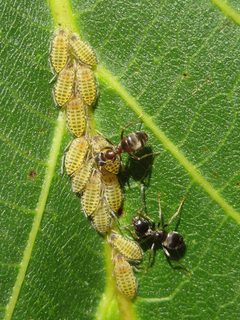
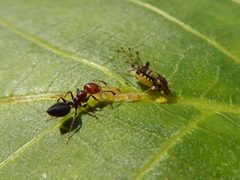
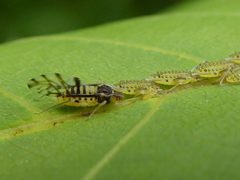
Panaphis juglandis, the large walnut , is a phloem-feeding pest of walnut trees (Juglans regia). It colonizes exclusively the upper (adaxial) surface of walnut compound leaves, forming dense colonies along the main vascular of the outer leaflets. Native to the Old World (Central Asia and southeastern Europe), it has spread across Europe and was introduced to California in the early 20th century. The reduces tree vigor, nut yield, and quality, and excretes honeydew that promotes growth. It forms mutualistic relationships with species that tend and protect colonies from .
Pronunciation
How to pronounce Panaphis juglandis: /ˈpænəfɪs d͡ʒʌˈɡlændɪs/
These audio files are automatically generated. While they are not always 100% accurate, they are a good starting point.
Identification
Distinguished from the small walnut (Chromaphis juglandicola) by its larger body size and exclusive feeding on the upper leaf surface; C. juglandicola feeds only on the lower leaf surface. Forms characteristic colonies along the main vascular , particularly on the first three external leaflets of compound leaves. Darkening of the leaf midrib occurs shortly after and persists after colonies depart.
Images
Habitat
Urban and suburban environments with walnut trees, including street-side locations with strong anthropogenic disturbance and home gardens. Temperate climate zones. Colonizes exclusively the upper surface of walnut compound leaves.
Distribution
Native to the Old World with homelands in Central Asia and southeastern Europe. Widespread across Europe from Spain, Italy, and Serbia to Denmark, Sweden, and Poland. Introduced to California at the beginning of the 20th century. Present in Yugoslavia, Serbia, Albania, and Austria.
Seasonality
Active from spring through early autumn. First specimens appear in April–May, with earlier in street-side locations compared to home gardens. Peak typically occurs in June, with activity continuing through August–September depending on temperature. Two peaks possible in some years when temperatures decrease in late summer.
Diet
Phloem feeder on walnut (Juglans regia). Feeds exclusively on the upper (adaxial) surface of walnut compound leaves.
Host Associations
- Juglans regia L. - primary common walnut; sole documented in detailed studies
Life Cycle
Development begins on external leaflets (positions 1–4), then spreads to all leaflets as increase. Both alatae (winged females) and apterae (wingless forms) present; alatae females observed in May–June. Population development influenced by weather: temperatures of 15–20°C with average rainfall enhance populations; temperatures above 25°C with intensive rainfall decrease populations; temperatures below 15°C cause population decline.
Behavior
Forms dense colonies along the main vascular on the upper leaf surface. Engages in mutualistic relationships with that tend colonies and protect against . Ant defensive vary by species: some ants fight or attempt rescue of grabbed aphids, while others flee when confronted by lady beetle predators.
Ecological Role
Pest of walnut that reduces tree vigor, nut size, yield, and quality. Excretes copious honeydew that supports growth of black fungi, reducing light penetration and photosynthetic capacity and predisposing nuts to sunburn and kernel quality loss. Serves as prey for lady beetles (Coccinellidae) including Harmonia axyridis and Adalia bipunctata. Mutualist partner for various (Camponotus piceus, C. vagus, Crematogaster scutellaris, Dolichoderus quadripunctatus, Lasius emarginatus) that tend colonies and provide protection from natural enemies.
Human Relevance
Significant pest of walnut orchards and urban walnut trees. High (>15 aphids per leaflet for at least 14 days) reduce current season nut quality and the following season's crop. Honeydew promotes that degrades nut quality and tree health. Subject to research involving predatory lady beetles and dynamics.
Similar Taxa
- Chromaphis juglandicolaBoth are walnut-feeding aphids, but C. juglandicola is smaller and feeds exclusively on the lower leaf surface, while P. juglandis is larger and feeds only on the upper surface.
Sources and further reading
- BugGuide
- GBIF taxonomy match
- iNaturalist taxon
- NCBI Taxonomy
- Catalogue of Life
- Walnut Twig Beetle: How a 'Failed' Research Project Led to Success | Bug Squad
- UC Davis Students Carry on Legacy of Walnut Twig Beetle Expert Steve Seybold | Bug Squad
- Jackson Audley: A Case Study with the Walnut Twig Beetle | Bug Squad
- Jackson Audley: Targeting the Walnut Twig Beetle | Bug Squad
- UC Davis Entomology/Nematology Seminars: What a Wealth of Information | Bug Squad
- A Sign of the Times: Why This Black Walnut Tree Is Dying | Bug Squad
- POPULATION DYNAMICS AND SPATIAL DISTRIBUTION OF Panaphis juglandis (Goeze, 1778) (Hemiptera: Aphididae) ON COMMON WALNUT (Juglans regia L.)
- Effect of temperature on predation by Harmonia axyridis (Pall.) (Coleoptera: Coccinellidae) on the walnut aphids Chromaphis juglandicola Kalt. and Panaphis juglandis (Goeze)
- Fight and rescue or give up and flee? Behavioural responses of different ant species tending the mutualist walnut aphid Panaphis juglandis to native and exotic lady beetles – CORRIGENDUM
- Fight and rescue or give up and flee? Behavioural responses of different ant species tending the mutualist walnut aphid Panaphis juglandis to native and exotic lady beetles