
Aleurocanthus woglumi
Ashby, 1915
Citrus blackfly
is a whitefly in the Aleyrodidae, native to India and widely distributed across tropical and subtropical regions. It is a significant agricultural pest of citrus and over 300 other plants, causing damage through sap feeding and honeydew that promotes growth. The species has been introduced to the Americas, Africa, and Pacific islands, where using parasitic has been implemented.
Pronunciation
How to pronounce Aleurocanthus woglumi: //əˌljʊəroʊˈkænθəs ˈwoʊɡluːmi//
These audio files are automatically generated. While they are not always 100% accurate, they are a good starting point.
Identification
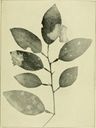
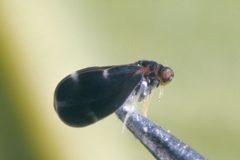
distinguished by slate-blue coloration from waxy powder, unlike the white or pale appearance of many other whiteflies. Nymphal stages show progressive darkening from brown to black with increasingly prominent spines. The spiral pattern on leaf undersides is characteristic. Adults are attracted to plant material reflecting light in the 500–600 nm range, which may aid in detection.
Images
Habitat
Tropical and subtropical environments; primarily associated with citrus orchards but occurs on diverse plants in agricultural and urban settings. Irrigation increases suitable range substantially.
Distribution
Native to India; established across Asia (Bangladesh, China, Indonesia, Malaysia, Pakistan, Philippines, Sri Lanka, Taiwan, Thailand, Vietnam), Africa (Kenya, South Africa, Tanzania, Uganda), the Americas (Mexico, Central America, Caribbean, Florida, Texas, Hawaii, South America), and Pacific islands. Present in the Azores. Climate modeling indicates potential for further spread into the Mediterranean Basin and Australia.
Diet
Phloem sap from foliage of plants; feeds on over 300 documented host with strong preference for citrus (lemon, orange, pomelo).
Host Associations
- Citrus spp. - primary Most heavily infested; includes lemon, orange, and pomelo
- Mangifera indica - Documented in Hawaii and field studies
- Persea americana - Documented in Hawaii
- Artocarpus heterophyllus - New identified in Rio de Janeiro, Brazil
- Pouteria caimito - New identified in Rio de Janeiro, Brazil
- Struthanthus flexicaulis - New identified in Rio de Janeiro, Brazil
- Tabebuia rosea - Pink tecoma; documented in Hawaii
- Eugenia uniflora - Surinam cherry; documented in Hawaii
- Fortunella spp. - Kumquat; as attractive as Citrus for oviposition
Life Cycle
Females lay in spiral patterns on leaf undersides. Eggs hatch in 7–10 days. Nymphs pass through three instars lasting 3–9 weeks total, with progressive darkening and spine development. follows third instar. Complete lifecycle ranges from 45 to 130 days depending on temperature.
Behavior
are attracted to plant material reflecting light in the 500–600 nm range, which appears to be the primary long-range attractant for location. Oviposition occurs preferentially on citrus but expands to alternative hosts as increases. Females lay in characteristic spiral batches.
Ecological Role
Agricultural pest causing economic damage through direct feeding and indirect effects of . Serves as for (Encarsia perplexa, Amitus hesperidum, Encarsia pergandiella) and including Coccinellidae beetles and lacewings (Ceraeochrysa cubana).
Human Relevance
Significant economic pest of citrus production globally. Damage includes reduced fruit yield, tree vigor decline, and impaired from . Subject of programs; parasitic Encarsia perplexa and Amitus hesperidum introduced to Hawaii in 1999 and established in Florida. Oil emulsions and cultural practices (irrigation, ) recommended over to preserve natural enemies.
Similar Taxa
- Aleurocanthus spiniferusSame ; both are citrus pests with spiny nymphs, but A. woglumi has slate-blue versus different coloration in A. spiniferus
- Dialeurodes citriAnother citrus whitefly; A. woglumi distinguished by dark coloration and spiral pattern versus pale and different oviposition
More Details
Biological Control
Amitus hesperidum is well synchronized with its , with female ready to oviposit when suitable blackfly larval stages are present. Encarsia perplexa has lower reproductive rate but superior host-searching ability. Both established successfully in Hawaii after 1999 introduction.
Climate Change Risk
Modeling indicates potential range expansion into Mediterranean Basin and Australia; irrigation increases potential distribution by 53% in Asia. Europe near doubling of at-risk area by 2050 under warming scenarios.
Sources and further reading
- BugGuide
- Wikipedia
- iNaturalist taxon
- NCBI Taxonomy
- Catalogue of Life
- Aleurocanthus woglumi Ashby Archives - AgriLife Extension Entomology
- Aleurocanthus woglumi . [Distribution map].
- Aleurocanthus woglumi . [Distribution map].
- Citrus Blackfly, Aleurocanthus woglumi Ashby (Insecta: Hemiptera: Aleyrodidae)
- (Neuroptera: Chrysopidae) fed with Aleurocanthus woglumi (Hemiptera: Aleyrodidae)
- Potential global distribution of Aleurocanthus woglumi considering climate change and irrigation
- Synchrony and impact ofAmitus hesperidum [Hym.: Platygasteridae] on its host,Aleurocanthus woglumi [Hym.: Aleyrodidae] in southern Florida
- Development and Survivorship of the Citrus Blackfly Aleurocanthus woglumi 1 on Six Citrus Hosts 2
- FIELD STUDIES OF THE HOST RANGE OF THE CITRUS BLACKFLY, ALEUROCANTHUS WOGLUMI (HOMOPTERA: ALEYRODIDAE)
- Dissemination of Aleurocanthus woglumi in citrus plants, its natural enemies and new host plants in the state of Rio de Janeiro, Brazil
- Aleurocanthus woglumi [Hom.: Aleyrodidae] andEncarsia opulenta [Hym.: Encyrtidae]: Density-dependent relationship between adult parasite aggregation and mortality of the host