
Amitus
Haldeman, 1850
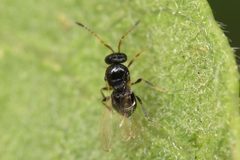
Amitus is a of in the Platygastridae, containing at least 16 described . Species in this genus are primarily known as agents of whiteflies (Aleyrodidae), with several species introduced internationally for pest management. Notable species include A. hesperidum, an effective parasitoid of citrus blackfly introduced to multiple countries; A. fuscipennis, used against greenhouse whitefly; and A. bennetti, a parasitoid of silverleaf whitefly.
Pronunciation
How to pronounce Amitus: /ˈæmɪtəs/
These audio files are automatically generated. While they are not always 100% accurate, they are a good starting point.
Images
Habitat
Associated with agricultural and horticultural systems where whitefly occur, including citrus groves, tea gardens, greenhouses, and bean fields. Specific preferences vary by and host association.
Distribution
occur across multiple continents including Asia (type locality of A. hesperidum in Hong Kong and Singapore), the Americas (Mexico, Texas, Florida, South America), and have been introduced to regions outside native ranges for purposes.
Host Associations
- Aleurocanthus woglumi - citrus blackfly
- Aleurocanthus citriperdus - original description
- Aleurocanthus spiniferus - citrus spiny whitefly in tea gardens
- Trialeurodes vaporariorum - greenhouse whitefly
- Bemisia argentifolii - silverleaf whitefly
- Tetraleurodes perileuca - of A. granulosus
Life Cycle
Development is temperature-dependent. For A. fuscipennis, development ranges from 61 days at 15°C to 22 days at 30°C. For A. bennetti, development time decreases from 72 days at 15°C to 28 days at 25°C, requiring approximately 400 with a development threshold of 10°C. are pro-ovigenic, emerging with lifetime load ready to oviposit.
Behavior
Females are attracted to -induced plant volatiles; A. hesperidum is specifically attracted to the tea plant synomone (E,E)-α-farnesene. Searching involves (comprising 61% of time budget), host drumming and probing, and area-restricted searching after . Oviposition typically targets first instar nymphs. A. fuscipennis disperses up to 12 meters with wind-assisted passive , showing preference for downwind movement.
Ecological Role
agent of whitefly pests in agricultural systems. have been introduced to new regions (Mexico, Texas, Florida, Dominica) for of whiteflies. Can significantly reduce pest , with field studies showing rates 2.25 times higher in treated versus control areas.
Human Relevance
Important agents used in programs. A. hesperidum successfully established in multiple countries for citrus blackfly control. A. fuscipennis evaluated for greenhouse whitefly management. A. bennetti assessed for silverleaf whitefly control in cotton and bean crops. Synomone-based attractants developed to enhance efficacy in tea production systems.
Similar Taxa
- EncarsiaBoth are of whiteflies used in ; Encarsia is in Aphelinidae rather than Platygastridae and exhibits synovigenic compared to pro-ovigenic Amitus
- EretmocerusAnother whitefly used in ; differs in (Aphelinidae) and specific range
More Details
Notable species
A. hesperidum: described by Silvestri in 1927, introduced from India to Mexico, Texas, and Florida for citrus blackfly control. A. fuscipennis: described by MacGown & Nebeker in 1978, studied extensively for greenhouse whitefly in Colombia. A. bennetti: described by Viggiani & Evans, of silverleaf whitefly with extended development time compared to other whitefly parasitoids.
Reproductive biology
Pro-ovigenic strategy with high ; A. fuscipennis produces 338-430 per female at optimal temperatures (15-25°C), with maximum oviposition on first day after . longevity reduced when present (5-8 days) versus without hosts (19-29 days).
Sources and further reading
- BugGuide
- Wikipedia
- GBIF taxonomy match
- iNaturalist taxon
- NCBI Taxonomy
- Catalogue of Life
- Publications | Entomology Research Museum
- Citrus Blackfly Parasitoid, Amitus hesperidum Silvestri (Insecta: Hymenoptera: Platygasteridae)
- Searching Behaviour of Amitus Fuscipennis: Residence Time and Walking Activity
- Using tea plant synomone (E, E)-α-farnesene to attract parastoid Amitus hesperidum to control Aleurocanthus spiniferus in tea gardens
- Field Evaluation of Amitus bennetti (Hymenoptera: Platygasteridae), a Parasitoid of Bemisia argentifolii (Hemiptera: Aleyrodidae), in Cotton and Bean
- Efecto del viento en la dispersión a corta distancia del parasitoide Amitus fuscipennis MacGown y Nebeker (Hymenoptera: Platygasteridae) en cultivos de fríjol y habichuela
- Male antennal gland of Amitus spiniferus (Brethes) (Hymenoptera : Platygastridae), likely involved in courtship behavior
- Searching and oviposition behaviour of Amitus fuscipennis, a parasitoid of the greenhouse whitefly
- Comparison of Foraging Behavior, Interspecific Host Discrimination, and Competition of Encarsia formosa and Amitus fuscipennis
- Biology of Amitus Fuscipennis (Macgown & Nebeker) Under Three Ecological Conditions In Rionegro (Ant.)
- Reproductive Biology and Search Behavior ofAmitus bennetti(Hymenoptera: Platygasteridae), a Parasitoid ofBemisia argentifolii(Homoptera: Aleyrodidae)
- Life‐history and oviposition behaviour of Amitus bennetti, a parasitoid of Bemisia argentifolii
- Intrinsic rate of population increase ofAmitus fuscipennisMacGown and Nebeker (Hym., Platygasteridae) according to climatic conditions and bean cultivar
- Life history of Amitus fuscipennis (Hym., Platygastridae) as parasitoid of the greenhouse whitefly Trialeurodes vaporariorum (Hom., Aleyrodidae) on tomato as function of temperature
- The Whitefly Tetraleurodes perileuca (Cockerell) (Hemiptera: Aleyrodidae) in Mexico and the First Record of its Parasitoid Amitus granulosus MacGown and Nebeker (Hymenoptera: Platygastridae)
- Post-release survey to assess impact and potential host range expansion by Amitus hesperidum and Encarsia perplexa, two parasitoids introduced for the biological control of the citrus blackfly, Aleurocanthus woglumi in Dominica