
Brochymena sulcata
Van Duzee, 1918
rough stink bug, tree stink bug
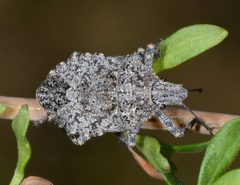
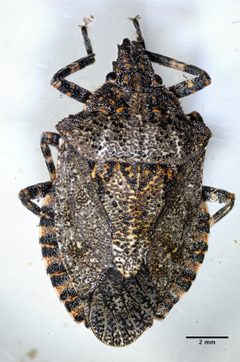
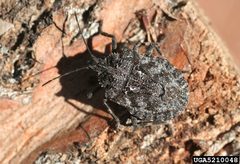
Brochymena sulcata is a of rough stink bug in the Pentatomidae, native to North America. exhibit cryptic coloration that closely resembles lichen-mottled tree bark, providing effective camouflage against . The species overwinters as adults, typically remaining outdoors beneath loose bark or in other sheltered locations. Like other members of the , it is not considered an agricultural or household pest.
Pronunciation
How to pronounce Brochymena sulcata: /broʊˈkaɪmɛnə sʊlˈkeɪtə/
These audio files are automatically generated. While they are not always 100% accurate, they are a good starting point.
Identification
Brochymena sulcata can be distinguished from the brown marmorated stink bug (Halyomorpha halys) by two key features: the lack the white bands present on the last two antennal segments of H. halys, and the leading edge of the pronotum bears fine teeth rather than a smooth margin. -level identification within Brochymena requires microscopic examination of morphological characters.
Images
Habitat
Associated with trees and shrubs; seek shelter under loose bark for . Specific plant associations for B. sulcata are not documented.
Distribution
North America; precise range boundaries within the continent are not well documented.
Seasonality
are active in spring and fall during from and entry into hibernation; may be observed on warm, sunny winter days.
Life Cycle
are laid in small clusters on twigs of trees. Nymphs progress through four instars before reaching adulthood. Development from egg to is prolonged, resulting in a single annually in temperate climates.
Behavior
are capable of and may alight on contrasting surfaces such as fences or sidewalks, becoming more visible against such backgrounds. Aggregates with conspecifics under loose bark for .
Ecological Role
Serves as prey for various including the sand wasp Bicyrtes quadrifasciata, birds, and fence lizards. are parasitized by platygastrid Trissolcus brochymenae and Telenomus sp., and by the eupelmid wasp Anastatus reduvii. Feather-legged tachinid flies in the Trichopoda attach eggs to , with larvae developing as internal .
Human Relevance
Not a pest ; does not invade structures in large numbers. Occasionally encountered indoors when individual seek shelter, but generally remains outdoors. Distinguished from the brown marmorated stink bug by morphological features.
Similar Taxa
- Halyomorpha halys (brown marmorated stink bug)Superficially similar appearance but distinguished by white-banded , smooth pronotal margin, and tendency to aggregate in large numbers on buildings in fall.
- Other Brochymena speciesApproximately 21–23 occur in North America north of Mexico; species-level identification requires microscopic examination.