
Picromerus
Amyot & Serville, 1843
Species Guides
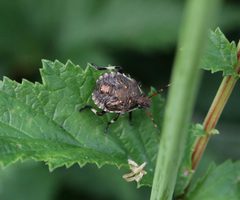
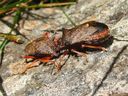
1- Picromerus bidens(spiny shieldbug)
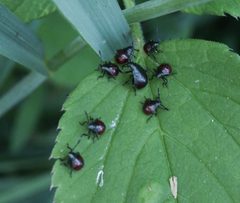
Picromerus is a of predatory shield bugs in the Pentatomidae. in this genus are predatory throughout their , feeding primarily on lepidopteran larvae and other soft-bodied insects. Several species, particularly P. bidens and P. lewisi, have been studied extensively for their potential as agents against agricultural and forest pests. The genus exhibits specialized adaptations for , including well-developed olfactory systems for locating prey and plants.
Pronunciation
How to pronounce Picromerus: //pɪˈkroʊmərəs//
These audio files are automatically generated. While they are not always 100% accurate, they are a good starting point.
Images
Distribution
Records from Denmark (DK), Norway (NO), Sweden (SE), and Vermont, United States (US). within the have broader distributions: P. bidens occurs in Europe including western Bohemia (Czech Republic); P. lewisi is widely distributed across China with confirmed in Hubei and Guizhou provinces.
Diet
Predatory on larvae of Lepidoptera including Spodoptera litura, Spodoptera frugiperda, Spodoptera exigua, Mythimna separata, Leucania separata, and Euphydryas aurinia. Picromerus bidens also preys on Leptinotarsa decemlineata (Colorado potato beetle). First instar nymphs of P. lewisi require 10% honey water solution; later instars feed on lepidopteran larvae.
Life Cycle
(one per year) in P. bidens, with obligatory summer dormancy () in from early summer until September; adults overwinter and reproduce in spring. Development from second to fifth instar takes 17–44 days at 18–27°C. occurs in some eggs; hatch rates without cold treatment range from 5.7% (long-day conditions) to 20.9% (short-day conditions).
Behavior
of P. bidens enter reproductive dormancy () triggered by long day length and high temperature, preventing early oviposition and second development. Adults exhibit efficient foraging , including returning to previously attacked prey locations. P. lewisi adults show significant preference for Spodoptera litura-infested tobacco plants over healthy plants, mediated by sex-dependent odorant-binding protein expression. varies with temperature and plant: type II at 18°C and 23°C, type III at 27°C in P. bidens females.
Ecological Role
Natural predatory enemy ( agent) of lepidopteran defoliator pests in agricultural and forest . Acts as substantial mortality factor in small of vulnerable lepidopteran .
Human Relevance
Evaluated as potential agent for augmentative release against lepidopteran, coleopteran, and hymenopteran defoliator pests. Considered as native European alternative to the North American Podisus maculiventris for biological control in Europe. Susceptible to neonicotinoid (dinotefuran), which impair offspring growth and ability. Climate change may reduce suitable range, potentially limiting effectiveness for pest control.
Similar Taxa
- Podisus maculiventrisBoth are predatory pentatomids used in ; P. bidens has longer nymphal development (17–44 vs. 14–32 days) and greater voracity at temperature extremes, while P. maculiventris shows higher rates at moderate temperatures (23°C).
- Other PentatomidaePicromerus are distinguished from phytophagous stink bugs by predatory mouthpart adaptations and ; molecular and morphological identification required for definitive differentiation.
Sources and further reading
- BugGuide
- Wikipedia
- GBIF taxonomy match
- iNaturalist taxon
- NCBI Taxonomy
- Catalogue of Life
- Functional response ofPicromerus bidens: effects of host plant
- Identification and odor exposure regulation of odorant-binding proteins in Picromerus lewisi
- Summer dormancy ensures univoltinism in the predatory bug Picromerus bidens
- Effects of diet on development and reproduction of the predatory pentatomids Picromerus bidens and Podisus maculiventris
- Transcriptome analysis reveals salivary gland-specific neuropeptide signaling genes in the predatory stink bug, Picromerus lewisi
- <i>Picromerus bidens</i> (Heteroptera: Pentatomidae) as predator of the Checkerspot <i>Euphydryas aurinia</i> (Lepidoptera: Nymphalidae)
- A full-length transcriptome and gene expression analysis of three detoxification gene families in a predatory stink bug, Picromerus lewisi
- Effects of diet on development and reproduction of the predatory pentatomids Picromerus bidens and Podisus maculiventris
- Study on the Potential Distribution of Leptinotarsa decemlineata and Its Natural Enemy Picromerus bidens Under Climate Change
- Effects of temperature on predation by the stinkbugsPicromerus bidensandPodisus maculiventris(Heteroptera: Pentatomidae) on noctuid caterpillars
- Acute Toxicity of Dinotefuran to Picromerus lewisi Scott (Hemiptera: Pentatomidae) and Its Impact on Offspring Growth and Predation Ability in Integrated Pest Management.