
Picromerus bidens
(Linnaeus, 1758)
spiny shieldbug, spiked shieldbug
Picromerus bidens is a predatory shield bug in the Pentatomidae, notable for its large size and distinctive spiny pronotal projections. It is , with summer dormancy () ensuring synchronization of its with seasonal conditions. The is native to the Palaearctic region but has been introduced to North America, where it has established . Both and nymphs are predatory, feeding primarily on insect larvae, and the species has been investigated as a potential agent.
Pronunciation
How to pronounce Picromerus bidens: /pɪˈkroʊmɛrəs ˈbaɪˌdɛnz/
These audio files are automatically generated. While they are not always 100% accurate, they are a good starting point.
Identification
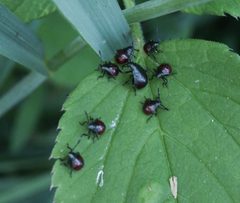
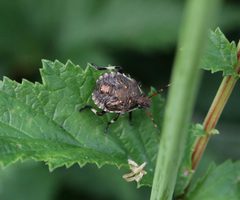
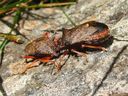
Distinguished from other shield bugs by the two prominent thornlike projections on the pronotum. The combination of large size (12–13.5 mm), variable brown to bluish coloration, red-brown appendages, and the distinctive 'spiny' pronotum separates it from and other Pentatomidae. Final instar nymphs can be recognized by their greyish black coloration with banded and legs.
Images
Habitat
Deciduous and mixed forests, heathland, gardens, chalk downland, and damp flower-rich meadows. In North America, has been recorded from more than 180 sites across varied .
Distribution
Native to the Palaearctic region, ranging from 64°N to North Africa and from the British Isles to China. Introduced to North America, probably on multiple occasions, with established recorded from more than 180 sites.
Seasonality
present from July or August until November. Nymphs become adults by July or August. laid on tree trunks and leaves; larvae hatch in spring. usually overwinters as eggs, less frequently as nymphs.
Diet
Life Cycle
(one per year). Females lay on tree trunks and leaves. Larvae hatch in spring and develop through five moults to become by July or August. Summer dormancy () in early-emerging adults prevents early oviposition and maintains univoltinism. occurs primarily as eggs, less commonly as nymphs.
Behavior
Exhibits summer dormancy () induced by long-day photoperiodic conditions, which delays and prevents untimely hatching of nymphs. When attacking prey in protective silken webs, exhibit efficient including returning to previously attacked webs. varies with temperature and plant context.
Ecological Role
of insect larvae, including agricultural and forest pests. Can act as a substantial mortality factor in small insect . Investigated as a potential agent for defoliating caterpillars and the Colorado potato beetle (Leptinotarsa decemlineata).
Human Relevance
Investigated as a agent for pest insects, particularly as a potential alternative to the North American Podisus maculiventris in Europe. High rates at varied temperatures suggest value for biological control, though mass production obstacles remain. Climate change may reduce suitable , potentially limiting its effectiveness as a biocontrol agent.
Similar Taxa
- Podisus maculiventrisBoth are predatory pentatomid used in ; P. bidens has longer nymphal development and greater voracity at temperature extremes, while P. maculiventris has higher rates at moderate temperatures.
More Details
Photoperiodic Response
Long-day conditions (L18:D6, L20:D4) induce , delaying oviposition; short-day conditions (L12:D12, L14:D10) result in synchronous -laying soon after .
Functional Response
Exhibits type II at 18°C and 23°C, but type III response at 27°C; and handling time vary significantly with plant and temperature.
Sources and further reading
- BugGuide
- Wikipedia
- GBIF taxonomy match
- iNaturalist taxon
- NCBI Taxonomy
- A new population of the federally-endangered decurrent false aster | Beetles In The Bush
- Plantae | Beetles In The Bush | Page 7
- Botanizing at Prairie Fork Conservation Area | Beetles In The Bush
- Insecta | Beetles In The Bush | Page 8
- Functional response ofPicromerus bidens: effects of host plant
- Summer dormancy ensures univoltinism in the predatory bug Picromerus bidens
- Effects of diet on development and reproduction of the predatory pentatomids Picromerus bidens and Podisus maculiventris
- Effects of diet on development and reproduction of the predatory pentatomids Picromerus bidens and Podisus maculiventris
- Study on the Potential Distribution of Leptinotarsa decemlineata and Its Natural Enemy Picromerus bidens Under Climate Change
- <i>Picromerus bidens</i> (Heteroptera: Pentatomidae) as predator of the Checkerspot <i>Euphydryas aurinia</i> (Lepidoptera: Nymphalidae)
- Effects of temperature on predation by the stinkbugsPicromerus bidensandPodisus maculiventris(Heteroptera: Pentatomidae) on noctuid caterpillars