
Rhagovelia
Mayr, 1865
smaller water striders, riffle bugs
Species Guides
12- Rhagovelia becki
- Rhagovelia choreutes
- Rhagovelia distincta(smaller water strider)
- Rhagovelia ignota
- Rhagovelia knighti
- Rhagovelia novahispaniae
- Rhagovelia obesa(riffle bug)
- Rhagovelia oriander(Broad-shouldered Water Strider)
- Rhagovelia plumbea
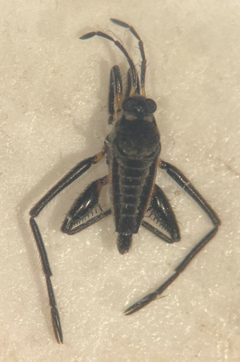
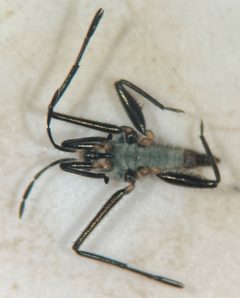
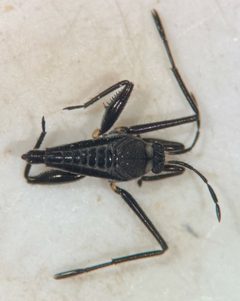
Rhagovelia is a large of small aquatic in the Veliidae, with over 390 described . Members are distinguished by a swimming fan on the tarsomere of the middle leg, an that enables rapid maneuvering on water surfaces. The genus has colonized lotic freshwater systems and coastal marine environments across the Americas, with additional species in Africa, Asia, and Oceania. Evolutionary origins trace to ('geisha' and 'mother-of-geisha') that created this propelling fan structure, allowing exploitation of faster-flowing and more turbulent streams than relatives lacking this adaptation.
Pronunciation
How to pronounce Rhagovelia: /ræɡoʊˈviːliə/
These audio files are automatically generated. While they are not always 100% accurate, they are a good starting point.
Identification
Distinguished from other Veliidae by the presence of a swimming fan (plume-like setae) on the tarsomere of the middle leg. In the Americas, are organized into four monophyletic complexes (angustipes, collaris, obesa, robusta), one grade (abrupta), and additional groups (varipes, salina, kiunga). Species-level identification requires examination of male parameres and other genitalic structures.
Images
Habitat
Primarily lotic freshwater systems including rivers and streams with moderate to swift flow. Also recorded from coastal marine environments. Specific microhabitat requirements vary by group.
Distribution
distribution with major diversification in the Americas. Documented from North America, South America (extensive records from Colombia), Africa, southern New Guinea, and India (Kerala, Tamil Nadu). Western hemisphere distribution reviewed in dedicated monograph; world distribution patterns noted.
Diet
Predatory on small organisms at the water surface. Run-and-tumble locomotion has been observed to enhance encounter rates with food particles in flowing environments.
Behavior
Exhibits interfacial run-and-tumble locomotion: two-dimensional movement consisting of straight runs (mean distance 30.7 ± 9.3 mm) followed by lateral tumbles. This persists across varying flow speeds and improves food capture compared to linear movement in rapid flow fields.
Ecological Role
in freshwater surface ; locomotion strategy represents with microbial movement patterns.
Human Relevance
Biophysical properties studied for bioinspired robotics design, specifically water strider-like robot feet reported in 2025. Serves as model organism for studies of locomotion and environmental exploration algorithms.
Similar Taxa
- Other Veliidae generaLack the distinctive swimming fan on the middle leg tarsomere; Rhagovelia evolved this trait through events enabling exploitation of faster-flowing
More Details
Evolutionary genetics
Propelling fan evolution driven by duplication of 'geisha' and 'mother-of-geisha' genes, representing a key morphological innovation in the
Taxonomic complexity
characterized by morphological complexity and historical character misinterpretation; ongoing revisionary work required, particularly in the Americas
Sources and further reading
- BugGuide
- Wikipedia
- GBIF taxonomy match
- iNaturalist taxon
- NCBI Taxonomy
- Catalogue of Life
- Revision of the Rhagovelia angustipes complex (Insecta: Hemiptera: Veliidae) from Colombia
- Two anomalous new species of Rhagovelia (Heteroptera: Veliidae) from southern New Guinea
- The Rhagovelia of the western hemisphere, with notes on world distribution (Hemiptera, Veliidae)
- Rhagovelia Uses Interfacial Run-and-Tumble Locomotion to Improve Food Capture in Flowing Environments
- Two new species of Rhagovelia in the salina group from Colombia (Hemiptera: Heteroptera: Veliidae)
- New record of riffle bug Rhagovelia (Neorhagovelia) nilgiriensis Thirumalai, 1994 (Hemiptera: Heteroptera: Veliidae) from Kerala, India