
Rhagovelia choreutes
Hussey, 1925
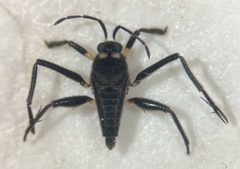
Rhagovelia choreutes is a of small water strider in the Veliidae. It belongs to the infraorder Gerromorpha, a group of semiaquatic true bugs adapted to life on the water surface. The species was described by Hussey in 1925. It occurs in running water in parts of North and Central America.
Pronunciation
How to pronounce Rhagovelia choreutes: /ræɡoʊˈviːliə kəˈruːtiːz/
These audio files are automatically generated. While they are not always 100% accurate, they are a good starting point.
Images
Habitat
Running water , including streams and rivers. Like other Rhagovelia , it is associated with lotic (flowing water) environments rather than standing water.
Distribution
North America and Central America. Specific records include the southwestern United States (including the Grand Canyon ecoregion) and Middle America.
Behavior
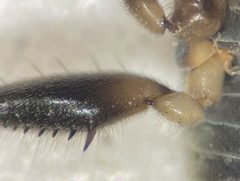
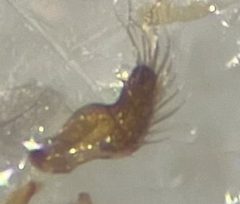
Uses middle legs modified with fan-like fringed hairs to propel across water surface; this 'skating' is characteristic of the Rhagovelia and allows movement on flowing water.
Similar Taxa
- Other Rhagovelia speciesDifferentiated by genitalic characters and subtle morphological features; R. choreutes is part of the western hemisphere fauna outside the angustipes complex
- Other Veliidae genera (e.g., Microvelia)Rhagovelia possesses the diagnostic fan-like fringed hairs on middle used for propulsion, which Microvelia and related lack
More Details
Taxonomic history
The was included in major taxonomic revisions of the Rhagovelia, including Bacon's 1956 study of Western Hemisphere species and Polhemus's 1997 systematic treatment.
Biogeographic significance
Documented in biogeographic studies of aquatic and semiaquatic Heteroptera in the Grand Canyon ecoregion, indicating its role in understanding regional insect diversity patterns.