
Microvelia
Westwood, 1834
small water striders, riffle bugs
Species Guides
16- Microvelia albonotata
- Microvelia americana(Broad-Shouldered Water Strider)
- Microvelia atrata
- Microvelia austrina
- Microvelia beameri
- Microvelia buenoi(smaller water strider)
- Microvelia californiensis
- Microvelia cerifera
- Microvelia cubana
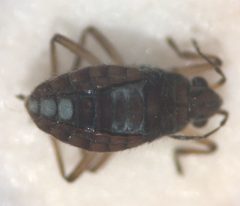
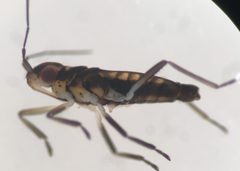
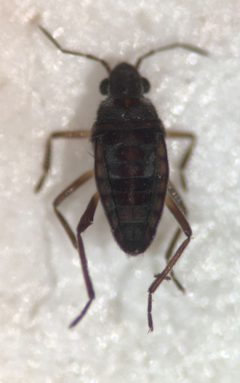
Microvelia is a large of small semiaquatic bugs comprising at least 230 described distributed worldwide. These insects inhabit nearshore areas of stagnant or slow-flowing freshwater, where they move on the water surface using surface tension. The genus exhibits wing dimorphism, with containing both fully winged () and short-winged (brachypterous) individuals. Several subgenera have been recognized including Austromicrovelia, Barbivelia, Pacificovelia, and Picaultia, based on phylogenetic and morphological analyses.
Pronunciation
How to pronounce Microvelia: /ˌmɪkroʊˈviːliə/
These audio files are automatically generated. While they are not always 100% accurate, they are a good starting point.
Images
Habitat
Nearshore areas of stagnant or slow-flowing freshwater bodies including ponds, lakes, streams, and wetlands. occupy the water surface film rather than submerging.
Distribution
Worldwide distribution with major faunas documented in Australia (with extensive subgeneric diversification), the Neotropical Region (more than 100 ), North America (M. pulchella ranging from Canada to Argentina), Asia (Japan including Ryukyu Islands), and Brazil (Amazon region).
Life Cycle
and four nymphal instars have been described for M. pulchella based on laboratory rearing. Wing dimorphism is present, with both and brachypterous forms occurring within .
Behavior
Exhibits wing dimorphism with behavioral and differences between morphs. Mating has been studied in M. horvathi, where behavioral patterns determine mating rates. Cold hardiness (supercooling point) is a key trait in temperate such as M. reticulata, with evidence for sex-specific parental effects on offspring cold .
Similar Taxa
- VeliaLarger body size; Microvelia are distinctly smaller (typically under 3mm)
- RhagoveliaPossesses modified middle legs for jumping, which Microvelia lacks
- ParaveliaDifferent preferences and morphological features of the pronotum and wings
Sources and further reading
- BugGuide
- Wikipedia
- GBIF taxonomy match
- iNaturalist taxon
- NCBI Taxonomy
- Catalogue of Life
- The genus Microvelia Westwood in Australia (Hemiptera : Heteroptera : Veliidae)
- A new species of the small water strider genus Microvelia (Hemiptera: Heteroptera: Veliidae) from the Ryukyus, Japan, with notes on the distribution of M. kyushuensis
- Descriptions of the immature stages of Microvelia pulchella Westwood, 1834 (Hemiptera: Heteroptera: Gerridae)
- Relative male and female contributions to the supercooling point of their offspring in Microvelia reticulata (Heteroptera: Veliidae)
- Behavioral patterns that determine the mating rates in a wing dimorphic riffle bug, Microvelia horvathi Lundblad, 1933 (Hemiptera: Heteroptera: Veliidae)
- Comparative studies on life history traits of three wing dimorphic water bugs, Microvelia spp. Westwood (Heteroptera: Veliidae)
- Gerromorpha (Hemiptera: Heteroptera) from the Metropolitan Region of Santarém, Brazil, including three new species of Microvelia Westwood, 1834 (Veliidae: Microveliinae)