
Microvelia cubana
Drake, 1951
Microvelia cubana is a small semiaquatic true described from Cuba in 1951. As a member of the Veliidae, it belongs to a group of insects commonly known as small water striders or riffle bugs. The inhabits freshwater environments in the Caribbean region. Limited published information exists regarding its and .
Pronunciation
How to pronounce Microvelia cubana: /maɪ.kroʊˈviː.li.ə kuːˈbɑː.nə/
These audio files are automatically generated. While they are not always 100% accurate, they are a good starting point.
Identification
Distinguished from other Caribbean Microvelia by male genitalic structures, particularly the shape of the parameres and , which are diagnostic at the species level. The species was described by Drake (1951) based on Cuban specimens. Separation from requires examination of genitalia under magnification; external alone is insufficient for definitive identification.
Images
Appearance
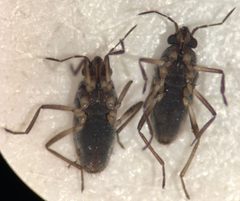
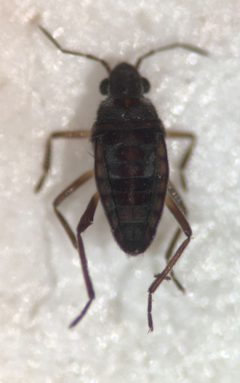
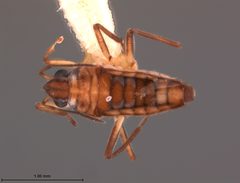
As a Microvelia , it is a minute semiaquatic , likely measuring 2–3 mm in length. Members of this possess a compact, oval body form with relatively short legs compared to larger water striders (Gerridae). The body is dorsoventrally flattened, with a dark coloration typical of the genus. Wing is common in Microvelia, with both (long-winged) and (wingless) forms occurring within .
Habitat
Freshwater including streams, rivers, and standing water bodies. As with other Veliidae, it occupies the water surface film and marginal areas of aquatic environments. Specific microhabitat preferences for this are not documented.
Distribution
Known from Cuba and the broader Caribbean region. GBIF records indicate presence in the Caribbean and North America, though North American records may represent misidentifications or require verification. The is not documented from the continental United States in authoritative sources.
Ecological Role
As a surface-dwelling hemipteran, it likely functions as a micropredator on small and organic matter at the air-water interface. Its role in nutrient cycling and as prey for larger aquatic and terrestrial is presumed but not quantified.
Similar Taxa
- Microvelia pulchellaOverlaps in Caribbean distribution; distinguished by male genitalia and subtle differences in body proportions. External similarity requires dissection for reliable separation.
- Microvelia americanaWidespread in the Americas including Caribbean; similar size and general appearance. Genitalic examination necessary for positive identification.
- Rheumatobates speciesOther small water striders in the same region; distinguished by longer, more slender body form and different leg proportions. Rheumatobates typically have more elongate .
More Details
Taxonomic note
Described by Carl J. Drake in 1951 based on specimens from Cuba. The original description is in the Proceedings of the Biological Society of Washington. The has received limited subsequent study, and its validity and relationships to other Caribbean Microvelia require modern revisionary work.
Conservation status
Not evaluated by IUCN. Given its restricted known range and specificity to freshwater systems, it may be vulnerable to habitat degradation, though no assessments exist.