
Microvelia pulchella
Westwood, 1834
smaller water strider
Microvelia pulchella is a semiaquatic predatory in the Veliidae, distributed throughout the American continents from Canada to Argentina. It is the type of the Microvelia and one of the most common species in the Neotropical Region. Laboratory studies demonstrate its potential as a agent against - mosquitoes and agricultural pests in rice fields. The species serves as a model organism for behavioral and ecological research due to its convenient rearing characteristics and measurable traits.
Pronunciation
How to pronounce Microvelia pulchella: //ˌmaɪkroʊˈviːliə pʌlˈkɛlə//
These audio files are automatically generated. While they are not always 100% accurate, they are a good starting point.
Identification
Distinguished from other Microvelia by its widespread distribution throughout the Americas. Positive identification requires examination of genitalia or molecular analysis. stages identifiable by specific morphological features described in taxonomic literature: and four nymphal instars have been formally described and illustrated.
Images
Appearance
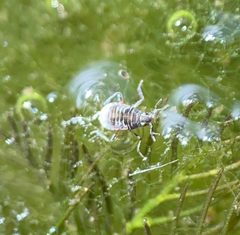
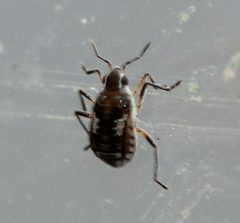
Small semiaquatic typical of smaller water striders. exhibit sexual size dimorphism, with males generally smaller than females. stages include and four nymphal instars. Laboratory-reared males are smaller than field-collected males, while female size remains consistent across rearing conditions.
Habitat
Semiaquatic environments including paddy rice fields, ponds, and slow-moving water bodies. Occupies the water surface film in freshwater .
Distribution
Widespread throughout the American continents from Canada to Argentina. Specifically recorded from the Caribbean, Central America, North America, and South America. Documented from numerous Brazilian states including Alagoas, Amazonas, Bahia, Ceará, Espírito Santo, Maranhão, Minas Gerais, Mato Grosso do Sul, Pará, Pernambuco, Piauí, Paraná, Rio de Janeiro, Rio Grande do Norte, Rio Grande do Sul, Santa Catarina, Sergipe, and São Paulo.
Diet
Predatory; feeds on mosquito larvae and rice field pests. Specific prey spectrum beyond these groups has not been detailed in available sources.
Life Cycle
-to- development averages 20.6 days at 25°C. includes egg stage and four nymphal instars before adult . stages have been formally described and illustrated based on specimens from southeastern Brazil.
Ecological Role
Potential agent against - mosquitoes and agricultural pests in rice systems.
Human Relevance
Studied as a candidate agent for mosquito management and rice pest suppression. Used as a model organism for non- behavioral and ecological research due to cost-effective, straightforward rearing requirements and minimal space needs.
Similar Taxa
- Other Microvelia speciesRequires examination of genitalia or molecular markers for definitive separation; M. pulchella distinguished by its extensive geographic range and status as type of the
More Details
Laboratory Rearing
Successful laboratory rearing protocols have been established using stage-specific containers. Females produce an average of 211.77 with peak and occurring within the first five weeks of life. Female longevity averages 74 days compared to 91 days for males.
Taxonomic History
Originally described by Westwood in 1834 as the type of Microvelia. placement has been revised: historically treated as Gerridae (water striders), now placed in Veliidae (smaller water striders) based on phylogenetic studies.
Sources and further reading
- BugGuide
- Wikipedia
- GBIF taxonomy match
- iNaturalist taxon
- NCBI Taxonomy
- Bembicid Holdings | Entomology Research Museum
- Erebidae | Beetles In The Bush | Page 2
- Descriptions of the immature stages of Microvelia pulchella Westwood, 1834 (Hemiptera: Heteroptera: Gerridae)
- Life history traits and rearing protocol of <i>Microvelia pulchella</i> (Hemiptera: Veliidae): a potential biological control agent and model for behavioral and ecological studies