
Microvelia buenoi
Drake, 1920
smaller water strider
Microvelia buenoi is a small semiaquatic in the Veliidae, commonly known as smaller water striders. The was described by Drake in 1920 and occurs across a broad transcontinental range spanning Europe, Northern Asia (excluding China), and North America. Like other members of the Microvelia, it inhabits the surface film of freshwater where it moves with characteristic rapid, darting movements. The specific epithet honors entomologist Erika Bueno's family name, though this appears coincidental rather than commemorative.
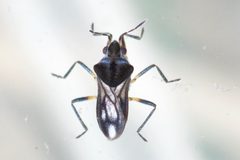
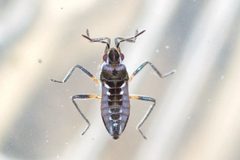
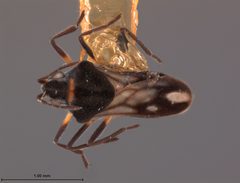
Pronunciation
How to pronounce Microvelia buenoi: //ˌmaɪkroʊˈviːliə ˈbweɪnoʊi//
These audio files are automatically generated. While they are not always 100% accurate, they are a good starting point.
Identification
Distinguished from larger water striders (Gerridae) by smaller body size, relatively shorter legs in proportion to body, and more compact build. Separated from by subtle morphological features of male genitalia and antennal proportions; precise identification requires examination of these structures. Presence of wing ( and brachypterous forms) has been observed in the but specific expression in M. buenoi requires verification.
Images
Appearance
Small, slender semiaquatic with body length typically under 5 mm. Dark coloration with possible pale markings on or . relatively short. Hind legs modified for propulsion on water surface, with dense fringe of hydrofuge hairs. Middle legs elongated, adapted for skating. Body dorsoventrally flattened compared to fully aquatic relatives.
Habitat
Freshwater surface including ponds, slow-moving streams, lake margins, and vegetated wetlands. Occupies the air-water interface where it exploits the surface tension film. Associated with emergent vegetation and debris that provide shelter and hunting substrate.
Distribution
Transcontinental distribution: Europe, Northern Asia (excluding China), and North America. Present across temperate regions of both the Palearctic and Nearctic realms.
Behavior
Skates rapidly across water surface in characteristic erratic, darting movements. Occupies the water surface film rather than submerging. Likely exhibits prey detection through surface wave perception, as documented in related semiaquatic bugs.
Ecological Role
or scavenger at the water surface interface, contributing to nutrient transfer between aquatic and terrestrial . Prey for larger aquatic and terrestrial predators including fish, birds, and other insects.
Human Relevance
No documented direct economic importance. Potential for freshwater quality due to surface water dependency. Subject of basic taxonomic and distributional research.
Similar Taxa
- Microvelia other species share small size, dark coloration, and semiaquatic habits; require examination of male genitalia and antennal segment proportions for definitive separation
- Rheumatobates spp.Other small veliids with similar use; distinguished by more elongated body form and different leg proportions
- Gerridae (larger water striders)Share surface-skating but are larger with proportionally longer legs and more elongate bodies
More Details
Taxonomic note
The specific epithet 'buenoi' predates by nearly a century the prominence of entomologist Erika Bueno; any connection appears coincidental.