
Mirini
Ashmead, 1904
Genus Guides
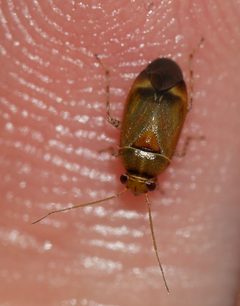
48Mirini is a large tribe of plant bugs (Hemiptera: Miridae: Mirinae) containing over 180 distributed worldwide. The tribe includes economically significant genera such as Lygus, whose members are major agricultural pests of North American crops. Mirini exhibit diverse ecological associations, including myrmecomorphic (-mimicking) forms and specialized relationships with particular plants.


Pronunciation
How to pronounce Mirini: /ˈmiːrɪnaɪ/
These audio files are automatically generated. While they are not always 100% accurate, they are a good starting point.
Identification
Mirini is distinguished from related tribes by the combination of dorsally punctate body surface and genitalic structures; the so-called 'Lygus complex' within Mirini is characterized by particular male and female genitalic morphologies. Specific identification requires examination of genitalic structures and detailed morphological analysis.
Images
Habitat
Diverse including agricultural fields, alfalfa and hay fields, and natural vegetation. Specific associations documented with gramineous dwarf bamboo (Pleioblastus chino), Japanese boxwood (Buxus microphylla), and rattlepod (Crotalaria sp.).
Distribution
Worldwide distribution with documented records from Nearctic region (southern Quebec, northeastern United States, California, Idaho, Ontario), Japan (central Honshu, Niigata Prefecture), Australia (northern Queensland), Vietnam, French Guiana, Cambodia, and Papua New Guinea.
Seasonality
Vernal activity period observed in some ; Azumamiris vernalis appear only in early May. documented in at least one species.
Host Associations
- Pleioblastus chino - plantgramineous dwarf bamboo
- Buxus microphylla - plantJapanese boxwood
- Crotalaria sp. - plantrattlepod, Fabaceae
- Oecophylla smaragdina - associated green tree ; myrmecomorphic association
Life Cycle
Nymphal stages are parasitized by endoparasitoid in the Leiophron and Peristenus (Braconidae: Euphorinae). has been observed in some .
Behavior
Myrmecomorphy (-mimicry) has been documented in at least one Australian . Some species show highly specific temporal activity patterns, with restricted to brief spring periods.
Ecological Role
for agents used in ; some (particularly Lygus) function as significant agricultural pests. Myrmecomorphic participate in -associated ecological networks.
Human Relevance
Members of the Lygus are important pests of a wide variety of North American crops. efforts using (Leiophron and Peristenus ) have been developed for programs, though establishment of introduced species has not yet shown evident impact on pest levels.
Similar Taxa
- Other Mirinae tribesMirini is distinguished by punctation and genitalic structures; subtribal classification has been revised with multiple synonymies established (Capsaria = Horistaria = Dionconotaria = Miraria)
More Details
Taxonomic complexity
The subtribal classification of Mirini remains under discussion, with the validity of the 'Lygus complex' being debated. Recent taxonomic work has established numerous new synonymies and combinations, and reinstated previously synonymized .
Parasitoid associations
Sixteen of Leiophron and Peristenus have been documented parasitizing Lygus nymphs. Most of these endoparasitoid species appear to be distinct in their distribution and , with high temperatures limiting geographical distribution of some species.
Sources and further reading
- BugGuide
- Wikipedia
- iNaturalist taxon
- NCBI Taxonomy
- Catalogue of Life
- New genus and new species of myrmecomorphic plant bug from Australia (Heteroptera: Miridae: Mirini)
- Azumamiris vernalis: a new genus and species of Mirini from central Japan (Heteroptera: Miridae: Mirinae)
- Review of the Nearctic species of Leiophron and Peristenus (Hymenoptera: Braconidae: Euphorinae) parasitizing Lygus (Hemiptera: Miridae: Mirini)
- A new genus and species of mirine plant bug endemic to central Honshu, Japan, a region receiving the world’s heaviest snowfall (Insecta: Hemiptera: Heteroptera: Miridae: Mirinae: Mirini)
- The genera of dorsally punctate Mirini and some related extralimital taxa: Short diagnosis and synthesis of available data with a focus on the so-called Lygus complex (Hemiptera: Heteroptera: Miridae)