
Closterotomus
Fieber, 1858
Species Guides
2- Closterotomus fulvomaculatus(spotted plant bug)
- Closterotomus norvegicus(potato capsid)
Closterotomus is a of plant bugs (Miridae) in the Mirinae, established by Fieber in 1858. The genus contains at least 34 distributed across the Palearctic and North America. Several species are agricultural pests, notably C. trivialis on olive and citrus in Mediterranean regions and C. norvegicus (potato ) on lucerne, clover, and potato. Members are phytophagous, feeding primarily on flowers, buds, and unripe fruit.


Pronunciation
How to pronounce Closterotomus: //ˌklɒstɛˈrəʊtəməs//
These audio files are automatically generated. While they are not always 100% accurate, they are a good starting point.
Identification
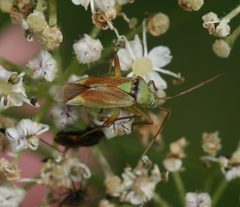
of C. norvegicus can be distinguished from similar lygus bugs by two dark spots on the prothorax; lygus bugs possess a colored triangular scutellum where the wings attach. Nymphs are green, becoming reddish-brown in adulthood in C. norvegicus. Size ranges 6–8 mm in C. norvegicus.
Images
Habitat
Agricultural landscapes including olive orchards, citrus orchards, lucerne fields, and associated weedy vegetation. Non-crop plants include Mercurialis annua, Urtica spp., Parietaria spp., and Sinapis alba, which serve as .
Distribution
Palearctic region and North America. Specific records from Denmark, Norway, Sweden, and Vermont, USA. C. trivialis documented in Crete and mainland Greece; C. norvegicus native to Europe, introduced to New Zealand and California, USA.
Seasonality
C. trivialis active from January through May in Crete, with nymphal instars appearing mid-January and first recorded early March. Adult timing varies by type, with 13-day lag observed between citrus and olive orchard .
Diet
Phytophagous, feeding on plant sap from flowers, buds, and unripe fruit. Documented include Olea europaea (olive), Citrus sinensis (sweet orange), Mercurialis annua, Urtica spp., Parietaria spp., Sinapis alba, potato, carrot, clover, and cannabis. Nutritional suitability varies by host; Mercurialis annua, Sinapis alba, and Citrus sinensis support better development and longevity than Urtica urens, Parietaria diffusa, or Olea europaea.
Host Associations
- Olea europaea - crop Koroneiki cultivar; lower suitability, higher mortality
- Citrus sinensis - crop Washington Navel cultivar; supports good longevity
- Mercurialis annua - non-crop strongly preferred, optimal developmental threshold (3.30°C)
- Urtica urens - non-crop development fails at 15°C and 20°C, higher mortality
- Parietaria diffusa - non-crop less suitable, highest developmental threshold (10.7°C)
- Sinapis alba - non-crop supports good survival and longevity
Life Cycle
Hemimetabolous development with , nymph, and stages. Nymphal development temperature-dependent; optimal at 24°C where plant effects on development rate are minimal. At suboptimal temperatures (15, 20, 27°C), host plant significantly affects development duration. Lower temperature developmental threshold varies by host: 3.30°C on Mercurialis annua to 10.7°C on Parietaria diffusa.
Behavior
Strong plant preference hierarchy observed, with weeds preferred over crop plants. Movement occurs among crop and non-crop host plants. Feeding concentrated on reproductive structures (flowers, buds, unripe fruit).
Ecological Role
Agricultural pest on major crops; typically higher on non-crop weed than on crop plants. Serves as host for including Peristenus closterotomae, which may contribute to . Non-crop hosts act as maintaining that move into crops.
Human Relevance
Economic pest of olive, citrus, lucerne, white clover, lotus seed, and pistachio crops. C. norvegicus introduced to New Zealand and California where it damages seed crops. Subject of research; potential explored using European .
Similar Taxa
- Lygus spp.Same (Miridae), similar size and general appearance; distinguished by lygus having colored triangular scutellum versus Closterotomus having two prothoracic spots
- Calocoris spp.Closely related ; C. trivialis historically classified as Calocoris trivialis, indicating taxonomic proximity and similar
More Details
Genomic Resources
sequence available for Closterotomus trivialis (Wellcome Open Research, 2025).
Taxonomic History
C. trivialis previously placed in Calocoris, reflecting ongoing refinement of mirid .
Parasitoid Associations
C. norvegicus at least eight in Europe, dominated by Peristenus closterotomae (Braconidae), with mean rate of 24% (maximum 77%).
Sources and further reading
- BugGuide
- Wikipedia
- GBIF taxonomy match
- iNaturalist taxon
- NCBI Taxonomy
- Catalogue of Life
- Bug Squad
- Bug Squad
- Fancy Meeting You Here, Mr. Potato Capsid | Bug Squad
- One Potato...Two Potato... | Bug Squad
- Life history of Closterotomus (Calocoris) trivialis (Costa) (Heteroptera: Miridae) in olive and citrus orchards in Crete
- Effect of host plant species and temperature on the development and survival of the plant bug Closterotomus trivialis (Costa) (Hemiptera: Miridae)
- Seasonal phenology and relative preference of Closterotomus (Calocoris) trivialis (Hemiptera: Miridae) on olive, citrus and associated host plants in the field
- Potential for classical biological control of the potato bug Closterotomus norwegicus (Hemiptera: Miridae): description, parasitism and host specificity of Peristenus closterotomae sp. n. (Hymenoptera: Braconidae)
- The genome sequence of the mirid plant bug, Closterotomus trivialis (A.Costa, 1853) (Hemiptera: Miridae).