
Mirinae
plant bugs
Tribe Guides
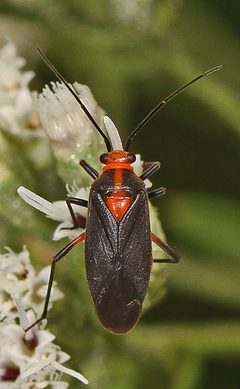
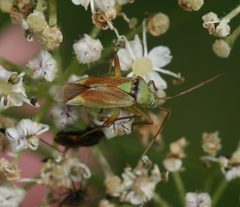
4Mirinae is a of plant bugs within the Miridae, comprising seven recognized tribes: Herdoniini, Hyalopeplini, Mecistoscelini, Mirini, Restheniini, Scutelliferini, and Stenodemini. Members are phytophagous true bugs with . The subfamily includes economically significant such as the fourlined plant bug (Poecilocapsus lineatus), which causes characteristic necrotic leaf damage on numerous ornamental and agricultural plants. Some species have been introduced to new regions, including New Zealand, where they have established non-native .

Pronunciation
How to pronounce Mirinae: //ˈmɪrɪniː//
These audio files are automatically generated. While they are not always 100% accurate, they are a good starting point.
Images
Distribution
Worldwide distribution with documented presence across multiple biogeographic regions including the Palearctic, Oriental, Afrotropical, Australasian, and Nearctic realms. Specific documented locations include: central Honshu, Japan; Vietnam (montane forests at 1250–1356 m altitude); New Zealand (introduced, non-native); Indonesia (Java, Sumatra); Philippines (Luzon, Mindanao); Cambodia; Korea; China; Papua New Guinea; Australia; and Africa.
Seasonality
of some appear in early spring; for example, Azumamiris vernalis adults are observed only in early May. The fourlined plant bug (Poecilocapsus lineatus) is active early in the growing season, with nymphs hatching from overwintered and causing damage during spring.
Diet
Phytophagous; members feed on plant sap using . Some inject salivary (pectinases) that liquefy plant tissues, causing persistent necrotic . Documented associations include: Poecilocapsus lineatus feeds on more than 250 plant species including vegetables, trees, shrubs, and herbaceous perennials such as Monarda ( balm); Tinginotum species have been collected on Pinus kesiya (Khasi pine); Azumamiris vernalis is associated with Pleioblastus chino (gramineous dwarf bamboo); Sidnia kinbergi breeds in carrot seed crops.
Host Associations
- Poecilocapsus lineatus - feeds onMore than 250 plant including vegetables, trees, shrubs, and herbaceous perennials
- Tinginotum - collected onPinus kesiya (Khasi pine)
- Azumamiris vernalis - associated withPleioblastus chino (gramineous dwarf bamboo)
- Sidnia kinbergi - breeds inCarrot seed crops
Life Cycle
Some are , producing one per year. Poecilocapsus lineatus overwinters as in plant debris; nymphs hatch in spring and develop through several instars before maturing into . Azumamiris vernalis is confirmed univoltine with adults appearing only in early May.
Behavior
Feeding causes characteristic damage: piercing plant tissue with needlelike stylets, pumping in salivary to digest contents, then sucking liquefied nutrients. Lingering enzymatic activity continues degrading cell walls after feeding ceases, producing necrotic spots that may drop out to create irregular holes. Some are attracted to light traps.
Ecological Role
Phytophagous herbivores that can influence plant health and productivity. Early-season feeding on perennials is often cosmetic and plants typically outgrow damage. Serve as prey for ground beetles and other soil-dwelling when dislodged from plants.
Human Relevance
Several are agricultural and horticultural pests. Poecilocapsus lineatus is considered a significant pest of ornamentals and vegetables, though damage is typically cosmetic on established perennials. Management strategies include removing (plant debris), physical removal by hand or soapy water, , insecticidal soaps, and water sprays to dislodge nymphs and . Introduced species in New Zealand (Closterotomus norvegicus, Stenotus binotatus, Sidnia kinbergi, Megaloceroea recticornis, Trigonotylus tenuis, Taylorilygus apicalis) have established non-native with potential economic impacts.
Similar Taxa
- Other Miridae subfamiliesDistinguished by tribal composition and specific morphological characters; Mirinae contains seven tribes (Herdoniini, Hyalopeplini, Mecistoscelini, Mirini, Restheniini, Scutelliferini, Stenodemini) with characteristic antennal, pronotal, and genitalic structures
More Details
Tribal classification
Mirinae comprises seven tribes: Herdoniini, Hyalopeplini, Mecistoscelini, Mirini, Restheniini, Scutelliferini, and Stenodemini. The tribe Mirini includes such as Azumamiris, Stenotus, and Elthemidea, which share assumed phylogenetic affinities.
Salivary enzyme damage
Feeding damage by Poecilocapsus lineatus is caused by pectinases in saliva that continue to degrade plant walls after the has finished feeding, producing long-lasting necrotic distinct from immediate mechanical damage.
Collection methods
Some Mirinae have been collected using light traps, while others are obtained by direct sampling on plants.
Sources and further reading
- BugGuide
- Wikipedia
- iNaturalist taxon
- NCBI Taxonomy
- Catalogue of Life
- Who’s been sucking on my bee balm? Fourlined plant bug, Poecilocapsus lineatus — Bug of the Week
- Bee Balm Blues Courtesy of Fourlined plant bug, Poecilocapsus lineatus — Bug of the Week
- Introduced Mirinae of New Zealand (Hemiptera: Miridae)
- Azumamiris vernalis: a new genus and species of Mirini from central Japan (Heteroptera: Miridae: Mirinae)
- The genus Tinginotum Kirkaldy, 1902 (Hemiptera, Miridae, Mirinae) with description of a new species from Vietnam and additional notes on Southeast Asian materials.
- Genomic and transcriptomic analyses of residual invasive triple-negative breast cancer after neoadjuvant chemotherapy in the prospective MIRINAE trial (a randomized phase II trial of adjuvant atezolizumab plus capecitabine compared to capecitabine; KCSG-BR18-21).
- Randomized, phase II trial to evaluate the efficacy and safety of atezolizumab plus capecitabine adjuvant therapy compared to capecitabine monotherapy for triple receptor-negative breast cancer with residual invasive cancer after neoadjuvant chemotherapy (MIRINAE trial, KCSG-BR18-21).