
Stenotus binotatus
(Fabricius, 1794)
Two-spotted Grass Bug, Timothy Plant Bug, Two-spotted Plant Bug, Slender Crop Mirid
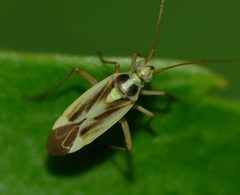
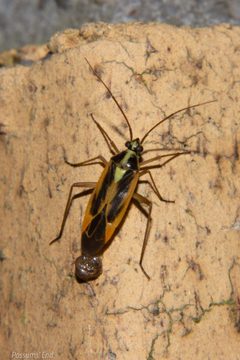
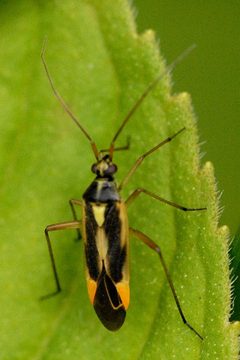
Stenotus binotatus is a grass-feeding mirid bug native to the Palearctic that has become established in temperate regions worldwide, including North America and New Zealand. measure 6–7 mm and show in coloration: males are yellow with dark pronotal and forewing markings, while females are greenish-yellow with paler markings. The is a documented pest of cereal crops, particularly wheat, where its feeding causes distinctive grain collapse and sticky dough problems due to gluten-degrading .
Pronunciation
How to pronounce Stenotus binotatus: //stɛˈnoʊtəs bɪˈnoʊtətəs//
These audio files are automatically generated. While they are not always 100% accurate, they are a good starting point.
Identification
Distinguished from similar grass-feeding mirids by combination of size (6–7 mm), yellowish ground color with dark pronotal markings, and association with grass inflorescences. in color intensity assists recognition. Wheat grain damage pattern differs from other mirid pests: S. binotatus causes grain collapse without visible puncture marks, whereas other produce pale puncture areas.
Images
Habitat
Grasslands, agricultural fields, and areas with abundant grass cover. Specifically associated with grass inflorescences, particularly timothy-grass (Phleum pratense) and orchard grass (Dactylis glomerata). In New Zealand, has been collected from diverse vegetation including native shrubs and trees, though grasses remain primary .
Distribution
Native to the Palearctic region (Europe, Russia, Turkey, Central Asia). Introduced and established in temperate North America (northern and central U.S., southern Canada), New Zealand (widespread), and Australia. GBIF records indicate presence across Europe, North America, and parts of Asia.
Seasonality
active June–September in the United Kingdom; December–January in New Zealand. First instar nymphs appear in mid-June in orchard grass fields, coinciding with ear sprouting; adults disappear by mid-August when ears wither.
Diet
Both nymphs and feed on grass inflorescences and seeds. Primary include timothy-grass (Phleum pratense) and orchard grass (Dactylis glomerata). In New Zealand, recorded from numerous additional plants including wheat, barley, maize, brown top, Yorkshire fog, cocksfoot, and various native and introduced shrubs and forbs.
Host Associations
- Phleum pratense - primary Timothy-grass; primary for feeding and development
- Dactylis glomerata - primary Orchard grass; nymphs complete development feeding on ears
- Triticum aestivum - pest Wheat; causes sticky dough through gluten-degrading
- Hordeum vulgare - Barley
- Zea mays - Maize
Life Cycle
Hemimetabolous development with , nymph, and stages. First instar nymphs emerge in mid-June synchronized with grass ear development. Nymphs feed exclusively on grass inflorescences and can complete development to adulthood on orchard grass ears alone. Adults present through mid-August in temperate regions, with timing varying by latitude (winter activity in New Zealand).
Behavior
Nymphs and settle persistently on grass ears throughout their . Laboratory experiments demonstrate active on ears even in darkness, indicating that location does not require visual cues. Both intact and antenectomized individuals show this , suggesting non-visual sensory mechanisms for host recognition.
Ecological Role
Herbivore specializing on grass reproductive structures. In native range, likely functions as natural regulator of grasses. In introduced regions, acts as agricultural pest with measurable impact on seed quality and grain processing properties.
Human Relevance
Recognized pest of wheat and other cereal crops. Feeding produces that degrade gluten, resulting in sticky dough that reduces bread-making quality. Damage signature differs from other mirid pests: grains appear collapsed without pale puncture marks. Economic impact documented in New Zealand and other regions where it has been introduced.
Similar Taxa
- Other Stenotus speciesSimilar size and general mirid ; distinguished by specific color pattern and genitalia
- Leptopterna spp.Grass-feeding mirids of similar size and ; differ in coloration and seasonal
- Other cereal-feeding MiridaeCause different grain damage (pale puncture marks vs. collapse) and have different effects on gluten
More Details
Rickettsia-like endosymbionts
Ultrastructural studies have documented -like microorganisms in the epithelium of some . Their relationship with the remains uncertain.
Sources and further reading
- BugGuide
- Wikipedia
- GBIF taxonomy match
- iNaturalist taxon
- NCBI Taxonomy
- Catalogue of Life
- cremastus_stenotus_dasch_holotype_female_ucrc_ent_283769_lateral.jpg | Entomology Research Museum
- Primary Type List | Entomology Research Museum
- Ultrastructure of rickettsia-like microorganisms in the midgut of a plant bug, Stenotus binotatus Jak. (Heteroptera: Miridae)
- Feeding Behaviour of the Timothy Plant Bug, Stenotus binotatus F. (Hemiptera : Miridae) and the Effect of Its Feeding on Orchard Grass