
Leptopterna
Fieber, 1858
meadow plant bugs
Species Guides
3- Leptopterna amoena
- Leptopterna dolabrata(meadow plant bug)
- Leptopterna ferrugata
Leptopterna is a of plant bugs in the Miridae comprising at least nine described . The genus includes the well-studied meadow plant , Leptopterna dolabrata, which has been sequenced as part of the Darwin Tree of Life Project. Species in this genus are grass-feeding insects found primarily in moist meadow across the Palearctic, with some species introduced to North America. in wing development is pronounced: males are fully winged () while females are typically short-winged (brachypterous).
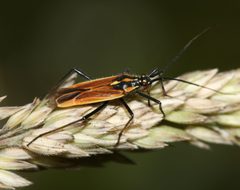
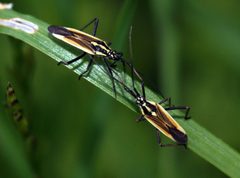
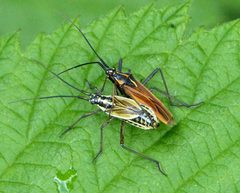
Pronunciation
How to pronounce Leptopterna: /lɛpˈtɒptərnə/
These audio files are automatically generated. While they are not always 100% accurate, they are a good starting point.
Images
Habitat
Moist conditions; meadows and grassy places. Specific data available for L. dolabrata; broader -level patterns inferred from this and related .
Distribution
Widespread across the Palearctic: UK (south coast of England to Outer Hebrides), throughout Europe with easterly range extending to Kazakhstan and West Siberia. Introduced and established in eastern and western North America. Distribution records also include Denmark, Norway, Sweden, and Vermont, USA.
Seasonality
In UK of L. dolabrata, overwinter with obligatory ; hatching begins in May; occur from June onwards, most frequently seen in June and July. Seasonality for other in not documented.
Diet
Feeding on range of common grasses including Phleum pratense, Elymus repens, Alopecurus pratensis, Dactylis glomerata, and Holcus lanatus. Diet information documented for L. dolabrata; broader patterns not established.
Host Associations
- Phleum pratense - grass , L. dolabrata
- Elymus repens - grass , L. dolabrata
- Alopecurus pratensis - grass , L. dolabrata
- Dactylis glomerata - grass , L. dolabrata
- Holcus lanatus - grass , L. dolabrata
Life Cycle
laid in lower part of stems of grasses; eggs overwinter and undergo obligatory . details documented for L. dolabrata; broader patterns not established.
Behavior
Suspected for transmission of silvertop of grasses (causal agent Fusarium poae), though direct transfer remains to be demonstrated. documented for L. dolabrata; broader patterns not established.
Ecological Role
Herbivore feeding on grasses; potential pest of cereal crops including corn (maize), rye and wheat; suspected for silvertop disease of grasses. Ecological role documented for L. dolabrata; broader patterns not established.
Human Relevance
Occasional pest of cereal crops including corn (maize), rye and wheat. Suspected for silvertop of grasses, though direct disease transmission remains to be demonstrated.
Similar Taxa
- Leptopterna ferrugataClosely related and co-occurring with L. dolabrata; distinguishable by antennal hair characteristics
More Details
Genomic data
Leptopterna dolabrata sequenced as part of Darwin Tree of Life Project; assembly is 987.9 Mb in 17 chromosomal pseudomolecules (16 + X ), with 18.18 kb mitochondrial genome. chromosome number 2n=34 (32 autosomes + XY). system: XY males (XO system observed in sequenced male).
Sexual dimorphism
Pronounced wing dimorphism: males always (long-winged), females mostly brachypterous (short-winged).