
Leptopterna dolabrata
(Linnaeus, 1758)
meadow plant bug
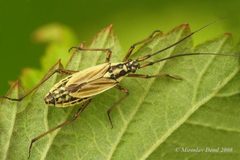
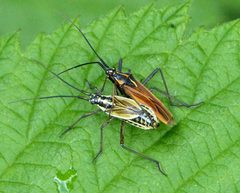
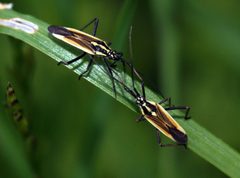
Leptopterna dolabrata is a heteropteran in the Miridae, measuring 8.3–9.8 mm in length. It is sexually dimorphic: males are always (long-winged), while females are mostly brachypterous (short-winged). The feeds on developing grass seeds and is considered a pest in grass seed production. It has an extensive native range across Europe and Asia, and is in North America.
Pronunciation
How to pronounce Leptopterna dolabrata: //ˌlɛp.tɔpˈtɛr.nə ˌdoʊ.ləˈbreɪ.tə//
These audio files are automatically generated. While they are not always 100% accurate, they are a good starting point.
Identification
Distinguished from the co-occurring Leptopterna ferrugata by antennal hair characteristics and the length of the second antennal segment. The combination of pale yellow to red-orange coloration with black longitudinal markings, long with dark hairs, and wing dimorphism ( males, brachypterous females) aids identification.
Images
Appearance
Elongate body, 8.3–9.8 mm in length. are pale yellow to red-orange, darkening with age. Black longitudinal markings present on , , and . Legs and covered with dark hairs. Antennae are long. in wing development: males always (long-winged), females mostly brachypterous (short-winged).
Habitat
Meadows and grassy places. Prefers moist conditions.
Distribution
Native across Europe from the southern coast of England to the Outer Hebrides, extending east through Asia Minor to Kazakhstan, West Siberia, and the Caspian Sea region. in North America, with established in eastern and western regions including Canada (Newfoundland, Ontario, Quebec) and the United States (Alabama, Georgia, New York, Tennessee, Virginia, West Virginia, Wisconsin).
Seasonality
In the UK, hatch beginning in May; occur from June onwards, most frequently seen in June and July.
Diet
Feeds on developing grass seeds. Known include Phleum pratense (timothy), Elymus repens (couch grass), Alopecurus pratensis (meadow foxtail), Dactylis glomerata (cocksfoot), and Holcus lanatus (Yorkshire fog).
Host Associations
- Phleum pratense - timothy grass
- Elymus repens - couch grass
- Alopecurus pratensis - meadow foxtail
- Dactylis glomerata - cocksfoot
- Holcus lanatus - Yorkshire fog
Life Cycle
are laid in the lower part of stems of grasses. Eggs overwinter and undergo obligatory . In the UK, hatching begins in May. appear from June onwards.
Ecological Role
Herbivore specializing on grass seeds. Suspected of silvertop of grasses (causal agent Fusarium poae), though direct transfer remains to be demonstrated.
Human Relevance
Regarded as a pest wherever grass is grown for seed, causing seed to shrivel and prematurely whiten. Occasional pest of cereal crops including corn (maize), rye, and wheat.
Similar Taxa
- Leptopterna ferrugataCo-occurs in range; distinguished by antennal hair characteristics and second antennal segment length
More Details
Genome
sequenced as part of the Darwin Tree of Life Project. Assembly is 987.9 Mb in 17 chromosomal pseudomolecules (16 + X ), with an 18.18 kb mitochondrial genome. karyotype 2n=34 (32 autosomes + XY).