
Poecilocapsus lineatus
(Fabricius, 1798)
fourlined plant bug, four-lined plant bug
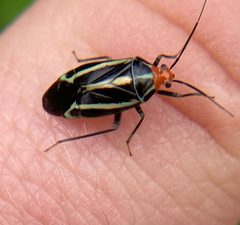
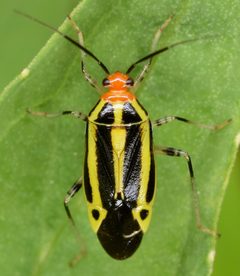
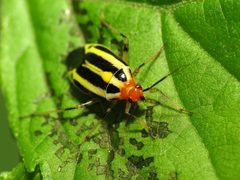
Poecilocapsus lineatus is a mirid plant bug native to North America, recognized by four longitudinal black stripes on a green to yellow background. measure 7–7.5 mm in length. The has a single , as in plant debris. It is considered a minor garden pest, with nymphs and adults feeding on leaves using that inject digestive , causing characteristic necrotic spots and small holes in foliage.
Pronunciation
How to pronounce Poecilocapsus lineatus: //ˌpiː.sɪ.loʊˈkæp.səs lɪˈneɪ.ətəs//
These audio files are automatically generated. While they are not always 100% accurate, they are a good starting point.
Identification
Distinguished from other mirids by the four prominent black longitudinal stripes on the dorsum. The orange and dark red provide additional diagnostic features. Nymphs are recognizable by their bright red or orange coloration with black markings, unlike the green or brown nymphs of many other plant bugs. The combination of striped pattern and specific associations (mint and composite ) aids field identification.
Images
Appearance
are 7–7.5 mm long and 3.5 mm wide, with an orange and prominent dark red . The surface displays four distinct longitudinal black lines against a background color ranging from green to yellow. Nymphs progress through five instars, beginning as bright red with black markings and becoming bright orange in the final instar. Wing pads develop progressively with each .
Habitat
Occurs in gardens, landscapes, and natural areas with herbaceous vegetation. Strongly associated with plants in the mint (Lamiaceae) and composite family (Asteraceae), including balm, mints, and various perennials. Also found on vegetables, shrubs, and occasionally woody plants such as forsythia, dogwood, wild hydrangea, and sumac.
Distribution
Native to North America. Recorded from Canada, Mexico, and throughout the United States including Georgia, New York, Ohio, Pennsylvania, Indiana, Missouri, West Virginia, Wisconsin, and Vermont.
Seasonality
Single per year. hatch in mid to late spring, with timing varying by latitude: mid to late April in southern Pennsylvania, 1–3 weeks later in northern Pennsylvania, and 2–3 weeks earlier in Indiana than in New York. appear by late May to early June. Active from spring through early summer, with damage occurring primarily during late spring to early summer.
Diet
Phytophagous. Feeds on plant sap from leaves of herbaceous plants, with documented including in Lamiaceae (mints, balms, monardas) and Asteraceae (composites). Known to attack more than 250 plant species including vegetables, herbaceous perennials, shrubs, and occasionally small trees.
Host Associations
- Monarda spp. (bee balm) - primary Strong preference; major source of observed damage
- Mentha spp. (mints) - primary Strong preference
- Forsythia spp. - occasional Rarely damaged woody shrub
- Cornus spp. (dogwood) - occasional Rarely damaged woody shrub
- Hydrangea arborescens (wild hydrangea) - occasional Rarely damaged woody shrub
- Rhus spp. (sumac) - occasional Rarely damaged woody shrub
Life Cycle
Hemimetabolous with one annually. Overwinters as deposited in plant stems or debris. Eggs hatch in mid to late spring. Nymphs develop through five instars over approximately six weeks. emerge in late spring, mate within six weeks of hatching, and females deposit eggs in plant tissue for the following year.
Behavior
Nymphs and feed by inserting needle-like stylets into plant tissue and pumping contents using muscular contractions that create negative pressure. Salivary (pectinases) are secreted during feeding to digest and liquefy plant tissues; these enzymes continue to degrade cell walls after feeding ceases, causing persistent necrotic . Adults are active and can be dislodged by shaking infested foliage.
Ecological Role
Herbivore that causes cosmetic damage to garden plants. Serves as prey for ground beetles and other . Early-season feeding activity may influence plant growth and flowering, though perennials typically outgrow damage.
Human Relevance
Considered a minor pest in gardens and landscapes. Damage is primarily cosmetic, consisting of leaf spots, distortion, and small holes. Rarely causes significant economic damage. Management recommendations include removal of plant debris in autumn to reduce survival, physical removal by hand or soapy water, , insecticidal soaps, and water sprays to dislodge nymphs and . Chemical controls should be applied when are not present.
Similar Taxa
- Other Miridae plant bugsMany mirids are green or brown without distinct striping; lack the four longitudinal black stripes and orange of P. lineatus
- Lygus spp. (tarnished plant bugs)Similar size and general shape but coloration is mottled brown or green without bold longitudinal stripes
More Details
Feeding damage mechanism
The distinctive necrotic spots result from pectinase in saliva that continue to break down plant walls after the has finished feeding and removed its beak.
Pest status
Despite attacking over 250 plant , damage is considered cosmetic and plants typically recover; major are uncommon.
Sources and further reading
- BugGuide
- Wikipedia
- GBIF taxonomy match
- iNaturalist taxon
- NCBI Taxonomy
- Catalogue of Life
- Archive — Bug of the Week
- Who’s been sucking on my bee balm? Fourlined plant bug, Poecilocapsus lineatus — Bug of the Week
- Bee Balm Blues Courtesy of Fourlined plant bug, Poecilocapsus lineatus — Bug of the Week
- Arachnid Matriphagy: These Spider Mothers Literally Die for Their Young
- Complexity Untangled: For Plant Defenses, Pest Attack Order Matters
- Beetle in a Haystack: Environmental DNA Reveals Invasive Pest Incursions
- Fourlined Plant Bug Poecilocapsus lineatus (Fabricius) (Insecta: Hemiptera: Miridae)