
Poecilocapsus
Reuter, 1876
Species Guides
2- Poecilocapsus lineatus(fourlined plant bug)
- Poecilocapsus nigriger
Poecilocapsus is a of plant bugs in the Miridae, commonly known as the fourlined plant bugs. Members are small, measuring 6–8 mm in length, and are found in North America including Canada, the United States, and Mexico. The genus contains approximately 12 described , with Poecilocapsus lineatus being the most well-known and economically significant as a pest of ornamental plants and herbs.
Pronunciation
How to pronounce Poecilocapsus: //ˌpɔɪ.sɪ.loʊˈkæp.səs//
These audio files are automatically generated. While they are not always 100% accurate, they are a good starting point.
Identification
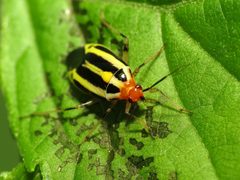
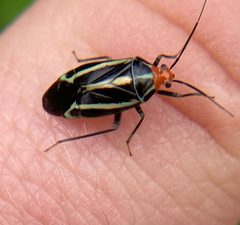
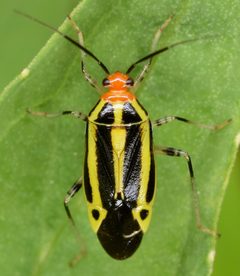
Distinguished from other mirid by the characteristic four longitudinal stripes on the surface of . The combination of small size (6–8 mm), striped coloration, and association with herbaceous perennials helps separate Poecilocapsus from similar plant bugs. Nymphs are recognized by their bright red color and presence on damaged foliage with characteristic necrotic spotting. Poecilocapsus lineatus specifically shows black stripes alternating with yellowish-green stripes, while other may differ in stripe coloration and width.
Images
Appearance
Small, slender true bugs measuring 6–8 mm in length. display distinctive longitudinal striping patterns, typically with alternating black and greenish or yellowish stripes running down the surface. The body is elongate with long . Nymphs are bright red when young, gradually developing darker coloration and wing pads as they mature through five instars.
Habitat
Associated with herbaceous perennials, ornamental plants, and landscape shrubs. Found in gardens, nurseries, and natural areas supporting diverse flowering plant . Overwinters as inserted into plant stems and debris.
Distribution
North America, including Canada, the United States, and Mexico. Documented from Vermont to Florida and across the continent.
Seasonality
One per year. Nymphs emerge in spring (typically April–May in temperate regions). present from late spring through early summer (May–June). overwinter in plant tissue.
Diet
Phytophagous; feeds on plant sap using . Documented to attack more than 250 plant including balms (Monarda), mints, lavender, phlox, viburnum, vegetables, trees, and shrubs.
Life Cycle
Hemimetabolous with one annually. are inserted into plant stems or debris and overwinter. Nymphs hatch in spring and progress through five instars. appear in late spring, mate, and females deposit eggs before senescing.
Behavior
Feeding involves insertion of stylets into plant tissue followed by secretion of salivary (pectinases) that digest and liquefy plant . The then pumps fluid into its digestive tract. Lingering enzyme activity continues to degrade cell walls after feeding, producing characteristic necrotic spots. Bugs are active during daylight and readily dislodged from plants.
Ecological Role
Herbivore and pest of ornamental plants and nursery crops. Serves as prey for including jumping spiders (Phidippus clarus), ground beetles, and . Damage is generally considered cosmetic rather than lethal to established perennials.
Human Relevance
Minor pest of ornamental gardens and nursery production. Damage appears as necrotic spots, leaf distortion, and small holes in foliage. Management through removal of debris, physical removal, or targeted applications of or insecticidal soaps. Most gardeners tolerate damage as plants typically outgrow injury.
Similar Taxa
- Other Miridae generaLack the distinctive four longitudinal stripes; often have mottled or uniform coloration
- Lygus lineolaris (tarnished plant bug)Similar size and plant-feeding habit but has mottled brown coloration without distinct stripes
- Taylorilygus apicalisSmall mirid with different color pattern, lacks bold striping
More Details
Feeding Damage Mechanism
The characteristic leaf spotting results from pectinase in saliva that continue breaking down plant walls after the has finished feeding and moved on. This delayed damage distinguishes fourlined plant bug injury from many other sap-feeding insects.
Sources and further reading
- BugGuide
- Wikipedia
- GBIF taxonomy match
- iNaturalist taxon
- NCBI Taxonomy
- Catalogue of Life
- Who’s been sucking on my bee balm? Fourlined plant bug, Poecilocapsus lineatus — Bug of the Week
- Bee Balm Blues Courtesy of Fourlined plant bug, Poecilocapsus lineatus — Bug of the Week
- Archive — Bug of the Week
- Fourlined Plant Bug Poecilocapsus lineatus (Fabricius) (Insecta: Hemiptera: Miridae)