
Ulidiinae
Tribe Guides
3- Lipsanini
- Seiopterini
- Ulidiini(picture-winged flies)
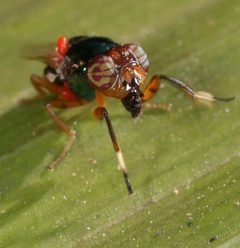
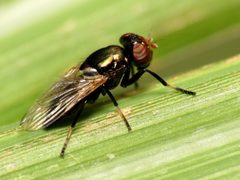
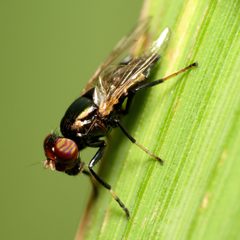
The Ulidiinae are a of picture-winged flies within the Ulidiidae. They are distinguished from similar groups by wing venation, particularly an elongated projection of the anal shared with Tephritidae but with a smoothly curving subcostal . The subfamily contains four tribes (Lipsanini, Pterocallini, Seiopterini, Ulidiini) and numerous distributed globally. Most are dull gray to shiny brown or black in coloration.
Pronunciation
How to pronounce Ulidiinae: //juːˈlɪ.di.aɪˌniː//
These audio files are automatically generated. While they are not always 100% accurate, they are a good starting point.
Identification
Differentiated from Tephritidae by the smoothly curving subcostal (Tephritidae have angular or interrupted subcostal). Distinguished from other Ulidiidae by the combination of anal projection and wing venation pattern. Tribe Ulidiini are mainly blackish-brown with some metallic sheen, though several species are predominantly yellowish.
Images
Habitat
Diverse; includes rotting tissues of palms, giant Euphorbia, baobabs, and poplars; roots of dying old plants of black saxaul; associated with decomposing wood containing coleopteran larvae; some attracted to ungulate
Distribution
Global distribution with regional variation: predominantly Afrotropical for Physiphora; first records of Timia and Ulidia from Saudi Arabia represent Arabian Peninsula expansions; some subcosmopolitan through human introduction (e.g., Physiphora alceae, P. clausa introduced to Australasian, Nearctic, and Neotropical Regions)
Diet
Saprophagous; larvae associated with rotting plant tissues. Based on cephalopharyngeal skeleton in Timia. Some possibly , attracted to and possibly developing in ungulate
Host Associations
- palms - larvae associated with rotting tissues, apparently infested by palm weevils
- giant Euphorbia - larvae associated with rotting tissues
- baobabs - larvae associated with rotting tissues
- poplars - larvae associated with rotting tissues
- black saxaul - larvae inhabit roots of dying old plantsHaloxylon aphyllum or related ; co-occurs with decomposing wood coleopteran larvae
Life Cycle
Larval stage inhabits specific plant substrates (roots of dying plants, rotting tissues); stage present; stages distinguished by anal plate structure and furrow shape on second and terminal puparium segments in Timia
Behavior
Some attracted to ungulate ; larvae co-occur with actively decomposing wood coleopteran larvae, though nature of interaction unspecified
Ecological Role
Saprophagous decomposers in plant root systems and rotting tissues; contributes to breakdown of dying plant material
Human Relevance
Some unintentionally introduced to new regions through human activity, becoming subcosmopolitan
Similar Taxa
- TephritidaeShares elongated projection of anal in wing, but distinguished by smoothly curving subcostal versus angular or interrupted subcostal in Tephritidae
- OtitinaeSimilar within Ulidiidae with herbivorous or saprophagous habits, but distinguished by wing venation characteristics
More Details
Tribal classification
Contains four tribes: Lipsanini (largest, with including Euxesta, Chaetopsis, Notogramma), Pterocallini, Seiopterini (including Seioptera, Homalocephala), and Ulidiini (three Old World genera: Physiphora, Timia, Ulidia)
Genus Physiphora
Includes at least 29 , predominantly Afrotropical; 12 new species described from Afrotropical Region in 2016 revision
First Arabian records
Timia and Ulidia first recorded from Saudi Arabia in 2025, completing the representation of all three Old World Ulidiini genera in the country
Sources and further reading
- BugGuide
- Wikipedia
- iNaturalist taxon
- NCBI Taxonomy
- Catalogue of Life
- Revision of the Genus Physiphora Fallén 1810 (Diptera: Ulidiidae: Ulidiinae)
- First Data on the Biology of the Genus Timia Wiedemann, 1824 (Diptera, Otitidae, Ulidiinae)
- First record of the genera Timia Wiedemann and Ulidia Meigen and their species T. berlandi (Séguy, 1953) and U. facialis Hendel, 1931 (Diptera, Ulidiidae, Ulidiinae) from Saudi Arabia