
Rhynchophorus
Herbst, J.F.W., 1795
palm weevils, giant palm weevils
Species Guides
3- Rhynchophorus cruentatus(Palmetto Weevil)
- Rhynchophorus ferrugineus(Red Palm Weevil)
- Rhynchophorus palmarum(South American palm weevil)
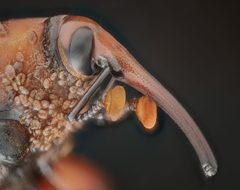
Rhynchophorus is a of large weevils commonly known as palm weevils. in this genus are significant agricultural pests of palms throughout tropical regions. Two species, R. ferrugineus and R. palmarum, have become outside their native ranges. The genus is characterized by large body size, elongated rostrum, and association with Arecaceae palms.
Pronunciation
How to pronounce Rhynchophorus: //rɪŋˈkɒfərəs//
These audio files are automatically generated. While they are not always 100% accurate, they are a good starting point.
Identification
Large weevils typically 30mm or more in length from snout tip to apex. Pronotum and elytra are relatively smooth and distinctly in R. palmarum, distinguishing it from superficially similar like Homalinotus which has rougher, more textured . Coloration varies by : R. palmarum is black, while R. ferrugineus has reddish-brown coloration. The elongated rostrum and large size separate Rhynchophorus from most other weevil genera.
Images
Habitat
Associated with palm trees ( Arecaceae) throughout tropical regions. Found in coconut palms, date palms, sago palms, and ornamental palms including Canary Island date palms.
Distribution
Native to tropical regions of Asia, Africa, and the Americas. R. ferrugineus is native to tropical Asia and has spread to Europe, the Middle East, and North Africa. R. palmarum is native to South and Central America and the Caribbean, and has been detected in southern California, Arizona, Texas, and northern Mexico. Other occur in West Africa and Southeast Asia.
Diet
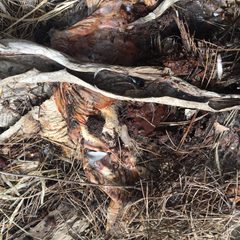
Larvae feed internally on palm tissue, tunneling into the crown and trunk. feed on palm tissues and are attracted to fermenting wounds on palms.
Host Associations
- Cocos nucifera - larval food sourcecoconut palm
- Phoenix dactylifera - larval food sourcedate palm
- Phoenix canariensis - larval food sourceCanary Island date palm, heavily impacted in California
- Metroxylon sagu - larval food sourcesago palm
- Areca catechu - larval food sourceareca palm, betel nut palm
- Calamus merrillii - larval food sourcerattan
Life Cycle
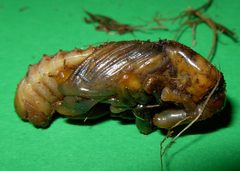
Complete . are laid in palm tissue. Larvae tunnel and feed within the palm trunk and crown, passing through multiple instars. occurs within the palm. Development time varies by and temperature; R. phoenicis completes development in approximately 108 days with 6 larval stages.
Behavior
are attracted to and fermenting odors from wounded palms. Strong fliers; R. palmarum females have been documented flying more than 100 km in 24 hours under laboratory conditions. Adults are and attracted to lights.
Ecological Role
Native function as decomposers of stressed or damaged palms. As , they become primary pests capable of killing healthy palms. R. palmarum the Bursaphelenchus cocophilus, causative agent of red ring in palms.
Human Relevance
Major agricultural pests causing significant economic damage to coconut, date, and ornamental palm industries. R. ferrugineus and R. palmarum are subjects of intensive management including trapping, chemical control, and research. Larvae of some , particularly R. phoenicis, are consumed as food in West Africa and considered a luxury product. threaten California's $100 million date palm industry and $70 million ornamental palm industry.
Similar Taxa
- HomalinotusLarge black weevils associated with palms, but distinguished by rougher, more coriaceous and different pronotal/elytral
More Details
Invasive Species Management
Research at University of California, Riverside has shown that cone traps capture 89% of visiting R. palmarum weevils compared to 18% for bucket traps. Acoustic monitoring of larval activity has been developed to assess treatment efficacy, particularly for agents like bassiana.
Taxonomic Note
The has been placed in Dryophthoridae by some modern classifications (e.g., Catalogue of Life), though traditionally treated as Curculionidae.
Sources and further reading
- BugGuide
- Wikipedia
- iNaturalist taxon
- NCBI Taxonomy
- Catalogue of Life
- UBI Professor Demonstrates 'How to Draw a Bug' at Bohart Museum Open House | Bug Squad
- Long-Distance Palm Weevil Flyers Threaten California Date Palms
- Fear No Weevil: Entomologists Say Cone Traps Better Protect Palm Trees
- Curculionidae | Beetles In The Bush | Page 3
- Listening to Larvae: How Acoustics Can Measure Efficacy of Palm Weevil Management
- Brazil Bugs | Beetles In The Bush | Page 2
- Rhynchophorus ferrugineus . [Distribution map].
- Rhynchophorus ferrugineus . [Distribution map].
- Biological studies on palm tree weevil Rhynchophorus Phoenicis fabricius (Coleoptera; Curculionidae): An interest food bug in Côte d’Ivoire (West Africa)
- Design and Validation of Computerized Flight-Testing Systems with Controlled Atmosphere for Studying Flight Behavior of Red Palm Weevil, Rhynchophorus ferrugineus (Olivier)
- Feeding preference of Rhynchophorus ferrugineus (Oliver) (Coleoptera: Curculionidae) on different date palm cultivars and host biochemical responses to its infestation
- Does catechin make the Mediterranean palm tree Chamaerops humilis L. an unsuitable host for Rhynchophorus ferrugineus?
- Exploring Speckle Change Genes of Rhynchophorus ferrugineus (Coleoptera: Curculionidae) Based on Genome-Wide Association Studies (GWASs).