
Otitinae
Tribe Guides
7- Cephaliini(picture-winged flies)
- Curranops
- Diacrita
- Idana
- Myennidini
- Otitini
- Tetropismenus
Otitinae is a of picture-winged flies within the Ulidiidae, formerly treated as the separate family . The group comprises approximately 50 distributed across three tribes: Cephaliini, Myennidini, and Otitini. Most are herbivorous or saprophagous, with some exhibiting psammophilous (sand-loving) habits. The subfamily is distinguished from similar groups by specific wing venation characters.
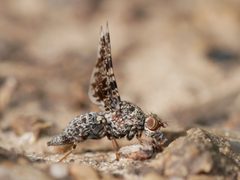
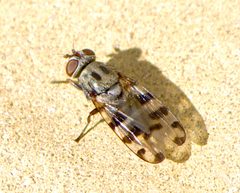
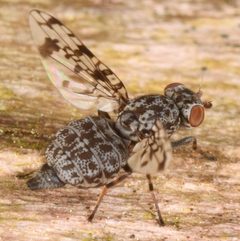
Pronunciation
How to pronounce Otitinae: //oʊˈtɪtɪniː//
These audio files are automatically generated. While they are not always 100% accurate, they are a good starting point.
Identification
Distinguished from Tephritidae by the smoothly curving subcostal (Tephritidae have an angled or interrupted subcostal vein). The elongated projection of the anal is shared with Tephritidae but the venation pattern differs. Within Ulidiidae, Otitinae is distinguished from Ulidiinae by the combination of wing venation characters and general coloration.
Images
Habitat
Coastal sand dunes for psammophilous such as Tetanops myopina; inland sandpits for some . Specific preferences for most species are poorly documented.
Distribution
Widespread across multiple continents based on -level records; documented from Europe including the Czech Republic (Tetanops myopina), with coastal distributions along the Irish Sea, North Sea, Baltic Sea, and Atlantic Ocean (Ireland and Wales) for some .
Diet
Most herbivorous or saprophagous.
Behavior
Psammophily (sand-loving ) has been documented in Tetanops myopina.
Similar Taxa
- TephritidaeShares the elongated projection of the anal in the wing, but Tephritidae have an angled or interrupted subcostal rather than the smoothly curving subcostal vein of Otitinae.
- UlidiinaeBoth are of Ulidiidae; Otitinae differs in wing venation details including the condition of R1 and subcostal vein structure.
More Details
Historical taxonomy
Formerly treated as the before reclassification as a of Ulidiidae.
Tribal classification
Contains three recognized tribes: Cephaliini, Myennidini, and Otitini, plus several of uncertain placement (incertae sedis).
Sources and further reading
- BugGuide
- Wikipedia
- iNaturalist taxon
- NCBI Taxonomy
- Catalogue of Life
- Tetanops myopina Fallén, 1820, a psammophilous species of Otitinae (Diptera: Ulidiidae) found in a sandpit in the northeastern part of the Czech Republic/ Tetanops myopina Fallén, 1820, psamofilní druh čelnice z podčeledi Otitinae (Diptera: Ulidiidae) nalezený v pískovně v severovýchodní části České republiky