
Euxesta
Loew, 1868
Cornsilk Flies
Species Guides
7- Euxesta abana
- Euxesta annonae(cornsilk fly)
- Euxesta nitidiventris
- Euxesta notata(Spotted Root Maggot)
- Euxesta pechumani
- Euxesta quaternaria(picture-winged fly)
- Euxesta stigmatias(Cornsilk fly)
Euxesta is a of picture-winged flies in the Ulidiidae, commonly known as cornsilk flies. Multiple are significant agricultural pests of sweet corn (Zea mays), particularly in Florida, the southeastern United States, Mexico, Argentina, and Brazil. The genus includes at least four species documented attacking corn in Florida: E. stigmatias, E. eluta, E. annonae, and E. mazorca. Larvae develop within corn ears, feeding on silks and kernels and causing direct crop damage, often in association with secondary fungal .
Pronunciation
How to pronounce Euxesta: /juːkˈsɛstə/
These audio files are automatically generated. While they are not always 100% accurate, they are a good starting point.
Identification
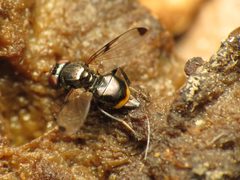
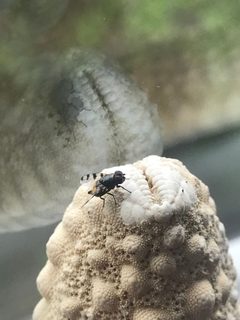
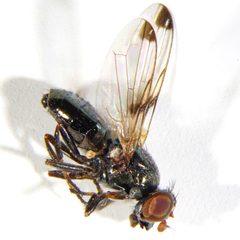
Medium to dark metallic green to black flies with distinctive wing patterns typical of picture-winged flies (Ulidiidae). exhibit characteristic wing flapping . -level identification requires examination of wing venation patterns and genitalic structures; E. stigmatias and E. eluta are the most commonly encountered pest species in North American corn production.
Images
Habitat
Agricultural areas, particularly sweet corn fields during the reproductive (silking) stage. rest on corn leaves, tassels, and silks. Larval development occurs within corn ears and on rotting plant material. takes place in soil, with depth influenced by substrate type and moisture levels.
Distribution
North, Central, and South America in warm temperate and tropical regions. Documented in Florida (USA), Puerto Rico, Mexico, Guatemala, Argentina, Ecuador, Chile, and Brazil. Specific distributions vary: E. stigmatias primarily in the southeastern United States; E. eluta in Florida, Argentina, and Brazil; E. mazorca in Brazil.
Diet
Larvae feed on corn silks, pollen, and developing kernels within corn ears; also develop on rotting plant material including agave leaves. feed on nectar, plant exudates, and sources. Laboratory colonies maintained on sugar water and protein sources.
Host Associations
- Zea mays (sweet corn) - primary — oviposition on cornsilk, larval development within corn earMajor economic pest; causes direct damage to kernels and secondary fungal establishment
- Agave atrovirens - developmental E. bilimeki develops on rotting agave leaves in Mexican altiplano
Life Cycle
Complete : , larva, pupa, . Eggs laid on corn silks. Larvae develop within corn ears or on rotting plant substrates, often in . Developed larvae leave cobs and pupate in soil; depth varies with soil type and moisture, shallower under dry or saturated conditions. Multiple per year in favorable climates; multivoltine can overwinter at temperatures below freezing.
Behavior
attracted to corn specifically during the silking stage. E. eluta exhibits distinctive visual attraction : attracted to yellow at all brightness levels, to blue at mid-level brightness only, and not attracted to green. E. bilimeki males engage in visual and tactile , with frequent female rejection; females mate multiply and often expel and consume ejaculates after mating. depth increases in presence of root-like structures.
Ecological Role
Agricultural pest causing significant economic damage to sweet corn production; can cause greater than 20% ear damage in untreated fields. Normally saprophytic lifestyle on decaying plant material, but shifts to herbivory on corn reproductive structures. Serves as for pupal (Spalangia spp., Muscidifurax spp., Nasonia vitripennis) and larval parasitoids (Figitidae: Eucoilinae).
Human Relevance
Serious economic pest of fresh market sweet corn requiring including applications, agents, and trap development. Enhanced trapping strategies target -specific color preferences. Commercially available pupal used for filth fly control show potential for field application against cornsilk flies.
Similar Taxa
- Chaetopsis massylaAlso a cornsilk fly pest of sweet corn in Florida; distinguished by behavioral attraction to yellow and green visual stimuli (avoiding blue), whereas E. eluta is attracted to yellow and blue but not green; requires examination of wing patterns and genitalia for definitive identification
- Eumecosommyia nubilaPart of the cornsilk fly pest complex in Mexico; similar and damage on corn
Sources and further reading
- BugGuide
- GBIF taxonomy match
- iNaturalist taxon
- NCBI Taxonomy
- Catalogue of Life
- Cornsilk Fly (suggested common name), Euxesta stigmatias Loew (Insecta: Diptera: Otitidae)
- Cornsilk Fly (suggested common name), Euxesta stigmatias Loew (Insecta: Diptera: Otitidae)
- Spectral sensitivity and color discrimination of Euxesta eluta and Chaetopsis massyla (Diptera: Ulidiidae)
- Substrate and Moisture Affect the Pupation Depth of the Corn Silk Flies Chaetopsis massyla and Euxesta eluta (Diptera: Ulidiidae)
- Laboratory Evaluation of Pupal Parasitoids for Control of the Cornsilk Fly Species, Chaetopsis massyla and Euxesta eluta
- Abundance and Reproduction of Euxesta stigmatis (Diptera: Otitidae) on Sweet Corn in Different Environmental Conditions
- The Natural History and Unusual Mating Behavior of Euxesta bilimeki (Diptera: Ulidiidae)
- POPULATION DYNAMICS OF EUXESTA SPP. (DIPTERA: OTITIDAE) IN MAIZE (Zea Mays L.), WHEAT (Triticum aestivum L.) AND POLYCULTURE
- Euxesta spp. NUEVA PLAGA EN Zea mayz L. VARIEDAD rugosa: ASOCIACIÓN CON ATAQUES DE Heliothis zea EN SIEMBRAS DE PRIMAVERA Y VERANO
- Ocorrência do parasitoide Dettmeria euxestae Borgmeier, 1935 (Hymenoptera: Eucoilidae) em Euxesta eluta Loew, 1868 (Diptera: Otitidae), na região de Sete Lagoas, MG
- Distribution of Arthropod Predators and their Responses toEuxestaspp. (Diptera: Ulidiidae) in the Laboratory and in Corn Fields in South Florida
- A new genus and species of Eucoilinae (Hymenoptera, Cynipoidea, Figitidae) parasitoid of Euxesta eluta Loew (Diptera, Otitidae) attacked Bt sweet corn in Argentina
- Spatial and temporal distribution of Helicoverpa zea (Boddie) (Lepidoptera: Noctuidae) and Euxesta spp. (Diptera: Otitidae) in the corn crop
- Supplementary material 1 from: Gallardo FE, Reche VA, Bertolaccini I, Zárate B, Curis C (2017) A new genus and species of Eucoilinae (Hymenoptera, Cynipoidea, Figitidae) parasitoid of Euxesta eluta Loew (Diptera, Otitidae) attacked Bt sweet corn in Argentina. Journal of Hymenoptera Research 54: 57-70. https://doi.org/10.3897/jhr.54.10096
- Enemigos naturales de las moscas de los estigmas del maíz: Euxesta stigmatias (Loew), Chaetopsis massyla (Walker) y Eumecosommyia nubila (Wiedemann) en Guasave Sinaloa, México