
Chaetopsis massyla
(Walker, 1849)
corn silk fly, picture-winged fly
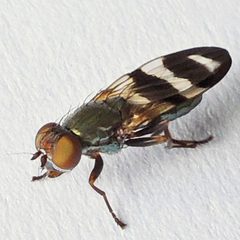
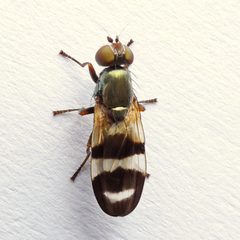
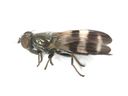
Chaetopsis massyla is a picture-winged fly (Diptera: Ulidiidae) and major agricultural pest of fresh market sweet corn in tropical and semitropical regions. Larvae develop within corn ears, feeding on developing kernels beneath protective husks, causing direct damage and secondary fungal that renders cobs unmarketable. Mature larvae exit cobs and pupate in soil at depths influenced by substrate type and moisture. The is native to the Americas, with established in Florida and documented occurrence in Mexico and Argentina.
Pronunciation
How to pronounce Chaetopsis massyla: //kaɪˈtɒpsɪs ˈmæsɪlə//
These audio files are automatically generated. While they are not always 100% accurate, they are a good starting point.
Identification
Member of the Chaetopsis distinguished from the congeneric and sympatric pest Euxesta eluta by behavioral responses to color: C. massyla is attracted to yellow and green visual stimuli and avoids blue, whereas E. eluta is attracted to yellow and blue but not green. As a picture-winged fly, displays the -characteristic patterned wings with dark markings, though specific wing patterns distinguishing C. massyla from are not detailed in available sources.
Images
Habitat
Agricultural areas with sweet corn production; specifically fields with muck soil (histosol), loamy sand, and sandy soils in southern Florida. Larvae develop within the protective husks of developing corn cobs; pupae occur in soil outside of cobs.
Distribution
North, Central, and South America: United States (Florida, with records from southern and central regions and the Everglades Agricultural Area), Mexico (Sinaloa, Guasave region), and Argentina.
Diet
Larvae feed on developing corn kernels and corn silk within sweet corn ears (Zea mays). have been maintained on 10% sugar water and corn/agar diet supplemented with green pepper sections in laboratory rearing.
Host Associations
- Zea mays - primary ; oviposition on corn silk, larval development within developing corn earssweet corn
Life Cycle
laid on corn silk of developing cobs. Larvae hatch and feed on silk and kernels under protective husks. Late third instars actively migrate out of cobs and burrow into soil to pupate; depth varies significantly with soil type and moisture, with deepest pupation (mean 3.5 cm) in muck soil at 10-50% field holding capacity and shallowest in dry or saturated conditions. emerge from pupae. Laboratory rearing maintained at 27°C, 60-80% relative humidity, 16:8 L:D .
Behavior
Late instar larvae crawl or jump out of rearing material prior to . Pupation depth varies with substrate and moisture: deeper in muck soil than sand, deeper at 10-50% field holding capacity than at 0% or 100%, and deeper when physical structures simulating corn roots are present. Visual attraction to yellow and green stimuli; avoidance of blue.
Ecological Role
Agricultural pest causing significant economic damage to sweet corn production; untreated fields may experience up to 100% loss. Serves as for pupal including Muscidifurax raptor, M. raptorellus, Spalangia endius, S. cameroni, and Nasonia vitripennis, as well as predatory pirate Orius insidiosus.
Human Relevance
Serious economic pest of fresh market sweet corn in Florida, causing kernel damage and fungal that results in packing house rejection. Subject of research on using commercially available pupal and on trap development based on color discrimination .
Similar Taxa
- Euxesta elutasympatric congeneric corn silk fly pest in Florida; distinguished by color preference (E. eluta attracted to yellow and blue, not green; C. massyla attracted to yellow and green, avoids blue) and differing spectral sensitivity despite similar visual pigment physiology
- Euxesta stigmatiasmember of corn silk fly complex in Mexico; co-occurs in Sinaloa maize fields and shares
- Eumecosommyia nubilamember of corn silk fly complex in Mexico; co-occurs in Sinaloa maize fields
Sources and further reading
- BugGuide
- Wikipedia
- GBIF taxonomy match
- iNaturalist taxon
- NCBI Taxonomy
- Catalogue of Life
- Spectral sensitivity and color discrimination of Euxesta eluta and Chaetopsis massyla (Diptera: Ulidiidae)
- Laboratory Evaluation of Pupal Parasitoids for Control of the Cornsilk Fly Species, Chaetopsis massyla and Euxesta eluta
- Substrate and Moisture Affect the Pupation Depth of the Corn Silk Flies Chaetopsis massyla and Euxesta eluta (Diptera: Ulidiidae)
- Enemigos naturales de las moscas de los estigmas del maíz: Euxesta stigmatias (Loew), Chaetopsis massyla (Walker) y Eumecosommyia nubila (Wiedemann) en Guasave Sinaloa, México