
Chaetopsis
Loew, 1868
picture-winged flies, corn silk flies
Species Guides
5- Chaetopsis aenea(picture-winged fly)
- Chaetopsis apicalis(picture-winged fly)
- Chaetopsis fulvifrons
- Chaetopsis massyla(corn silk fly)
- Chaetopsis quadrifasciata(picture-winged fly)
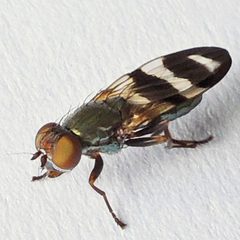
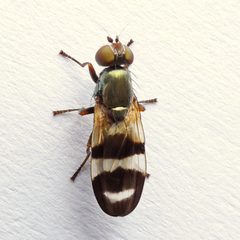
Chaetopsis is a of ulidiid flies (Diptera: Ulidiidae) established by Loew in 1868. The genus includes at least 13 described distributed in tropical and semi-tropical regions of the Americas. Chaetopsis massyla is the most economically significant species, a major pest of fresh market sweet corn in Florida and tropical regions where larvae feed on developing corn kernels and silk. The genus is characterized by picture-winged typical of Ulidiidae, with patterned wings and robust body form.
Pronunciation
How to pronounce Chaetopsis: //kiːˈtɒpsɪs//
These audio files are automatically generated. While they are not always 100% accurate, they are a good starting point.
Identification
Members of Chaetopsis possess the diagnostic features of Ulidiidae: patterned or banded wings with distinct dark markings, and a relatively robust body with a somewhat elongated profile. -level identification within Chaetopsis requires examination of specific wing patterns, body coloration, and male genitalia. Chaetopsis massyla can be distinguished from the sympatric Euxesta eluta by behavioral responses to color: C. massyla is attracted to yellow and green visual stimuli and avoids blue, whereas E. eluta is attracted to yellow and blue but not green. Electroretinogram studies show both species share similar spectral sensitivity peaks at UV (350 nm) and green (500–550 nm) wavelengths, but differ markedly in brightness-independent color discrimination .
Images
Habitat
Agricultural and natural in tropical and semi-tropical climates. Larval habitat is within developing corn ears (Zea mays), protected by husks, where they feed on kernels and silk. occurs in soil or substrate outside the cob, with depth influenced by soil type and moisture—deepest pupation in muck soil at 10–50% field holding capacity, shallowest under dry or saturated conditions. Presence of structures simulating roots generally results in deeper pupation.
Distribution
Tropical and semi-tropical regions of North, Central, and South America. Documented in Florida (USA), Brazil, Argentina, and Sinaloa (Mexico).
Diet
Larvae feed on developing corn kernels and silk within corn cobs. Laboratory colonies maintained on corn kernel/agar diet supplemented with fresh green pepper sections.
Host Associations
- Zea mays - larval sweet corn; primary economic
- Capsicum - laboratory green pepper; used in laboratory rearing
Life Cycle
are laid on corn silk of developing cobs. Larvae hatch and feed on silk and kernels while protected within corn husks. Late instar larvae actively migrate out of cobs prior to , crawling or jumping to reach soil or substrate. Pupation occurs outside the cob, burrowed into soil or cardboard layers. Laboratory rearing at 27°C, 60–80% relative humidity, and 16:8 light:dark yields living 10–14 days.
Behavior
Late instar larvae exhibit active , leaving feeding substrate and crawling or jumping prior to . demonstrate strong attraction to yellow and green visual stimuli independent of brightness, with avoidance of blue. This color discrimination behavior differs from sympatric Euxesta eluta despite similar underlying visual pigment physiology. Larvae burrow into substrate (cardboard or soil) for pupation.
Ecological Role
Major agricultural pest of fresh market sweet corn production, causing direct damage to developing kernels and facilitating secondary fungal establishment on damaged cobs. Untreated fields may experience up to 100% crop loss. Natural pupal include Spalangia spp. (Pteromalidae) with observed rates of 47%, as well as Muscidifurax raptor, M. raptorellus, Spalangia endius, S. cameroni, and Nasonia vitripennis. by Orius insidiosus (Anthocoridae) on and larvae has been documented.
Human Relevance
Significant economic pest causing millions of dollars in losses to sweet corn production. Damage renders cobs unmarketable due to kernel feeding and secondary fungal . Management challenges include resistance, difficulty targeting larvae within protected corn husks, and alternate crop sources. Potential for using commercially available pupal (Muscidifurax and Spalangia ) originally developed for filth fly control.
Similar Taxa
- Euxesta elutaSympatric congeneric corn silk fly pest with similar , use, and geographic distribution; distinguished by behavioral attraction to blue and yellow (avoiding green) versus Chaetopsis massyla attraction to yellow and green (avoiding blue), despite similar spectral sensitivity physiology
- Euxesta stigmatiasSympatric corn silk fly pest in the same , co-occurring in Sinaloa, Mexico and Florida; part of the same pest complex causing similar damage to corn
- Eumecosommyia nubilaThird member of the corn silk fly pest complex in Sinaloa, Mexico, with similar ecological role and damage
More Details
Visual Physiology
Electroretinogram studies of Chaetopsis massyla reveal spectral sensitivity curves with peaks in UV (350 nm) and green (500–550 nm) regions, best matched by visual pigments with maximum sensitivity at 350, 430, 500 and 560 nm in a 28:18:27:27 ratio. Despite this physiological similarity to Euxesta eluta, the two show markedly different behavioral responses to colored targets.
Pupal Biology
Pupal weight averages 4.24 mg in C. massyla. depth is significantly affected by substrate type and moisture, with practical implications for management: shallow pupation under dry or saturated conditions may increase vulnerability to surface-applied treatments, while deeper pupation in muck soil at moderate moisture may protect pupae from some control measures.
Species Diversity
The includes 13 described : C. aenea, C. angusta, C. apicalis, C. debilis, C. duplicata, C. fulvifrons, C. hendeli, C. laticauda, C. magna, C. massyla, C. mucronata, C. praeceps, and C. quadrifasciata. Detailed natural history is documented primarily for C. massyla due to its economic importance.
Sources and further reading
- BugGuide
- Wikipedia
- NCBI Taxonomy
- Catalogue of Life
- Spectral sensitivity and color discrimination of Euxesta eluta and Chaetopsis massyla (Diptera: Ulidiidae)
- Laboratory Evaluation of Pupal Parasitoids for Control of the Cornsilk Fly Species, Chaetopsis massyla and Euxesta eluta
- Substrate and Moisture Affect the Pupation Depth of the Corn Silk Flies Chaetopsis massyla and Euxesta eluta (Diptera: Ulidiidae)
- Enemigos naturales de las moscas de los estigmas del maíz: Euxesta stigmatias (Loew), Chaetopsis massyla (Walker) y Eumecosommyia nubila (Wiedemann) en Guasave Sinaloa, México