
Callopistromyia annulipes
(Macquart, 1855)
Peacock Fly
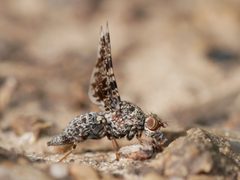
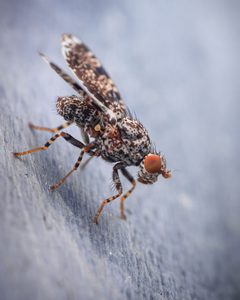
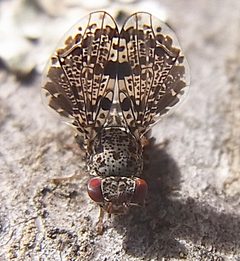
A small picture-winged fly native to North America, introduced to Europe around 2007. Known for its distinctive in which both sexes raise their wings vertically while strutting on rotting wood. The has spread rapidly across Europe, with records from more than fifteen countries. are 3.5–5.5 mm in length and active primarily in spring and fall.
Pronunciation
How to pronounce Callopistromyia annulipes: //ˌkæloʊˌpɪstrəˈmaɪə æˈnjuːlɪˌpiːz//
These audio files are automatically generated. While they are not always 100% accurate, they are a good starting point.
Identification
Distinguished from other Callopistromyia by wing pattern and geographic range; C. strigula occurs in Canada and northeastern North America. Separated from similar picture-winged flies like Ceroxys by wing pattern details—Ceroxys has different bar arrangements. Distinguished from Pseudotephretina species, which have more complete 'tiger-striped' wing bars. The vertical wing-raising display is characteristic of this and aids field identification.
Images
Appearance
Small fly, 3.5–5.5 mm in length. Wings display bold dark patterning against a clear background. Wings are held vertically and pointed forward during display, revealing blue iridescent reflections. Body coloration includes metallic elements typical of the .
Habitat
Associated with rotting trees and logs, where display and likely oviposit. Larvae develop under bark. Found in wooded areas, forest edges, and urban parks with decaying wood. In Europe, has been recorded in diverse including city centers and natural areas.
Distribution
Native to North America: widespread across northern United States south to northern Georgia, Louisiana, Oklahoma, northern Utah, and Washington state. Introduced to Europe around 2007; established in Switzerland, Germany, Netherlands, France, Italy, Slovenia, Slovakia, Hungary, Czechia, Austria, Belgium, Poland, Ukraine, Romania, San Marino, Croatia, and continuing to spread.
Seasonality
Active primarily in spring and fall. activity peaks during these seasons; likely overwinters as adults or larvae.
Life Cycle
Larvae develop under bark of rotting trees and logs. Specific larval diet unknown. emerge and engage in display on wood surfaces. Complete duration not documented.
Behavior
Males and females perform conspicuous on rotting trees or logs: wings are raised vertically and pointed forward while individuals strut and sidle. This posture creates a peacock-like appearance enhanced by blue wing reflections. The display is used for mate attraction and territorial signaling. rarely fly during display, remaining on substrate.
Ecological Role
Decomposer associated with rotting wood; contributes to nutrient cycling in forest . As a recent European introduction, ecological impacts remain unstudied but likely minimal given specialized wood-decay .
Human Relevance
Non-pest ; poses no known agricultural or health threat. Subject of citizen science documentation, with multiple European records derived from social media observations (Facebook, iNaturalist). Serves as an example of successful insect tracking through digital platforms.
Similar Taxa
- Callopistromyia strigulaCongeneric with similar display ; distinguished by geographic range (Canada and northeastern North America) and subtle wing pattern differences
- Ceroxys latiusculusSimilar size and wing patterning; distinguished by different wing bar arrangement and lack of blue iridescent display
- Pseudotephretina speciesSimilar size and general appearance; distinguished by more complete 'tiger-striped' wing bars and association with poplar/willow rather than rotting logs
More Details
Invasion History
First detected in Europe in Switzerland in 2007. Spread has been rapid and well-documented through citizen science, with new country records appearing annually. The ' association with transported wood products likely facilitated introduction.
Research Value
Notable as one of the first insect whose European spread was substantially documented through social media and citizen science platforms, demonstrating the potential of non-traditional observation networks for invasion .
Sources and further reading
- BugGuide
- Wikipedia
- GBIF taxonomy match
- iNaturalist taxon
- NCBI Taxonomy
- Catalogue of Life
- Encyrtid Holdings | Entomology Research Museum
- Bug Eric: Picture-winged Flies
- First record of the peacock fly Callopistromyia annulipes (Diptera: Ulidiidae) in Romania
- The first records of Callopistromyia annulipes (Macquart, 1855) (Diptera: Ulidiidae) from the Czech Republic
- The first record of the peacock fly Callopistromyia annulipes Macquart, 1855 (Diptera: Ulidiidae) in Croatia revealed by social media