
Callopistromyia strigula
(Loew, 1873)
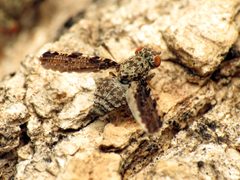
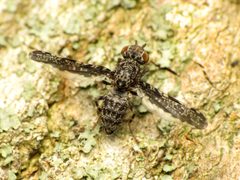
Callopistromyia strigula is a small picture-winged fly ( Ulidiidae) found in Canada and the northeastern United States. measure approximately 3.5-5.5 mm and display patterned wings characteristic of the family. Males perform distinctive , raising their wings perpendicular to the body while moving sideways on fence rails or logs. The is closely related to C. annulipes, the "Peacock Fly," and shares its behavioral repertoire.
Pronunciation
How to pronounce Callopistromyia strigula: /kæloʊpɪˈstrɔːmiə ˈstrɪɡjʊlə/
These audio files are automatically generated. While they are not always 100% accurate, they are a good starting point.
Identification
Small size (3.5-5.5 mm) with patterned wings typical of Ulidiidae. Distinguished from C. annulipes by distribution: C. strigula occurs in Canada and the northeast U.S., while C. annulipes ranges south to northern Georgia, Louisiana, Oklahoma, northern Utah, and Washington. Wing patterns differ between the two , though specific markings for C. strigula are not documented in available sources.
Images
Habitat
Associated with wooden substrates including fence rails and logs, which serve as display sites for male courtship. Larvae develop under bark.
Distribution
Canada and the northeastern United States. Distribution records include Vermont.
Life Cycle
Larval stage develops under bark. Specific larval diet unknown.
Behavior
Males perform on fence rails or logs, erecting their patterned wings perpendicular to the body and sidling back and forth. This is shared with C. annulipes.
Similar Taxa
- Callopistromyia annulipesVery similar in size, appearance, and (the "Peacock Fly"), but differs in geographic distribution—C. annulipes occurs across the northern U.S. south to northern Georgia, Louisiana, Oklahoma, northern Utah, and Washington state, while C. strigula is restricted to Canada and the northeast U.S.
More Details
Behavioral note
The Callopistromyia is noted for particularly captivating courtship among ulidiids, with males of both C. strigula and C. annulipes performing elaborate wing displays.