
Callopistromyia
Hendel, 1907
Peacock flies
Species Guides
2- Callopistromyia annulipes(Peacock Fly)
- Callopistromyia strigula
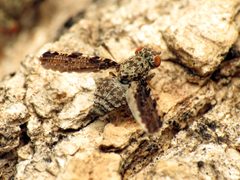
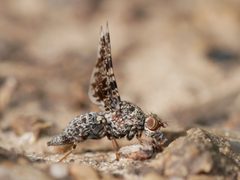
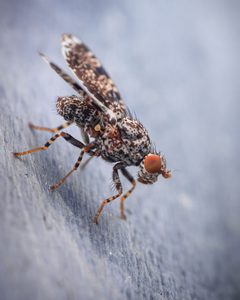
Callopistromyia is a of small picture-winged flies ( Ulidiidae) known for the distinctive of males, which hold their patterned wings perpendicular to the body while sidling along substrates. The genus contains two : C. annulipes (the peacock fly) and C. strigula. are typically 3.5–5.5 mm in length. C. annulipes has expanded from its native North American range to become an established species in Europe since 2007.
Pronunciation
How to pronounce Callopistromyia: //ˌkæloʊpɪˈstrɒmiə//
These audio files are automatically generated. While they are not always 100% accurate, they are a good starting point.
Identification
Distinguished from other Ulidiidae by small size (3.5–5.5 mm) and the characteristic male courtship of holding wings perpendicular to the body while sidling along fence rails or logs. C. annulipes and C. strigula can be separated by distribution: C. annulipes occurs throughout the northern U.S. south to northern Georgia, Louisiana, Oklahoma, northern Utah, and Washington state, while C. strigula is restricted to Canada and the northeastern U.S.
Images
Appearance
Small flies, 3.5–5.5 mm in length, with boldly patterned wings characteristic of the Ulidiidae. Wing patterns consist of dark spots, bars, or lines on a clear background. Body relatively compact for the family.
Habitat
found on fence rails, logs, and tree trunks that serve as display sites for courtship. Larvae develop under bark.
Distribution
Native to North America. C. annulipes: northern U.S. south to northern Georgia, Louisiana, Oklahoma, northern Utah, and Washington state; introduced and established in Europe since 2007 (more than ten countries including Croatia, Czech Republic, and Romania). C. strigula: Canada and northeastern U.S.
Seasonality
Active in spring and fall; may seek winter shelter in buildings in autumn (based on pattern, specifically noted for C. annulipes).
Life Cycle
Larvae develop under bark; specific diet of larvae unknown.
Behavior
Males perform elaborate on fence rails or logs, erecting their patterned wings perpendicular to the body and sidling back and forth. This has earned C. annulipes the 'peacock fly'.
Human Relevance
C. annulipes has become an established in Europe with expanding distribution; its spread has been documented through citizen science platforms including iNaturalist and Facebook. may enter buildings in autumn seeking winter shelter.
Similar Taxa
- CeroxysSimilar size and wing patterning, but Ceroxys males do not hold wings perpendicular to body during courtship; wing bars less complete than in Callopistromyia.
- PseudotephretinaSimilar size and appearance to Ceroxys, with more 'tiger-striped' and complete wing bars than Ceroxys, but lacks the perpendicular wing display of Callopistromyia males.
More Details
Citizen science documentation
The spread of C. annulipes in Europe has been tracked partly through social media posts, demonstrating the utility of citizen science for detecting expansions.
Larval biology gap
Despite detailed knowledge of , the larval diet remains unknown, representing a significant gap in the understanding of this .
Sources and further reading
- BugGuide
- Wikipedia
- GBIF taxonomy match
- iNaturalist taxon
- NCBI Taxonomy
- Catalogue of Life
- Bug Eric: Picture-winged Flies
- First record of the peacock fly Callopistromyia annulipes (Diptera: Ulidiidae) in Romania
- The first records of Callopistromyia annulipes (Macquart, 1855) (Diptera: Ulidiidae) from the Czech Republic
- The first record of the peacock fly Callopistromyia annulipes Macquart, 1855 (Diptera: Ulidiidae) in Croatia revealed by social media