
Temnostoma daochus
(Walker, 1849)
Yellow-spotted Falsehorn
Temnostoma daochus is a rare syrphid fly in the eastern United States, notable for its elaborate of solitary mason wasps. It exhibits both morphological and behavioral mimicry, including darkened wing edges that imitate vespid wing folds and deliberate foreleg movements that mimic . The species is closely related to T. barberi, with which it forms a lineage sister to the rest of the . Larvae develop in moist decayed wood.
Pronunciation
How to pronounce Temnostoma daochus: //ˌtɛm.nəˈstɒ.mə ˈdaʊ.kəs//
These audio files are automatically generated. While they are not always 100% accurate, they are a good starting point.
Identification
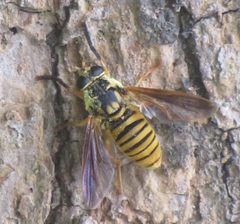
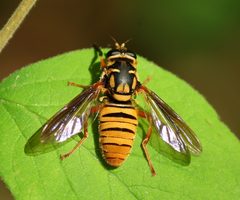
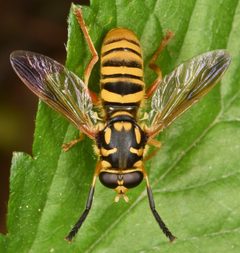
are distinguished from other Temnostoma by their strikingly different mimicry pattern compared to the closely related T. barberi. The species exhibits darkened leading edges on the wings that mimic the longitudinal wing folds of resting vespid . are short, but the fly compensates by waving its forelegs in front of its to simulate wasp antennae—a behavioral trait diagnostic for the . Specific color pattern differences from T. barberi and other are key to species-level identification.
Images
Habitat
Associated with woodland edges and forested areas where moist decayed wood is available for larval development. frequent flowers in these .
Distribution
Eastern United States; Nearctic region. Documented from Illinois and other eastern states.
Life Cycle
Larvae burrow in moist decayed wood. stage visits flowers.
Behavior
Exhibits behavioral mimicry of by moving forelegs in front of the . are capable of remaining nearly motionless in . The elaborate wasp mimicry includes wing darkening patterns that imitate the folded wings of resting vespid wasps.
Ecological Role
likely contribute to pollination through flower visitation. Larval development in decayed wood contributes to nutrient cycling in forest .
Human Relevance
Observations are infrequent enough that the is considered rare; contributes to biodiversity documentation in eastern U.S. forests.
Similar Taxa
- Temnostoma barberiClosely related sister with strikingly different mimicry pattern; both form a lineage sister to the rest of the
- Somula decoraAnother syrphid mimic in same but different ; roughly -sized with golden yellow markings rather than mason wasp mimicry
- Helophilus spp.Syrphid flies with vertical yellow thoracic stripes; yellowjacket mimics rather than mason wasp mimics, with different larval (submerged decaying plant matter)
- Chalcosyrphus spp.Related syrphid with larvae in decaying wood; typically mimic solitary in Pompilidae, Crabronidae, or Sphecidae rather than mason wasps, and some flick wings while running
- Xylota spp.Closely allied with larvae in rotting wood; rarely visit flowers, feeding instead on pollen from leaf surfaces, and may resemble or ichneumon wasps rather than vespid
More Details
Phylogenetic significance
T. daochus and T. barberi together form a lineage sister to all other Temnostoma , making them important for understanding the evolutionary origins of mimicry in the . The behavioral mimicry of appears to be a plesiomorphic trait inherited from the common ancestor of Temnostoma and Takaomyia.
Evolution of mimicry
Within Temnostoma, dark color patterns representing imperfect mimicry are ancestral, with perfect mimicry evolving twice independently. T. daochus represents one of the two independent origins of perfect mimicry, though its specific pattern differs from that of T. barberi.
Rarity
With 317 iNaturalist observations, the is considered rare relative to more common syrphid flies, and its detection requires careful observation of -mimicking flies in appropriate woodland .