
Temnostoma barberi
Curran, 1939
Bare-bellied Falsehorn
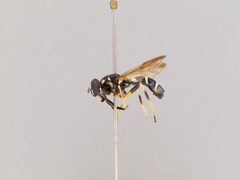
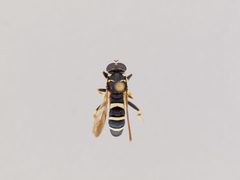
Temnostoma barberi is a Nearctic syrphid fly (hoverfly) described by Curran in 1939. The exhibits of hymenopterans, with showing behavioral mimicry by moving their forelegs in front of the to simulate . It is closely related to T. daochus, and both species form a lineage sister to the rest of the Temnostoma. The species has a strikingly different mimicry pattern compared to T. daochus, contributing to understanding of evolutionary plasticity in wasp mimicry.

Pronunciation
How to pronounce Temnostoma barberi: /tɛm.nəˈstoʊ.mə ˈbɑr.bɛ.ri/
These audio files are automatically generated. While they are not always 100% accurate, they are a good starting point.
Identification
are mimics with darkened leading edge of wings that mimics the longitudinal folds of vespid wasp wings at rest. Distinguished from other Temnostoma by specific mimicry pattern details; T. barberi and T. daochus share a lineage but exhibit strikingly different mimicry patterns. The forelegs are waved in front of the to simulate wasp , a key behavioral identification feature.
Images
Distribution
Nearctic region; specifically recorded from the eastern half of the United States and adjacent areas of Canada. GBIF records indicate presence in Vermont, USA.
Life Cycle
Larvae burrow in moist decayed wood.
Behavior
exhibit behavioral mimicry of hymenopteran by waving forelegs in front of the . This is a plesiomorphic inherited from the common ancestor of Temnostoma and Takaomyia. Adults are strong mimics.
Similar Taxa
- Temnostoma daochusClosely related sister forming a lineage with T. barberi that is sister to the rest of the ; exhibits strikingly different mimicry pattern despite close phylogenetic relationship
- Other Temnostoma speciesShare the -level trait of behavioral mimicry but differ in specific color pattern and degree of mimicry perfection
More Details
Evolutionary significance
T. barberi represents an important case study in the evolution of . Phylogenetic analysis indicates that the dark color pattern (imperfect mimicry) is ancestral in Temnostoma, with perfect mimicry evolving independently twice within the . The demonstrates high evolutionary plasticity in morphological characters related to mimicry.
Phylogenetic position
Molecular based on six markers (COI, 28s rRNA, AATS, CK1, TULP, and RBP-15) places T. barberi and T. daochus as sister to all other Temnostoma , with the Temnostoma sister to Takaomyia.
Sources and further reading
- BugGuide
- Wikipedia
- GBIF taxonomy match
- iNaturalist taxon
- NCBI Taxonomy
- Catalogue of Life
- Bugs in orange and black: Three assassins - milkweed assassin bug, Zelus longipes; orange assassin bug, Pselliopus barberi; and wheel bug, Arilus cristatus — Bug of the Week
- Bugs in orange and black – Three spooky assassins: milkweed assassin bug, Zelus longipes; orange assassin bug, Pselliopus barberi; and wheel bug, Arilus cristatus — Bug of the Week
- Bug Eric: Eight Illinois Wasp and Bee Mimics in Twenty Minutes
- How One State's Mosquito Data Could Reduce Risk of Malaria Returning to U.S.
- Bug of the Week Academy Awards 2018 — Bug of the Week
- Farmer Feedback: Needs Assessment Reveals Growers' Views on Corn Insect Pests in Iowa
- The evolution of wasp mimicry and biogeography in the genus Temnostoma (Diptera: Syrphidae)