
Calycomyza
Hendel, 1931
Species Guides
28Calycomyza is a of leaf-mining flies in the Agromyzidae, containing approximately 90 described . Larvae feed internally within leaf tissue, creating distinctive serpentine or blotch mines. The genus has a broad geographic distribution spanning the Nearctic, Neotropical, Palearctic, Oriental, and Afrotropical regions. Several species have been documented as agricultural pests or agents for plants.
Pronunciation
How to pronounce Calycomyza: //kəˌlaɪkoʊˈmaɪzə//
These audio files are automatically generated. While they are not always 100% accurate, they are a good starting point.
Identification
are small flies, typically 2-4 mm in length. Identification to level requires examination of male genitalia, particularly the and associated structures. Larvae are recognized by their leaf-mining habit and can be distinguished from other agromyzid by cephalopharyngeal skeleton and arrangement. Wing venation and coloration patterns on the and scutellum provide additional diagnostic characters for species separation.
Images
Habitat
occur in diverse including agricultural fields, natural vegetation, and disturbed areas. Many are associated with herbaceous plants, particularly in the Asteraceae, Lamiaceae, Malvaceae, and Convolvulaceae. Specific microhabitat preferences vary by species and plant availability.
Distribution
Documented from North America, Central America, South America, Europe, Asia, and Africa. GBIF records indicate presence in Denmark, Norway, Sweden, and the United States (including Vermont). The South Caucasus represents a recently documented region for C. jucunda. C. eupatorivora has been established in South Africa as a agent.
Seasonality
Activity patterns vary by and region. C. eupatorivora in South Africa shows seasonal fluctuations in correlated with plant and climatic conditions. C. jucunda has been observed in the South Caucasus during active growing periods of Beta vulgaris.
Diet
Larvae are leaf miners that feed on mesophyll tissue of plants. Documented host associations include: Ocimum basilicum (basil) and Mentha spicata (spearmint) for C. hyptidis; Beta vulgaris for C. jucunda; Chromolaena odorata for C. eupatorivora; in Malvaceae for C. malvae. Host range varies from monophagous to oligophagous among species.
Host Associations
- Ocimum basilicum - basil; first report in Mexico for C. hyptidis
- Mentha spicata - spearmint; new record for C. hyptidis
- Beta vulgaris - sugar beet; first record for C. jucunda
- Chromolaena odorata - target for by C. eupatorivora in South Africa
- Malvaceae - for C. malvae
Life Cycle
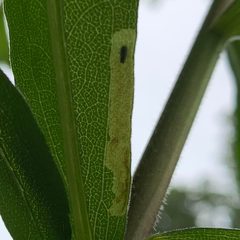
Holometabolous development with , three larval instars, pupa, and stages. Larvae mine within leaf tissue, with feeding damage visible as pale trails or blotches. typically occurs within the mine or in soil. Duration of developmental stages varies with temperature and plant quality. Specific parameters are documented for few .
Behavior
are active fliers with activity patterns. Larvae exhibit sedentary leaf-mining , feeding internally and expanding mines as they grow. Some show plant specificity, while others exploit multiple related hosts. C. eupatorivora has established self-sustaining in South Africa following intentional release for .
Ecological Role
Primary consumers of leaf tissue, functioning as herbivores in plant-insect . Some are agricultural pests causing yield reduction in crops including basil and mint. Others serve as agents for weeds. Larvae are subject to by hymenopteran , with documented parasitoid associations for C. hyptidis in Mexico.
Human Relevance
Economic impact as pests of cultivated herbs and ornamental plants. C. hyptidis damages basil and mint crops in Mexico. C. eupatorivora was introduced to South Africa for of Chromolaena odorata, an weed. Management strategies include using and cultural practices to reduce .
Similar Taxa
- PhytomyzaBoth contain leaf-mining agromyzids with serpentine mines; distinguished by male genitalia structure, larval cephalopharyngeal skeleton , and wing venation patterns. Calycomyza was historically treated as a subgenus of Phytobia.
- LiriomyzaSimilar leaf-mining habit and ; separated by differences in male terminalia, particularly the shape and armature of the , and larval configuration.
More Details
Taxonomic History
Calycomyza was originally described as a subgenus of Phytobia Lioy by Hendel in 1931. It has been treated variously as a distinct or subgenus in taxonomic literature. The genus Phytagromyza Hendel is closely related and has been confused with Calycomyza in some regional faunas.
Research Methods
identification relies heavily on examination of male genitalia, with structure being the primary diagnostic character. Larval and pupal , particularly cephalopharyngeal skeleton and spiracular patterns, are used for stage identification. plant associations provide supplementary evidence for species determination.
Sources and further reading
- BugGuide
- Wikipedia
- GBIF taxonomy match
- iNaturalist taxon
- NCBI Taxonomy
- Catalogue of Life
- Calycomyza hyptidis1 y sus Parasitoides, Primer Reporte en Albahaca, en México
- Spearmint (Mentha spicata L.)1 New Host of the Leaf Miner Calycomyza hyptidis2
- New Record ofCalycomyza malvae(Diptera: Agromyzidae) in Mexico and New Host Records
- New species of the genus <i>Calycomyza</i> Hendel (Diptera, Agromyzidae) in the South Caucasus fauna
- Notes on the Biology and Distribution of Florida Leaf-Mining Flies of the Genus Phytobia Lioy, Subgenus Calycomyza Hendel (Diptera: Agromyzidae)
- Immature Stages of Agromyzidae (Diptera) from India. IX. Taxonomy and Biology of Four Species ofPhytagromyzaHendel andCalycomyzaHendel*
- Seasonal activity, habitat preferences and larval mortality of the leaf-mining flyCalycomyza eupatorivora(Agromyzidae), a biological control agent established onChromolaena odorata(Asteraceae) in South Africa