
Phytobia
Lioy, 1864
Phytobia is a of small to medium-sized agromyzid flies (approximately 5 mm in P. betulae) comprising over 50 recognized with worldwide distribution concentrated in Europe and the Americas. The genus is considered one of the most primitive groups in the Agromyzidae. Larvae are specialized miners of the differentiating xylem in woody plants, creating concealed galleries within stems that can reach considerable lengths—reportedly up to 17 meters in P. betulae. This feeding habit produces distinctive wood defects known as pith flecks or ray flecks, which can degrade commercial timber and veneer.
Pronunciation
How to pronounce Phytobia: //faɪˈtoʊ.bi.ə//
These audio files are automatically generated. While they are not always 100% accurate, they are a good starting point.
Identification
Larvae are distinguished by their unique feeding location in the differentiating xylem just below the cambium, not in the cambium itself despite common terminology. Mines fill with proliferated parenchyma from severed vascular rays, creating characteristic starch-storage zones in the xylem. identification to is difficult due to minimal morphological differentiation; has been used to distinguish cryptic species. Pith flecks or ray flecks in harvested wood indicate prior Phytobia .
Images
Appearance
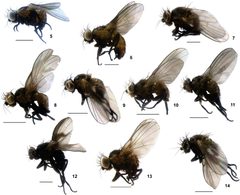
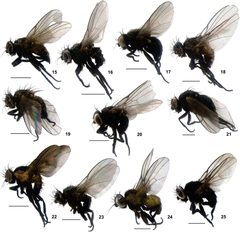
are small- to medium-sized flies, approximately 5 mm in length for P. betulae. The exhibits small morphological differences between , contributing to poorly understood . No distinctive adult coloration or structural features are consistently documented across the genus.
Habitat
Associated with growing forest trees and woody plants. Larval is specifically the differentiating xylem layer just beneath the vascular cambium of living stems and twigs. occur in forested and wooded environments where plants are present.
Distribution
Worldwide distribution with principal concentration in Europe and the Americas. Documented from distribution records in Denmark, Norway, and Sweden. Individual show more restricted ranges: P. betulae occurs in Europe on birch; P. setosa occurs in North America on sugar maple; P. cepae occurs in Europe (Austria, Germany), China, Japan, Malaya, and Singapore.
Diet
Larvae feed exclusively on the differentiating xylem tissue just below the vascular cambium of woody plants. They do not mine the cambium itself. Feeding creates elongated galleries within the developing xylem layer.
Host Associations
- Betula pendula - larval European white birch; P. betulae
- Betula pubescens - larval downy birch; P. betulae
- Alnus incana - larval grey alder
- Alnus glutinosa - larval common alder
- Sorbus aucuparia - larval rowan; Rosaceae
- Populus tremula - larval aspen; Salicaceae
- Salix phylicifolia - larval willow; Salicaceae
- Salix caprea - larval goat willow; Salicaceae
- Acer saccharum - larval sugar maple; P. setosa
- Allium cepa - larval onion; P. cepae
- Allium senescens - larval P. cepae
Life Cycle
Females lay on the bark of new-growth twigs of suitable trees. After hatching, larvae tunnel downward along the shoot within the differentiating xylem layer, sometimes reaching the base of the tree. The larval stage is the primary feeding and growing phase. Specific details on and are not documented in available sources.
Behavior
Oviposition is concentrated in fast-growing shoots, with only about 5% of available shoots utilized. Usually one oviposition per shoot (80% of cases), but significant occur with 11% of selected shoots containing multiple ovipositions and 22% of larvae sharing shoots. Females show selectivity for plant , with more ovipositions in faster-growing genotypes. for host resources has been suggested. Most are mono- or oligophagous.
Ecological Role
Cambium miners that create unique ecological interactions with trees. Larval tunneling stimulates proliferation of parenchyma from vascular rays, resulting in increased starch storage zones in the xylem of heavily infested trees. The serves as a model for studying insect-plant ; host associations correlate with taxonomic affinities of host plants but do not show strict parallel cladogenesis.
Human Relevance
Larval tunnels produce pith flecks and ray flecks that mar the appearance of wood used commercially for veneer and furniture, causing economic degradation of timber products. P. cepae is known as the onion leaf-miner, indicating agricultural relevance for that .
Similar Taxa
- ProtophytobiaRelated fossil and extant cambium-mining agromyzid ; distinguished by dimensions of associated pith flecks and hypertrophic in wood
- PaleophytobiaRelated fossil cambium-mining ; distinguished by dimensions of associated pith flecks and hypertrophic
Misconceptions
Despite common terminology as 'cambium miners,' Phytobia larvae do not actually mine the vascular cambium. Mines pass close to the cambium but the initial are not affected; instead, larvae feed in the zone of newly differentiating xylem, which provides the path of least resistance.
More Details
Taxonomic challenges
boundaries in Phytobia are poorly understood due to minimal morphological differences between species. has proven necessary to distinguish cryptic species, with studies identifying five probable species from eight tree species in southern Finland where morphological examination alone was insufficient.
Evolutionary significance
The is considered one of the most primitive groups in the Agromyzidae, making it important for understanding -level . -plant associations show correlation with host but not strict cospeciation, providing insights into the evolution of insect-plant relationships.
Wood anatomy impacts
In heavily infested trees, the starch storage area in the xylem may be measurably increased due to parenchyma proliferation in larval mines. Variation in the condition of secondary xylem may account for variability in susceptibility to .
Sources and further reading
- BugGuide
- Wikipedia
- GBIF taxonomy match
- iNaturalist taxon
- NCBI Taxonomy
- Catalogue of Life
- Phytobia cepae . [Distribution map].
- Biology of Phytobia setosa, a Cambium Miner of Sugar Maple1
- Host-associated allozyme variation in tree cambium miners, Phytobia spp. (Diptera: Agromyzidae)
- Histological relationship of Phytobia setosa to Acer saccharum
- Some New Host Plant Records and Parasites of Phytobia (Amauromyza) Maculosa in Florida (Diptera: Agromyzidae)
- Supplemental Information 2: Comparison of the dimensions of the pith flecks (PF) and the hypertrophic cells (HC) associated with Paleophytobia Süss & Müller-Stoll, Protophytobia Süss and Phytobia Lioy.
- Notes on the Biology and Distribution of Florida Leaf-Mining Flies of the Genus Phytobia Lioy, Subgenus Calycomyza Hendel (Diptera: Agromyzidae)
- Oviposition and mining by Phytobia betulae (Diptera: Agromyzidae) in genotypes of European white birch ( Betula pendula )
- Miocene Cupressinoxylon from Gökçeada (Imbros), Turkey with Protophytobia cambium mining and the study of ecological signals of wood anatomy.