
Exorista larvarum
(Linnaeus, 1758)
Exorista larvarum is a Palaearctic tachinid fly and larval endoparasitoid of Lepidoptera. The was introduced to North America in the 20th century for of the gypsy moth (Lymantria dispar). It is notable for being one of the few that can be efficiently reared from to on artificial diets without living , making it a promising candidate for mass production in programs.

Pronunciation
How to pronounce Exorista larvarum: /ɛksəˈrɪstə lɑrˈvɛrəm/
These audio files are automatically generated. While they are not always 100% accurate, they are a good starting point.
Identification
Distinguished from other tachinid by its habit and ability to develop in a wide range of lepidopteran . are laid externally on host rather than injected, with visible dark eggs attached to caterpillar . The respiratory funnel formed at the penetration site, constructed from modified host integument, is a distinctive feature of its parasitic association. require examination of genitalia for definitive identification within the Exorista.
Images
Appearance
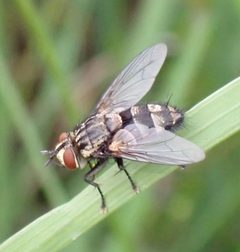
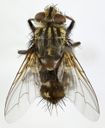
are typical medium-sized tachinid flies with a bristly body. Larvae are maggot-like with a well-developed cephalopharyngeal skeleton used to penetrate . First-instar larvae are small and capable of burrowing through host ; later instars grow within the host body. are formed from the hardened larval cuticle.
Habitat
Forests and agricultural areas supporting of lepidopteran . Laboratory rearing occurs at 26±1°C with 70% humidity.
Distribution
Native to the Palaearctic region: Europe, northern Africa (Egypt, Tunisia), and Asia (Russia, Central Asia, China, Japan, Korea, India, Taiwan, Iran, Israel, Palestine, Saudi Arabia, Mongolia). Introduced and established in North America: Canada and northern United States.
Host Associations
- Lymantria dispar - primary Target of introduction to North America
- Malacosoma neustria -
- Tortrix viridana -
- Hyphantria cunea -
- Dendrolimus pini -
- Peridroma saucia -
- Spodoptera littoralis -
- Mythimna unipuncta - Laboratory studies confirm suitability
- Xestia c-nigrum -
- Agrotis segetum -
- Spodoptera litura - As 'Prodenia litura' in literature
- Mamestra brassicae -
- Pieris brassicae -
- Autographa gamma -
- Lacanobia oleracea -
- Galleria mellonella - factitious Standard laboratory for and rearing; not a natural host
- Cydalima perspectalis - laboratory-tested Accepted for oviposition but supports only partial development; no formed
Life Cycle
Females deposit on the external of caterpillars. Eggs hatch and first-instar larvae penetrate the host using their robust cephalopharyngeal skeleton, leaving a melanized dark spot at the penetration site. The larva induces host response, which it modifies to construct a respiratory funnel connecting to the host surface. The larva remains attached to this funnel via anal hooks and cuticular spines while developing internally. Development completes with formation; emerge from puparia. Optimal parasitization rate is 3-4 eggs per host to avoid . Complete development from egg to adult occurs in approximately 19-26 days under laboratory conditions. rearing on artificial diets eliminates the need for living hosts.
Behavior
Females locate caterpillars and oviposit on the external . Oviposition on non-preferred hosts requires extended exposure time (approximately 3 hours). The exhibits polyphagy, accepting hosts from multiple lepidopteran . Larvae demonstrate wandering in artificial rearing conditions, which can lead to starvation if not managed. mate soon after .
Ecological Role
agent regulating of phytophagous lepidopteran defoliators. Used in through inoculative releases and has potential for . Contributes to natural suppression of forest pests and agricultural noctuid pests.
Human Relevance
Employed in programs against the gypsy moth (Lymantria dispar) and other forest defoliators. Its capacity for mass rearing on artificial diets makes it economically viable for commercial biological control production. Research continues on optimizing rearing protocols, including low-temperature storage of and replacement of with plant-derived antimicrobial agents.
Similar Taxa
- Other Exorista species-level morphological similarity; require examination of male genitalia for definitive identification
- Other Tachinidae larval parasitoidsSimilar as endoparasitoids of Lepidoptera; distinguished by external placement and respiratory funnel construction
More Details
In vitro rearing capability
Unusually amenable to artificial rearing; can be cultured from to fecund on meat homogenate-based or milk-based diets without any insect-derived materials. This makes it one of the most promising for mass production. However, -reared females may produce fewer eggs than -reared individuals, possibly due to deficiencies in artificial media.
Cold storage protocols
can be stored at 15°C for 1-4 weeks to assist mass-rearing facility management, though longevity and may be reduced. Storage at 5-11°C causes significant reductions in , ability, and fecundity.
Host immune interaction
The actively uses the 's response to build its respiratory funnel. Tachinid antigens trigger acute immunological responses in hosts; simulated parasitization with antigen-coated microspheres causes host death from immune response rather than mechanical damage.
Sources and further reading
- BugGuide
- Wikipedia
- GBIF taxonomy match
- iNaturalist taxon
- NCBI Taxonomy
- ID Challenge #11 | Beetles In The Bush
- Importance of Exorista Larvarum (Linnaeus, 1758) (Diptera: Tachinidae) species in the biological regulation of Lepidoptera species
- In vitro rearing of Exorista larvarum on tissue culture‐based diets
- Effects of Storage at Suboptimal Temperatures on the In Vitro-Reared Parasitoid Exorista larvarum (Diptera: Tachinidae)
- Low‐temperature storage of Exorista larvarum puparia as a tool for assisting parasitoid production
- Biological and biochemical differences between in vitro‐ and in vivo‐reared Exorista larvarum
- In Vitro Rearing of the Parasitoid Exorista larvarum (Diptera: Tachinidae) from Eggs Laid Out of Host
- In Vitro Rearing of the Parasitoid Exorista larvarum (L.) (Diptera: Tachinidae) on Meat Homogenate-Based Diets
- Host location and suitability of the armyworm larvae of Mythimna unipuncta for the tachinid parasitoid Exorista larvarum
- Larval Morphology and Anatomy of the Parasitoid Exorista larvarum (Diptera: Tachinidae), with an Emphasis on Cephalopharyngeal Skeleton and Digestive Tract
- Weight Differences of Male and Female Pupae of Gypsy Moth (Lymantria dispar) and Host-Sex Preference by Two Parasitoid Species Lymantrichneumon disparis and Exorista larvarum
- Improvements in the Rearing of the Tachinid ParasitoidExorista larvarum(Diptera: Tachinidae): Influence of Adult Food on Female Longevity and Reproduction Capacity
- In Vitro Rearing of the Parasitoid <I>Exorista larvarum</I> (Diptera: Tachinidae) from Eggs Laid Out of Host
- Penetration and encapsulation of the larval endoparasitoidExorista larvarum(Diptera: Tachinidae) in the factitious hostGalleria mellonella(Lepidoptera: Pyralidae)
- Effects of conventional and transgenicBacillus thuringiensisgalleriaetoxin onExorista larvarum(Diptera: Tachinidae), a parasitoid of forest defoliating Lepidoptera
- Monarda fistulosa hydrolate as antimicrobial agent in artificial media for the in vitro rearing of the tachinid parasitoid Exorista larvarum