
Cydalima perspectalis
(Walker, 1859)
box tree moth, box tree caterpillar
Cydalima perspectalis, commonly known as the box tree , is a highly pest moth native to East Asia. First described in 1859, it has spread rapidly across Europe since 2006 and was detected in North America in 2018. The is a herbivore of boxwood (Buxus spp.), with larvae capable of causing severe defoliation and plant mortality. Multiple per year and efficient via horticultural trade have facilitated its global expansion.

Pronunciation
How to pronounce Cydalima perspectalis: /sɪdælɪmə pɜːrsˈpɛktəlɪs/
These audio files are automatically generated. While they are not always 100% accurate, they are a good starting point.
Identification
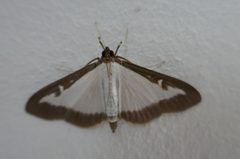
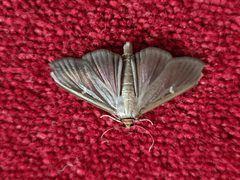
resemble several native crambid but can be distinguished by the combination of wing pattern and association with Buxus. The white morph with brown marginal banding is most distinctive. Larvae are readily identified by their exclusive feeding on boxwood foliage, presence of silk webbing, and characteristic black striping. Green pellets are often visible on infested plants. Accurate identification is critical as adults resemble non-pest ; larvae and damage provide more reliable diagnostic features.
Images
Appearance
exhibit two distinct color morphs: a predominantly white form with brown wing margins, and a uniformly light brown form. The white morph displays characteristic brown borders and a faint central spot on the forewings. Wingspan measures 40–45 mm. Larvae reach 35–40 mm at maturity, with green bodies marked by longitudinal black stripes and black capsules. Young larvae are 1–2 mm upon . Pupae are 25–30 mm long, initially green with brown longitudinal stripes, darkening progressively to brown.
Habitat
Primarily associated with cultivated and wild boxwood (Buxus spp.) in urban, suburban, and natural landscapes. Thrives in temperate climates with sufficient moisture. In invaded regions, found in gardens, parks, historic estates, nurseries, and natural Buxus stands. Urban with extensive boxwood plantings support rapid establishment.
Distribution
Native to East Asia including Japan, China, Taiwan, Korea, Russian Far East, and India. in Europe: first recorded in Germany (2006), subsequently spreading to Switzerland, Netherlands (2007), Great Britain (2008), France, Austria (2009), Hungary (2011), and numerous other countries. Detected in North America: Ontario, Canada (August 2018), and eastern United States (2021). Climate modeling indicates potential for further expansion across temperate regions of Eurasia and North America.
Seasonality
are active from April/May through September in temperate regions. Two to three occur annually; up to four generations possible in warmer climates with extended growing seasons. occurs as larvae (5–10 mm) within silk-bound leaf shelters () constructed from two joined Buxus leaves.
Diet
herbivore feeding exclusively on Buxus . Larvae consume leaves and shoots; young larvae skeletonize leaves by feeding on upper while leaving and lower waxy layer intact, creating a peeled appearance. Older larvae consume entire leaves, often leaving only thin marginal strips. Under severe , larvae feed on bark after foliage depletion, causing cambium damage and branch dieback.
Host Associations
- Buxus sempervirens - primary common box, European box
- Buxus colchica - primary wild boxwood in Caucasus region
- Buxus spp. - all Buxus appear susceptible
Life Cycle
(1 mm diameter, pale yellow) are deposited singly or in small groups on undersides of leaves. Larval development includes 5–8 instars, typically requiring 18–29 days under laboratory conditions; development is asynchronous even among siblings. Most individuals pupate at the 6th instar. occurs within a loose silk cocoon, often between leaves. larvae construct from two Buxus leaves bound with silk. time varies with temperature and latitude; 2–3 generations annually in most of Europe, potentially 4 in southern regions.
Behavior
Larvae produce extensive silk webbing that binds leaves and twigs together, creating protected feeding shelters. First-instar larvae often feed gregariously; older larvae are more solitary. When disturbed, larvae may drop from foliage on silk threads. are and attracted to light. Larvae have been observed exhibiting , consuming pupae in laboratory conditions. Asynchronous development within cohorts may represent a strategy.
Ecological Role
As an herbivore, C. perspectalis functions as a significant disturbance agent in invaded . Severe defoliation can kill mature boxwood plants, altering vegetation structure in historic gardens and natural Buxus . The has limited natural enemy pressure in invaded regions, contributing to population . In its native range, natural regulatory mechanisms maintain non-destructive population levels. Some bird has been documented in Europe, including by Turdus merula, Parus major, and Cyanistes caeruleus.
Human Relevance
Major economic and aesthetic pest of boxwood, the most widely planted evergreen shrub in North America (wholesale value $126 million). Damage threatens historic gardens, formal landscapes, and nursery production. Regulatory agencies in North America have implemented and containment programs following detections. Citizen science platforms, particularly iNaturalist, have proven critical for early detection in new regions. Management relies on combining monitoring, Bacillus thuringiensis applications, and synthetic .
Similar Taxa
- Palpita vitrealisSimilar white crambid with translucent wings, but lacks brown marginal banding and does not associate with Buxus
- Anania hortulataSmall crambid with brown and white patterning, but smaller size and different wing shape; not a boxwood
- Diaphania spp.Related crambid with similar body form, but distinct wing patterns and associations; larvae do not feed on Buxus
More Details
Invasion History
The 2014 Winter Olympics in Sochi, Russia, facilitated an unintended introduction when infested Buxus sempervirens planting stock was imported from Italy, leading to widespread defoliation of native Buxus colchica the following year.
Thermal Limits
Climate change modeling indicates that warming temperatures in southern Europe may approach the upper thermal limits of this , potentially limiting future expansion in Mediterranean regions despite favorable winter conditions.
Biological Control Research
Investigations into agents are ongoing, including evaluation of the tachinid fly Exorista larvarum. organisms, particularly Bacillus thuringiensis and , show promise for management programs.
Sources and further reading
- BugGuide
- Wikipedia
- GBIF taxonomy match
- iNaturalist taxon
- Cydalima perspectalis damage - Entomology Today
- Cydalima perspectalis adult - Entomology Today
- Beware, Boxwoods: Another Pest is On the Horizon
- New Guide Highlights IPM for Boxwood Pests
- Curious People Lead the Way in Catching New Invasive Species
- Archive — Bug of the Week
- Cydalima perspectalis Walker. [Distribution map].
- Cydalima perspectalis . [Distribution map].
- Cydalima perspectalis . [Distribution map].
- Cydalima perspectalis (box tree moth).
- Overview of invasion and control management options of Cydalima perspectalis (Lepidoptera, Crambidae) Pregled invazije i mogućnosti upravljanja kontrolom Cydalima perspectalis (Lepidoptera, Crambidae)
- Predictive Determination of Cydalima perspectalis Spread Areas by Using Maxent Model
- Cydalima perspectalis Walker (Lepidoptera: Crambidae) Presence and Distribution in Montenegro
- Biology of development of Cydalima perspectalis (Lepidoptera: Crambidae) in laboratory conditions
- Cydalima perspectalis (Walker) (Lepidoptera: Crambidae, Spilomelinae)’in Türkiye’de Coğrafi Yayılışı, Yaşam Döngüsü Ve Zararı Geographic Distribution, Lifecycle and Damage of Cydalima perspectalis (Walker) (Lepidoptera: Crambidae, Spilomelinae) in Turkey
- Ecological aspects of manifestations of the inva-sive species Cydalima Perspectalis (Walker, 1859) in urbanized ecosystems
- Modeling of the modern climatic range of <i>Cydalima perspectalis</i> (Lepidoptera, Crambidae) in Eurasia
- The temperature increase due to climate change will not favour Cydalima perspectalis in southern Europe
- [Bird predation on larvae of the box tree moth, Cydalima perspectalis (Walker, 1859)]
- Potential of entomopathogens in biological control of the box-tree moth, Cydalima perspectalis (Lepidoptera: Crambidae)
- The box tree moth Cydalima perspectalis: a review of biology, invasiveness, management practices and future perspectives of control strategy in Europe
- Comparative metabolomics reveals how the severity of predation by the invasive insect Cydalima perspectalis modulates the metabolism re-orchestration of native Buxus sempervirens.