
Anania hortulata
Linnaeus, 1758
Small Magpie
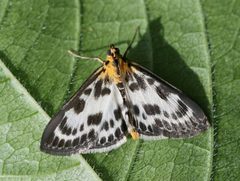
Anania hortulata, commonly known as the small magpie, is a crambid with a wingspan of 24–28 mm. It is found across Asia, Europe, and North America, where it is considered in Canada and the United States. The was described by Carl Linnaeus in 1758 and has undergone several taxonomic revisions, having been placed in Phalaena, Eurrhypara, and Pyralis before its current classification.
Pronunciation
How to pronounce Anania hortulata: //əˈnɑː.ni.ə hɔːr.tuˈlɑː.tə//
These audio files are automatically generated. While they are not always 100% accurate, they are a good starting point.
Identification
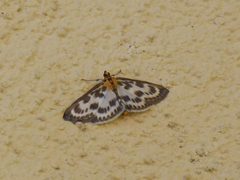
The small magpie can be distinguished from similar crambid by its specific wing pattern: the combination of yellowish-white ground color with blackish markings, the two ochreous-yellow marks at the wing base, and the discal spots that touch the costal streak. Geometric morphometry of wing venation landmarks can separate it from look-alike such as Sitochroa verticalis and Pleuroptya ruralis, which share similar coloration and markings. It is active by day and easily disturbed, unlike many moth species.
Images
Appearance
have yellowish-white forewings with blackish markings. The and are deep ochreous-yellow with black spots. Forewing pattern includes a blackish base with two ochreous-yellow marks, a suffused costal streak, and two thick lines: the first irregular, the second curved and tending to form spots. Small and large round discal spots touch the costal streak. Hindwings share similar coloration, second line, and terminal fascia with forewings, plus a blackish discal spot. Larvae are whitish with a dull green line that is white-edged; head and plate of segment 2 are black.
Habitat
Associated with gardens and areas where plants grow. Larvae develop in rolled or spun leaves of host plants and overwinter in transparent cocoons under loose bark or in hollow stems of Umbelliferae such as hogweed (Heracleum sphondylium).
Distribution
Recorded from Asia, Europe, and North America. In North America, it is present in Canada and the United States as an . Documented occurrences include Belgium (Antwerpen and Brabant Wallon provinces).
Seasonality
fly from June to July depending on location. They are active from dusk onward and come to light. Larvae occur in August and September. occurs as larvae in cocoons, with in spring at the overwintering site.
Diet
Larvae feed on stinging nettle (Urtica dioica) and occasionally on Labiatae including white horehound (Marrubium vulgare), woundwort (Stachys ), and mint (Mentha species).
Host Associations
- Urtica dioica - larval plantprimary oviposition site
- Marrubium vulgare - larval plantoccasional
- Stachys - larval plantwoundwort , occasional
- Mentha - larval plantmint , occasional
- Heracleum sphondylium - sitelarvae overwinter in hollow stems
Life Cycle
are laid on plants. Larvae feed in rolled or spun leaves during August and September, then overwinter in transparent cocoons under loose bark or in hollow stems. occurs in spring at the site. emerge and fly from June to July.
Behavior
are easily disturbed by day and fly from dusk onward. They are attracted to light. Larvae construct rolled or spun leaves for feeding shelter.
Human Relevance
Can be confused with agricultural pests such as the European corn borer (Ostrinia nubilalis) in monitoring programs, requiring careful identification to avoid misdirected pest management efforts. Wing venation patterns have been used in developing automated identification systems to distinguish it from true crop pests.
Similar Taxa
- Sitochroa verticalisSimilar coloration and wing markings; found in corn fields at same time as European corn borer; distinguished by wing venation geometry
- Pleuroptya ruralisSimilar coloration and wing markings; found in corn fields at same time as European corn borer; distinguished by wing venation geometry
- Ostrinia nubilalisEuropean corn borer is a major agricultural pest that A. hortulata resembles; misidentification could lead to unnecessary control measures
More Details
Etymology
The name Anania, established by Jacob Hübner in 1823, refers to 'his pleasure in the beauty of' Anania funebris. The specific epithet hortulata derives from Latin hortus (garden), referencing the ' typical .