
Exorista
Meigen, 1803
uzi fly
Species Guides
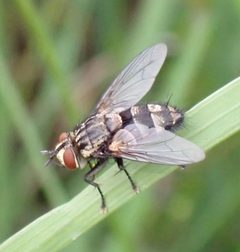
2Exorista is a of tachinid flies comprising approximately 70 described distributed across multiple subgenera. The genus includes both beneficial biocontrol agents and economically significant pests of . Species such as E. sorbillans (uzi fly) are major constraints on silk production, causing up to 80% crop loss in outdoor operations through endoparasitic larval development. Other species have been evaluated for of agricultural pests, including E. larvarum for rearing and E. deligata for control of tea loopers. The genus exhibits diverse associations, primarily targeting Lepidoptera.

Pronunciation
How to pronounce Exorista: //ɛkˈsɔrɪsta//
These audio files are automatically generated. While they are not always 100% accurate, they are a good starting point.
Identification
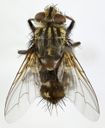
Exorista are tachinid flies distinguished from related by combinations of bristle patterns, abdominal coloration, and male genitalic structures. Subgeneric classification relies on chaetotaxy of the scutellum, leg bristling, and wing venation patterns. Species-level identification requires examination of the male terminalia and often association records. The genus lacks the prominent facial carina found in some related exoristine genera.
Images
Habitat
occur in diverse associated with their lepidopteran , including agricultural , forests, and environments. E. sorbillans is closely tied to rearing facilities and outdoor semidomesticated sericulture systems. E. deligata has been recorded from tea plantations in India. typically occurs in soil or substrate near host habitats.
Distribution
distribution with records from Europe (Denmark, Norway, Sweden), Asia (India, China, Japan), and other silk-producing regions. E. sorbillans occurs in all major silk-producing countries. E. japonica is distributed in East Asia. Specific distributions vary by ; many species have restricted ranges while others are widespread.
Diet
of E. sorbillans have been observed feeding on 8% glucose solution in laboratory conditions. Natural adult feeding habits are poorly documented. Larvae are endoparasitic and do not feed independently.
Host Associations
- Bombyx mori - primary for E. sorbillans; endoparasitic development inside larvae
- Antheraea mylitta - for E. sorbillans; tasar
- Samia cynthia ricini - for E. sorbillans;
- Antheraea assamensis - for E. sorbillans; muga ; up to 80% seed loss reported
- Hyposidra talaca - for E. deligata; Indian tea looper; larval-pupal endoparasitoid
Life Cycle
Larvae are developing inside lepidopteran . E. sorbillans: laid on larval body surface, maggots penetrate and develop internally, mature maggots exit host by cutting hole in cocoon case, pupate in soil. Infested silkworms die in late larval, pre-pupal, or pupal stage. E. deligata: stages (larva, pre-pupa, pupa) observed inside developing pupa of host with complete host consumption. Post-parasitic maggots collected from infested cocoons undergo to pupae then .
Behavior
E. japonica uses visual and olfactory cues to locate herbivore-infested plants. E. sorbillans females preferentially oviposit on larvae, laying 1-3 per . endosymbionts in E. sorbillans influence reproductive through and sex ratio distortion. longevity not significantly affected by Wolbachia status.
Ecological Role
Dual role as biocontrol agents and agricultural pests. E. sorbillans causes 15-20% yield loss in silk industry, up to 40% overall crop loss and 80% in outdoor seed . Damaged cocoons become commercially unreelable. E. deligata shows potential as agent against tea looper pests, causing mean 25.4% pupal mortality. E. larvarum has been evaluated for mass rearing and .
Human Relevance
Major economic impact on industry in Asia. E. sorbillans (uzi fly) is a primary pest requiring integrated management including -based controls (Ocimum gratissimum, thymol, carvacrol), physical barriers, and (Trichomalopsis uziae). Research has explored -based suppression and rearing techniques for E. larvarum. Some studied for of crop pests.
Similar Taxa
More Details
Wolbachia symbiosis
E. sorbillans harbors endosymbionts essential for normal . Infected females show ~17% higher . Removal causes (88-90% embryonic mortality), sterility in uninfected crosses (64-70% mortality), and male-biased sex ratios (~2:1). Represents mutualistic controlling reproductive physiology.
Subgeneric classification
divided into 9+ subgenera (Exorista, Adenia, Exoristella, Fauniodes, Podotachina, Ptilotachina, Spixomyia, Tricoliga) based on morphological characters including scutellar chaetotaxy, leg bristling, and abdominal structure. Numerous remain unplaced to subgenus.
Sources and further reading
- BugGuide
- Wikipedia
- GBIF taxonomy match
- iNaturalist taxon
- NCBI Taxonomy
- Catalogue of Life
- ID Challenge #11 | Beetles In The Bush
- The parasitoid fly Exorista japonica uses visual and olfactory cues to locate herbivore-infested plants
- Prospects of Ocimum Gratissimum Linn. (Lamiaceae) to Control Exorista SorbillansWiedemann (Diptera: Tachinidae) Menace of Silkworm in Seriecosystem
- Effects of Wolbachia in the uzifly, Exorista sorbillans, a parasitoid of the silkworm, Bombyx mori
- Adult Biology of Exorista mella1,2
- Toxicity of essential oil compounds against Exorista sorbillans (Diptera: Tachinidae), a parasitoid of silkworm
- Economical and distributional status of Uzi fly Exorista sorbillans Wied (Diptera: Tachinidae) in sericulture in India
- Visual Recognition of the Host in the Parasitoid Fly Exorista japonica
- Comparative Performance of Trichomalopsis Uziae A Pupal Parasitoid of The Tachinid Exorista Bombycis
- Effects of Storage at Suboptimal Temperatures on the In Vitro-Reared Parasitoid Exorista larvarum (Diptera: Tachinidae)
- New record of larval-pupal endoparasitoid Exorista deligata parasitising Indian Tea looper Hyposidra talaca from India