
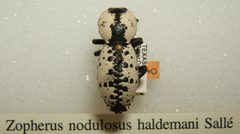
Zopherus nodulosus haldemani
Horn, 1870
Texas Ironclad Beetle
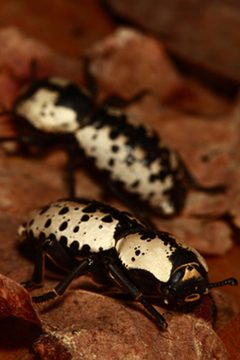
Zopherus nodulosus haldemani, commonly known as the Texas Ironclad Beetle, is a of ironclad beetle in the Zopheridae. These beetles are renowned for their exceptionally hard, heavily sclerotized that make them notoriously difficult to pin for collection. The exhibits activity patterns, with frequently observed on tree trunks at night. The subspecies name honors American entomologist Samuel Stehman Haldeman.

Pronunciation
How to pronounce Zopherus nodulosus haldemani: /ˈzoʊfərəs ˈnɒdjʊˌloʊsəs ˈhældəˌmæni/
These audio files are automatically generated. While they are not always 100% accurate, they are a good starting point.
Identification
Distinguished from ground beetles (Carabidae) by bead-like rather than thread-like antennal segments and concealed rather than exposed . Separated from darkling beetles (Tenebrionidae) by the extremely dense, almost metallic hardness of the and lack of defensive -standing . Differs from other Zopherus by geographic distribution and subtle morphological features of the nodular sculpturing pattern. The combination of tree-trunk preference and the characteristic 'ironclad' exoskeleton hardness is diagnostic for the .
Images
Appearance
possess a robust, cylindrical body form with extremely hard, dark-colored . The is heavily sclerotized and notably thick, earning the 'ironclad.' The body surface often shows tuberculate or nodular sculpturing, particularly pronounced in this . are short with bead-like segments. The are concealed beneath the . Overall coloration is typically black or very dark brown, sometimes with subtle surface texture variations.
Habitat
Associated with coniferous woodlands, particularly those dominated by Ponderosa pine (Pinus ponderosa). are found on tree trunks at night. Occurs in montane and submontane zones with mature pine and juniper stands. include campgrounds and undisturbed forest areas with large-diameter trees providing suitable trunk surfaces for activity.
Distribution
Recorded from the southwestern United States, including southern Utah, northern Arizona, and adjacent regions. Documented from Ponderosa Grove Campground in southwestern Utah and similar montane localities. The epithet reflects historical association with Texas, though precise range boundaries relative to nominate Z. nodulosus nodulosus require further clarification.
Seasonality
activity documented from June through September, with peak observations in mid-summer. Late-season activity recorded into early September at higher elevations. Nighttime surveys consistently productive when temperatures remain above 50°F.
Behavior
Strictly , with active on tree trunks after dark. Observed on trunks of large Ponderosa pines and Utah junipers. Moves slowly, relying on hardened for defense rather than rapid escape. Does not exhibit the -standing defensive posture characteristic of Eleodes darkling beetles. Activity ceases or diminishes significantly when nighttime temperatures drop below approximately 50°F.
Ecological Role
Functions as a or fungivore in coniferous forest . Serves as prey for including rodents and birds. The exceptional hardness represents an evolutionary response to pressure. Contributes to nutrient cycling through feeding activities on decaying wood or fungal material.
Human Relevance
Collected by entomologists for scientific study, though specimens are notoriously difficult to prepare due to hardness. Standard insect pins often bend or fail to penetrate the ; specialized techniques or equipment required for proper curation. Not considered economically significant. habits and specificity make it an for intact montane coniferous forest .
Similar Taxa
- Zopherus nodulosus nodulosusNominate with overlapping morphological features; distinguished by geographic distribution and subtle differences in nodular sculpturing pattern.
- Zopherus uteanusSympatric also active nocturnally on tree trunks; separated by body form and surface sculpturing details, though both share the characteristic ironclad .
- Eleodes spp. (darkling beetles)Superficially similar dark coloration and ground-dwelling habits; distinguished by -standing defensive , less extreme exosclerotization, and different antennal structure.
More Details
Taxonomic History
Formerly classified within Tenebrionidae; reassigned to family Zopheridae based on phylogenetic studies. The epithet 'haldemani' honors Samuel Stehman Haldeman (1812-1880), prominent 19th-century American naturalist and entomologist.
Collection Challenges
The exceptional hardness that gives ironclad beetles their creates significant difficulties for specimen preparation. Standard entomological pins frequently bend or fail to penetrate the . Collectors may need to use specialized pinning techniques, drill holes for pin placement, or employ alternative preservation methods.
Sources and further reading
- BugGuide
- GBIF taxonomy match
- iNaturalist taxon
- NCBI Taxonomy
- Grasshoppers of Colorado
- Haldeman’s shieldback katydid (Pediodectes haldemani) | Beetles In The Bush
- Calopterygidae | Beetles In The Bush
- August | 2013 | Beetles In The Bush | Page 2
- Bug Eric: ID Tip: Ground Beetle or Darkling Beetle?
- ironclad beetles | Beetles In The Bush