
Polyphylla decemlineata
(Say, 1824)
Ten-lined June Beetle, Watermelon Beetle
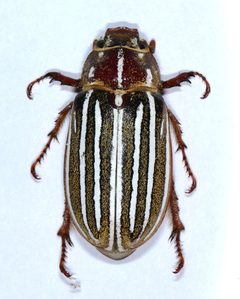
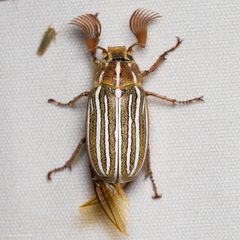
Polyphylla decemlineata is a large scarab beetle native to western North America, commonly known as the Ten-lined or Watermelon . are notable for their distinctive ten white stripes on dark and greatly enlarged, fan-like in males. The is strongly attracted to lights and exhibits distinctive -mediated mating where males actively search for flightless females. Larvae develop underground, feeding on roots of grasses and other plants.

Pronunciation
How to pronounce Polyphylla decemlineata: /ˌpɒlɪˈfɪlə ˌdɛsɛmˌlaɪniˈeɪtə/
These audio files are automatically generated. While they are not always 100% accurate, they are a good starting point.
Identification
are large, robust beetles 25–35 mm in length with dark brown to black bearing ten distinct longitudinal white or cream-colored stripes. Males possess dramatically enlarged that can be spread fan-like to detect female ; female antennae are much smaller and less elaborate. The pronotum is densely punctured and often has a . The can be distinguished from other Polyphylla by the combination of ten elytral stripes (rather than fewer or more), large body size, and male antennal structure. Similar species include P. hammondi (Hammond's lined ), which has different striping patterns and distribution in the Great Plains.
Images
Habitat
Primarily associated with sandy soils including sand dunes, sandy prairies, and loose soil areas in grasslands, open woodlands, and agricultural lands. are often found near lights in residential areas. Larval is underground in sandy or loamy soils where root feeding occurs.
Distribution
Western North America from southern Canada through the western United States to northern Mexico. In the United States: Arizona, California, Colorado, Idaho, Kansas, Montana, Nebraska, Nevada, New Mexico, North Dakota, Oklahoma, Oregon, South Dakota, Texas, Utah, Washington, Wyoming. In Canada: Alberta, British Columbia, Saskatchewan. In Mexico: Aguascalientes, Baja California, Chihuahua, Hidalgo, San Luis Potosí.
Seasonality
are active primarily from June through August, with peak activity in June and July. Males begin flying in late afternoon, become most active at dusk, and cease activity shortly after sunset.
Diet
feed on foliage of various plants including pine needles and other conifer foliage, as well as leaves of deciduous trees. Larvae feed underground on roots of grasses, cereals, and other herbaceous plants, occasionally becoming pests in agricultural settings.
Life Cycle
Complete with , larva, pupa, and stages. Larvae are large, C-shaped white that develop underground over 2–3 years. occurs in soil . Adults emerge in early summer, with males flying to locate flightless females that remain on or near the ground surface. Mated females burrow into soil to oviposit.
Behavior
Males exhibit distinctive mate-searching : they begin flying in late afternoon, initially making rapid irregular , then as dusk approaches switch to rapid upwind flight followed by slow zigzag return flights indicative of osmoclinotactic orientation toward female plumes. Upon locating a female, males alight within centimeters and mating ensues. Multiple males are often attracted to single females. When disturbed, stridulate loudly and can produce a hissing sound by forcing air out between wings and body. Males attracted to lights hold splayed open while actively searching, becoming inactive after sunset.
Ecological Role
Larvae contribute to soil aeration and nutrient cycling through burrowing and root feeding. serve as prey for various vertebrate and . The is part of , with adults attracted to lights serving as food for bats, birds, and other .
Human Relevance
Occasionally a minor agricultural pest when larval root feeding damages grasses, cereals, or ornamental plants. are conspicuous at lights and sometimes cause concern due to large size and noisy . The has been studied extensively for its chemical and communication.
Similar Taxa
- Polyphylla hammondiSimilar large size and lined , but has different striping pattern (typically fewer, broader lines) and occurs primarily in the Great Plains sand dunes rather than western mountains and coasts. Male are similarly enlarged but can be distinguished by elytral pattern and geographic separation.
- Strigoderma spp.Similar size and general scarab appearance, but much smaller, with different antennal structure (not in males), different elytral patterns, and active during day rather than night.
- Phyllophaga spp. (May/June beetles)Similar size and general form, but are not enlarged in males, lack distinct longitudinal stripes, and they are generally more uniformly colored brown.
Sources and further reading
- BugGuide
- GBIF taxonomy match
- iNaturalist taxon
- NCBI Taxonomy
- Catalogue of Life
- UC Davis Scientist Spotlighted in 'Antenna' | Bug Squad
- Bug Eric: Results of the Red Rock Canyon Open Space Bioblitz
- Super duper June bugs | Beetles In The Bush
- Scarabaeidae | Beetles In The Bush | Page 2
- Bug Eric: National Moth Week Recap, 2015
- Bug Eric: National Moth Week Recap for Colorado Springs