
Strigoderma
Burmeister, 1844
shining leaf chafers, sand chafers
Species Guides
5- Strigoderma arbicola(sand chafer)
- Strigoderma knausi
- Strigoderma pimalis
- Strigoderma pygmaea(pygmy chafer)
- Strigoderma teapensis
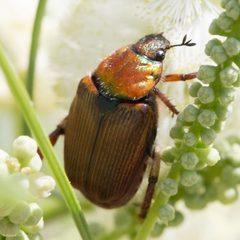
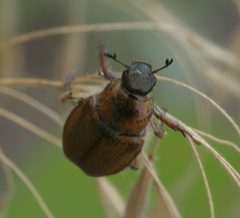
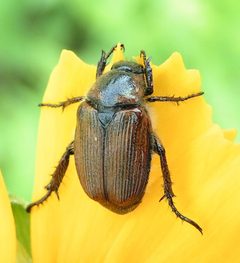
Strigoderma is a of small scarab beetles commonly known as shining leaf chafers, containing approximately nine described distributed across North and Central America. The genus includes notable species such as Strigoderma pygmaea (pygmy ) and Strigoderma arbicola (sand chafer). Members are associated with sandy and herbaceous vegetation, with frequently observed on flowers. The genus has undergone taxonomic revision, with a new Mexican subgenus Costatergus described in 2026.
Pronunciation
How to pronounce Strigoderma: /ˌstɹɪɡoʊˈdɜːrmə/
These audio files are automatically generated. While they are not always 100% accurate, they are a good starting point.
Identification
within Strigoderma are distinguished by features of the pronotum, elytral , and male genitalia. Strigoderma knausi possesses a on the pronotum, absent in the similar S. pygmaea. The subgenus Costatergus is characterized by finely tumescent with prominent longitudinal ridges and simple genitalia, with diagnostic characters including inner protarsal claw shape and pronotum punctation.
Images
Habitat
Sandy including sand dunes and sandstone glades; associated with low vegetation and flowers of herbaceous plants such as Coreopsis, Gaillardia, and Ratibida.
Distribution
North America (United States: Kansas, Oklahoma, Arkansas, Texas, Florida, Atlantic coastal states) and Central America (Mexico: Chiapas, Pacific slope); primarily Nearctic and Neotropical regions.
Seasonality
active in late spring and summer (May–June in temperate regions); patterns appear seasonal with peak activity during flowering periods of associated plants.
Diet
feed on pollen and floral tissues of herbaceous plants; larvae feed on decaying organic matter or roots in soil.
Host Associations
- Coreopsis lanceolata - feeding/visitation
- Coreopsis tinctoria - feeding/visitation
- Gaillardia pulchella - feeding/visitation
- Ratibida columnifera - feeding/visitation
- Opuntia - feeding/visitation
Life Cycle
Complete with , larval (), pupal, and stages. Larvae develop in soil, likely feeding on decaying organic matter or roots. Adults emerge in spring to summer.
Behavior
Males of at least some adopt a characteristic perching posture on vegetation, clinging with middle and hind legs while extending the body horizontally with front legs free and antennal club segments spread, presumably to detect female . are and frequently encountered on flowers.
Ecological Role
function as through flower visitation; larvae contribute to soil nutrient cycling through decomposition of organic matter.
Human Relevance
Some are collected for entomological study; S. knausi is noted for its rarity and restricted distribution. No significant agricultural pest status documented.
Similar Taxa
- Strigoderma pygmaeaSimilar size and sandy preference; distinguished from S. knausi by absence of pronotal and broader southeastern U.S. distribution.
- Euphoria kerniiSympatric flower-visiting scarab; distinguished by larger size, more robust build, and association with cactus flowers.
More Details
Taxonomic History
Originally described by Burmeister in 1844. The Strigodermella was synonymized with Strigoderma, with S. knausi transferred accordingly. A new subgenus Costatergus was erected in 2026 for Mexican with distinctive elytral ridges.
Sexual Dimorphism
Females of some appear rarely collected compared to males; in S. knausi, only one female was found among nearly 100 specimens examined by Bader (1992), suggesting either cryptic or lower female abundance at sampling sites.
Collection Methods
are collected by sweeping low vegetation, especially in sandy areas, and by light trapping. Beating vegetation and direct observation on flowers during peak bloom periods are effective techniques.
Sources and further reading
- BugGuide
- Wikipedia
- GBIF taxonomy match
- iNaturalist taxon
- NCBI Taxonomy
- Catalogue of Life
- A suitable ode to Warren Knaus | Beetles In The Bush
- 2019 Arkansas/Oklahoma Insect Collecting Trip iReport | Beetles In The Bush
- Life History and Habits of Strigoderma arboricola
- A new Mexican species and new taxonomic and distributional data of Strigoderma Burmeister (Coleoptera: Scarabaeidae: Rutelinae)
- Description of a new Mexican endemic subgenus of Strigoderma Burmeister with six new species (Coleoptera, Melolonthidae, Anomalini)