
Strigoderma pygmaea
(Fabricius, 1798)
pygmy chafer
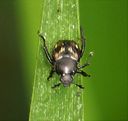
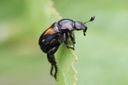
Strigoderma pygmaea, commonly known as the pygmy , is a small scarab beetle in the Scarabaeidae and Rutelinae. It belongs to the group of 'shining leaf chafers' characterized by their metallic coloration. The occurs across the southeastern United States, with records from Florida to New York, and is frequently associated with sandy . It can be collected by sweeping low vegetation or at light traps.
Pronunciation
How to pronounce Strigoderma pygmaea: //ˌstrɪɡoʊˈdɜːrmə pɪɡˈmiːə//
These audio files are automatically generated. While they are not always 100% accurate, they are a good starting point.
Identification
May be confused with Strigoderma knausi, from which it differs by lacking a on the front part of the pronotum. The two share similar preferences and collecting methods. Strigoderma pygmaea is generally more widespread across the southeastern U.S., while S. knausi has a more restricted distribution centered on sand dunes in Kansas, Oklahoma, and northern Texas.
Images
Habitat
Sandy , including sand dunes and sandy fields. Associated with low vegetation in open, sandy areas.
Distribution
Nearctic region: United States (Alabama, Florida, Maryland, Missouri, New York, South Carolina). More broadly distributed across the southeastern U.S. than the related S. knausi, with particular abundance in Florida and along the Atlantic coast.
Behavior
Males have been observed perching on low vegetation with front legs extended and antennal spread, presumably to detect female . This has been documented in the related S. knausi and is likely similar in S. pygmaea given shared and use.
Similar Taxa
- Strigoderma knausiSimilar size, preference (sandy areas), and collecting methods (sweeping vegetation, light traps). Distinguished by presence of pronotal in S. knausi (absent in S. pygmaea) and more restricted distribution.
More Details
Taxonomic history
The Strigoderma was revised by Bader (1992), who clarified boundaries and diagnostic characters. Strigoderma pygmaea was originally described by Fabricius in 1798.
Collecting methods
Based on observations of , the is likely collected by sweeping grasses and low vegetation, or at light traps. Males are more frequently encountered than females.