
Euphoria kernii
Haldeman, 1852
Kern's flower scarab
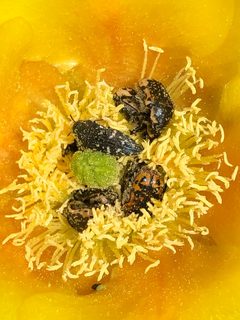
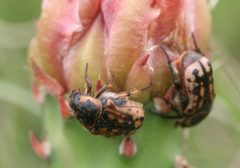
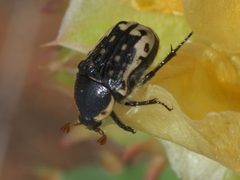
Euphoria kernii is a scarab beetle in the Cetoniinae, commonly known as Kern's flower scarab. The exhibits extreme color , with individuals ranging from all black to various combinations of black with white or yellow markings, to nearly entirely yellow. are and frequently observed aggregating in flowers. The species occurs across the southern Great Plains and southwestern United States, extending into northern Mexico.
Pronunciation
How to pronounce Euphoria kernii: //juːˈfɔːriə ˈkɜːrnaɪ.aɪ//
These audio files are automatically generated. While they are not always 100% accurate, they are a good starting point.
Identification
Distinguished from similar Euphoria by geographic range and color pattern variation. E. sepulchralis, which occurs sympatrically in some areas, is typically all black or dark with less pronounced variation. E. fulgida is predominantly metallic green. E. herbacea shows different color patterns. Examination of genitalia may be required for definitive identification where ranges overlap and color forms are similar.
Images
Appearance
Medium-sized scarab beetle with highly variable coloration. Body form typical of flower scarabs: robust, oval, with clubbed . Color morphs include: all black; black with white markings; black with yellow markings; and predominantly yellow. The may be entirely dark or bear pale maculations. Size and body proportions consistent with in Euphoria.
Habitat
Arid and semi-arid grasslands, prairies, and open woodlands. Associated with sandy soils, gypsum exposures, and rocky slopes. Found in mesquite chaparral, sand dune systems, and pinyon-oak-juniper woodland edges. frequently encountered on flowering vegetation in open, sun-exposed areas.
Distribution
Nearctic region: United States (Arizona, Colorado, Kansas, Minnesota, Nebraska, New Mexico, Oklahoma, South Dakota, Texas). Neotropical region: Mexico (Chihuahua, Coahuila, Distrito Federal, Durango, México, Nuevo León, Tamaulipas, Zacatecas). Core range centered on the southern Great Plains with western extensions into the Chihuahuan Desert and eastern Rocky Mountain foothills.
Seasonality
active primarily from late spring through summer, with peak activity during May–July. Observations extend into early fall in some areas. Activity patterns tied to flowering periods of plants.
Diet
feed on pollen and nectar from diverse flowering plants. Documented floral include Opuntia (prickly pear cactus), Argemone (prickly poppy), Cirsium (thistle), Yucca, and other composite and succulent flowers. Larval diet unknown but presumed to involve decaying organic matter or plant roots typical of Cetoniinae.
Host Associations
- Opuntia macrorhiza - floral congregate densely in flowers
- Argemone spp. - floral Prickly poppy flowers
- Cirsium spp. - floral Thistle flowers
- Yucca spp. - floral
- Tamarix ramosissima - floral Observed on saltcedar flowers in Oklahoma
- Mimosa nuttallii - floral Nuttall's sensitive-briar flowers in Kansas
- Thelesperma magnicamporum - floral Rayless greenthread flowers
Life Cycle
Complete with , larva, pupa, and stages. Larval poorly documented; likely subterranean or in decaying wood/organic matter given characteristics. Adults emerge in spring, with seasonal activity extending through summer months.
Behavior
are and strongly attracted to flowers, where they aggregate in numbers to feed on pollen and nectar. Exhibits tight clustering in blossoms, particularly Opuntia flowers. activity occurs during warm, sunny conditions. Adults are not aggressive and do not bite or sting.
Ecological Role
function as of native flowering plants, particularly cacti and other arid-land flora. Their flower-visiting facilitates pollen transfer among plant . The is considered a beneficial native pollinator in its range.
Human Relevance
Considered beneficial due to pollination services. Does not damage crops or ornamental plants. Does not bite, sting, or damage property. Occasionally collected by entomologists and enthusiasts. Color variation makes it of interest to collectors.
Similar Taxa
- Euphoria sepulchralisSympatric in much of range; typically darker with less color variation, lacks bright yellow morphs
- Euphoria fulgidaPredominantly metallic green coloration distinguishes it from variable but non-metallic E. kernii
- Euphoria herbaceaDifferent color pattern and geographic distribution
More Details
Color polymorphism
Euphoria kernii exhibits among the most extensive color variation of any North American scarab, with individuals ranging from melanistic (all black) through various maculated patterns to nearly entirely yellow. This variation has led to past taxonomic confusion and multiple described forms now synonymized.
Aggregation behavior
frequently form dense in individual flowers, with multiple individuals competing for access to pollen and nectar. This makes them highly visible and photographable when plants are in bloom.