
Euphoria herbacea
(Olivier, 1789)
Olive Flower Beetle
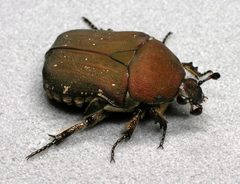
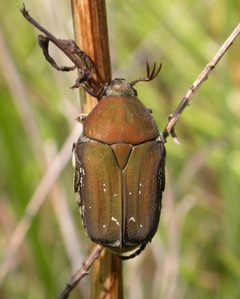
Euphoria herbacea is a medium-sized scarab beetle in the Cetoniinae, commonly known as flower chafers or fruit chafers. measure 15–16 mm and display an olive-green coloration. The is to the United States, with its distribution centered on the central plains and areas east of the Mississippi River. Like other members of its , it is attracted to fermenting sap flows on trees and exhibits a distinctive with hind wings that deploy while the remain closed.
Pronunciation
How to pronounce Euphoria herbacea: //juːˈfɔːriə hɜːrˈbæsiə//
These audio files are automatically generated. While they are not always 100% accurate, they are a good starting point.
Identification
Euphoria herbacea can be distinguished from similar Euphoria by its uniform olive-green coloration and size of 15–16 mm. It is smaller than Euphoria fulgida (13.4–19.8 mm, variable green to blue-green and burgundy) and lacks the metallic color variation seen in that species. Euphoria sepulchralis is darker and more slender. The species occurs in a more restricted eastern and central range compared to the widespread E. fulgida. Confirmation may require examination of genitalia or reference to the monographic revision by Orozco (2012).
Images
Habitat
Found in association with deciduous hardwood forests, particularly where oak trees occur. are attracted to sap flows on tree trunks, especially on stressed or wounded trees. The has been collected in xeric dolomite prairie remnants and dry post oak woodland in Missouri, suggesting adaptability to open woodland and prairie-edge .
Distribution
to the United States. Primary range includes the central plains and areas east of the Mississippi River. Documented from Alabama, Delaware, District of Columbia, Florida, Georgia, Illinois, Kansas, Kentucky, Louisiana, Maryland, Mississippi, Missouri, New Jersey, New York, North Carolina, Ohio, Oklahoma, Pennsylvania, South Carolina, Tennessee, Texas, Virginia, and West Virginia.
Seasonality
are active primarily in late spring and early summer. In Missouri, specimens have been collected in traps in late July, suggesting the activity period extends through mid-summer. The takes approximately one year, with adults emerging mostly in late spring.
Diet
feed on fermenting sap exuding from wounds on trees, especially oak. The beetles are attracted to odors from fermentation rather than the sap itself. Adults may also visit flowers for nectar and pollen, including dogwood, sumac, and thistle.
Host Associations
- Quercus spp. - sap feeding attracted to fermenting sap flows on oak trees
Life Cycle
Complete with one-year . Larvae develop in soil, feeding on organic matter. Laboratory-reared larvae fed on manure and ungerminated seeds took an average of 122 days to mature. Larvae enter a quiescent pre-pupal stage in autumn and overwinter. occurs in spring, often under logs in moist . emerge in late spring to early summer.
Behavior
are fast, powerful, and erratic fliers. They exhibit a distinctive mechanism where the membranous hind wings deploy through a special body hinge while the hardened forewings () remain closed. Adults are and are attracted to fermenting tree sap, where they may aggregate with other insects. When feeding on sap containing alcohol from fermentation, they may become lethargic and less skittish.
Ecological Role
contribute to nutrient cycling through their consumption of fermenting plant sap. Their attraction to sap flows creates points that may facilitate interactions among multiple insect . Larval feeding on organic matter in soil contributes to decomposition processes.
Human Relevance
Has been used as a study organism for understanding flower chafer and mechanics. The is not considered an agricultural pest. Historical specimens have been traded among collectors, though the species is not particularly sought after commercially.
Similar Taxa
- Euphoria fulgidaOverlapping range and similar size, but E. fulgida shows greater color variation (metallic green, blue-green, burgundy) and is more widespread; E. herbacea is uniformly olive-green
- Euphoria sepulchralisSimilar size and sap-feeding , but E. sepulchralis is darker, more slender, and has a more elongated body form
- Cotinis nitidaShares attraction to fermenting sap and overlaps in , but C. nitida is larger (about 20 mm), more robust, and has a velvety green coloration with yellowish margins
More Details
Taxonomic history
The Euphoria was monographically revised by Jesús Orozco in 2012 (The Coleopterists Bulletin 66: 1–182), which clarified boundaries and distributions. Some previously identified as E. fulgida have been split into separate species, including E. monticola (Arizona mountains) and E. limbalis (Florida).
Collection methods
are readily collected at sap flows on oak trees, particularly during warm, sunny days. They may also be captured using traps containing ethanol and red wine, which has proven more effective than ethanol alone for attracting cetoniine scarabs.
Sources and further reading
- BugGuide
- Wikipedia
- GBIF taxonomy match
- iNaturalist taxon
- Catalogue of Life
- Ascalaphidae | Beetles In The Bush
- August | 2022 | Beetles In The Bush
- entomology | Beetles In The Bush | Page 5
- Art and Bob and Ted’s Excellent Adventure | Beetles In The Bush
- Bug Eric: A Flower Scarab, Euphoria fulgida
- Party on a pin oak | Beetles In The Bush