
Strigoderma arbicola
(Fabricius, 1792)
sand chafer, spring rose beetle, false Japanese beetle, rose chafer
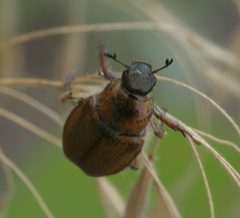
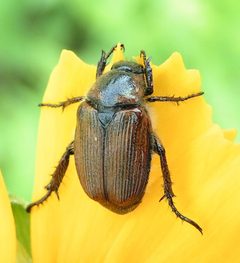
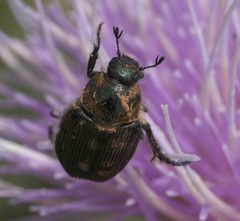
Strigoderma arbicola is a small scarab beetle in the Scarabaeidae, commonly known as the sand . It inhabits sandy areas including dunes and glades, where are frequently collected from low vegetation and flowers. The has a relatively restricted distribution in the central United States. Males are commonly observed in characteristic perching postures with spread, presumably detecting female .
Pronunciation
How to pronounce Strigoderma arbicola: /ˌstrɪɡoʊˈdɜrmə ɑrˈbɪˌkoʊlə/
These audio files are automatically generated. While they are not always 100% accurate, they are a good starting point.
Identification
Strigoderma arbicola is a small, compact scarab beetle. It can be distinguished from the similar Strigoderma pygmaea by the presence of a (furrow) on the portion of the pronotum; this sulcus is absent in S. pygmaea. The also resembles S. knausi, with which it shares sandy preferences.
Images
Habitat
Sandy including sand dunes, sandstone glades, and sandy prairies. are found on low vegetation and grasses in these open, sandy environments.
Distribution
Central United States, with records from Kansas, Oklahoma, Arkansas, and northern Texas. The type locality is the sand hills near Medora, Kansas.
Seasonality
Active in late spring and early summer; collected in June in Arkansas and Oklahoma.
Behavior
Males perch on vegetation with middle and hind legs extended, body held nearly horizontal, front legs free, and antennal club segments spread widely apart. This posture is presumed to facilitate detection of female . Females are rarely encountered.
Human Relevance
Collected as bycatch during general insect surveys in sandy . Sometimes mistaken for the more widespread Strigoderma pygmaea.
Similar Taxa
- Strigoderma pygmaeaLacks the pronotal present in S. arbicola; occurs more broadly across the southeastern United States including Florida and the Atlantic coast.
- Strigoderma knausiSimilar size and sandy preference; distinguished by subtle morphological differences in pronotal and elytral .