
Rutelini
MacLeay, 1819
shining leaf chafers
Genus Guides
8- Chrysina(Jewel Scarabs)
- Cotalpa
- Parabyrsopolis
- Paracotalpa(little bears)
- Parastasia
- Pelidnota(Precious Metal Scarabs)
- Pseudocotalpa
- Rutela
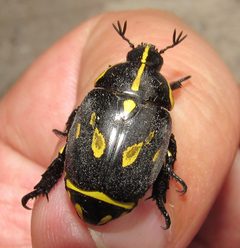
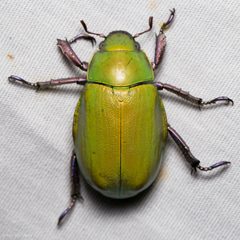
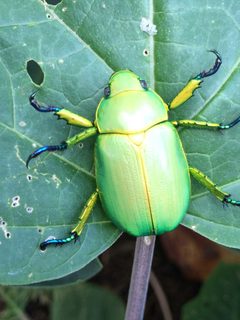
Rutelini is a tribe of scarab beetles commonly known as shining leaf chafers, distinguished by their often metallic or iridescent coloration. The tribe comprises approximately 14 and at least 40 described , with notable genera including Chrysina (jewel scarabs), Pelidnota, and Macraspis. Members are primarily distributed in the New World tropics and subtropics. Many species exhibit striking structural coloration and have been subjects of taxonomic revision due to their morphological diversity and conservation interest.
Pronunciation
How to pronounce Rutelini: //ruːˈtɛlɪnaɪ//
These audio files are automatically generated. While they are not always 100% accurate, they are a good starting point.
Identification
Rutelini can be distinguished from related tribes in Rutelinae by the combination of: 10 antennomeres; 10 elytral ; presence of a mesoventral process; and asymmetrical parameres in males. The quadrangular with trilobate apex (male) or rounded apex (female) extending beyond the separates certain from Brazilian Areodina. Larvae are distinguished from other scarab larvae by the arrangement of raster bristles and the shape of the maxillary stridulatory area. Chrysina are recognized by their exceptional metallic luster and often translucent elytral margins. Pelidnota species are generally larger with more subdued coloration and distinct elytral maculations.
Images
Appearance
typically exhibit metallic or iridescent coloration, ranging from gold, green, and blue to and silver, often with structural coloration produced by cuticular microsculpturing. Body form varies from robust and oval to more elongate. The shape is taxonomically significant: in some it is quadrangular with trilobate apex in males and rounded in females, extending beyond the . possess three distinct teeth; have six teeth. have 10 antennomeres. typically display 10 . The mesoventral process is present. Larvae are scarabaeiform (C-shaped), white to cream-colored, with well-developed thoracic legs and a distinct raster pattern on the surface of the last abdominal segment.
Habitat
are associated with forested in tropical and subtropical regions. Larvae develop in decaying wood, including rotten logs and stumps of various tree . Some species have been documented in montane cloud forests and mid-elevation rainforests. The Macraspis has been recorded from decaying trunks in both Mexican and Brazilian forests.
Distribution
Primarily Neotropical, with distribution extending from the southern United States through Mexico, Central America, and South America. Documented occurrences include: Panama (25 Chrysina ), Colombia, Ecuador, Brazil (multiple including Oplognathus, Macraspis, Homoiosternus), and the southwestern United States (Pseudocotalpa sonorica in Arizona/Sonora). The tribe is most diverse in tropical montane forests of Central and South America.
Host Associations
- decaying wood of various tree species - larval development siteLarvae of Macraspis and Chrysophora confirmed in rotten logs and stumps
Life Cycle
Larvae are scarabaeiform and develop in decaying wood. Third-instar larvae and pupae have been described for multiple including Macraspis, Chrysophora, and Pseudocotalpa. The duration of stages and total life span remain undocumented for most . occurs within the larval galleries in wood.
Behavior
are primarily and attracted to light. Many are arboreal or found in forest , descending to lower vegetation or ground level. Specific behavioral observations are sparse beyond light-trapping records and occasional feeding observations on foliage.
Ecological Role
Larvae function as decomposers in forest , processing decaying wood and contributing to nutrient cycling. Their role in dead wood decomposition has been documented for Macraspis in Mexico and Brazil, and for Chrysophora chrysochlora in Colombia. feeding habits are poorly documented but likely include folivory; their role as or herbivores has not been quantified.
Human Relevance
Chrysina (jewel scarabs) are highly prized by insect collectors due to their exceptional metallic coloration, creating conservation concerns for rare or restricted-range species. Some species are protected by national legislation or international trade regulations. The tribe has been subject to extensive taxonomic research, with multiple recent revisions and species descriptions. No agricultural pest status has been documented.
Similar Taxa
- Areodina (Rutelinae)Overlaps in distribution and general ; distinguished by symmetrical parameres, different clypeal structure, and other genitalic features
- Rutelisca (tribe Rutelini)Congeneric within Rutelini; distinguished by specific combinations of clypeal, mandibular, and genitalic characters detailed in taxonomic revisions
- Pelidnota vs. ChrysinaBoth in Rutelini; Pelidnota generally larger with more robust build, less brilliant metallic coloration, and distinct elytral patterning; Chrysina smaller with exceptional iridescence and often translucent elytral margins
More Details
Taxonomic instability
Generic limits within Rutelini have undergone significant revision, with multiple new described in recent decades and synonymies proposed based on examination of . The Oplognathus was revised in 2021, resulting in neotype designation and synonymy resolution. The oreicola and veraguana species-groups have been proposed within Chrysina to accommodate phylogenetic relationships.
Conservation significance
The exceptional coloration of Chrysina has led to intensive collection pressure. Several species have extremely restricted ranges, and loss in montane forests poses additional threats. However, formal conservation assessments are lacking for most Rutelini species.
Sources and further reading
- BugGuide
- Wikipedia
- iNaturalist taxon
- Catalogue of Life
- Larva and pupa ofChrysophora chrysochlora(Coleoptera: Scarabaeidae: Rutelinae: Rutelini)
- Taxonomic revision of the genus Oplognathus MacLeay, 1819 (Coleoptera: Scarabaeidae: Rutelinae: Rutelini)
- Larvae and pupae of species of the genusMacraspis(Coleoptera: Scarabaeidae: Rutelinae: Rutelini)
- A new species of Chrysina Kirby, 1828 (Coleoptera: Scarabaeidae: Rutelinae: Rutelini) from Ecuador and inclusion into proposed veraguana species-group
- A Monographic Revision of The Jewel Scarabs Genus Chrysina from Panama, Colombia, and Ecuador (Coleoptera: Scarabaeidae: Rutelinae: Rutelini)
- Lectotype designation, redescription, and synonymy of Homonyx cupreus Guérin-Méneville, 1839 (Coleoptera: Scarabaeidae: Rutelinae: Rutelini)
- Description of the Larva of Pseudocotalpa sonorica Hardy (Scarabaeidae: Rutelinae: Rutelini) with Notes on Life History
- New species and illustrated key of Macraspis (Scarabaeidae, Rutelinae, Rutelini) from the Amazon biome of Brazil.