Xyleborus pfeili
Wood & Bright, 1992
Xyleborus pfeili is an ambrosia beetle in the Scolytinae, native to regions including Europe and Asia. Like other ambrosia beetles, it cultivates symbiotic fungi within wood tunnels as its primary food source. Laboratory studies have documented its on semi-artificial diets, revealing arrhenotokous where unmated females produce only male offspring. The has been successfully reared using sawdust-based diets with fungal , providing a model for studying ambrosia beetle .
Pronunciation
How to pronounce Xyleborus pfeili: //zaɪˈlɛbɔːrəs ˈfaɪlaɪ//
These audio files are automatically generated. While they are not always 100% accurate, they are a good starting point.
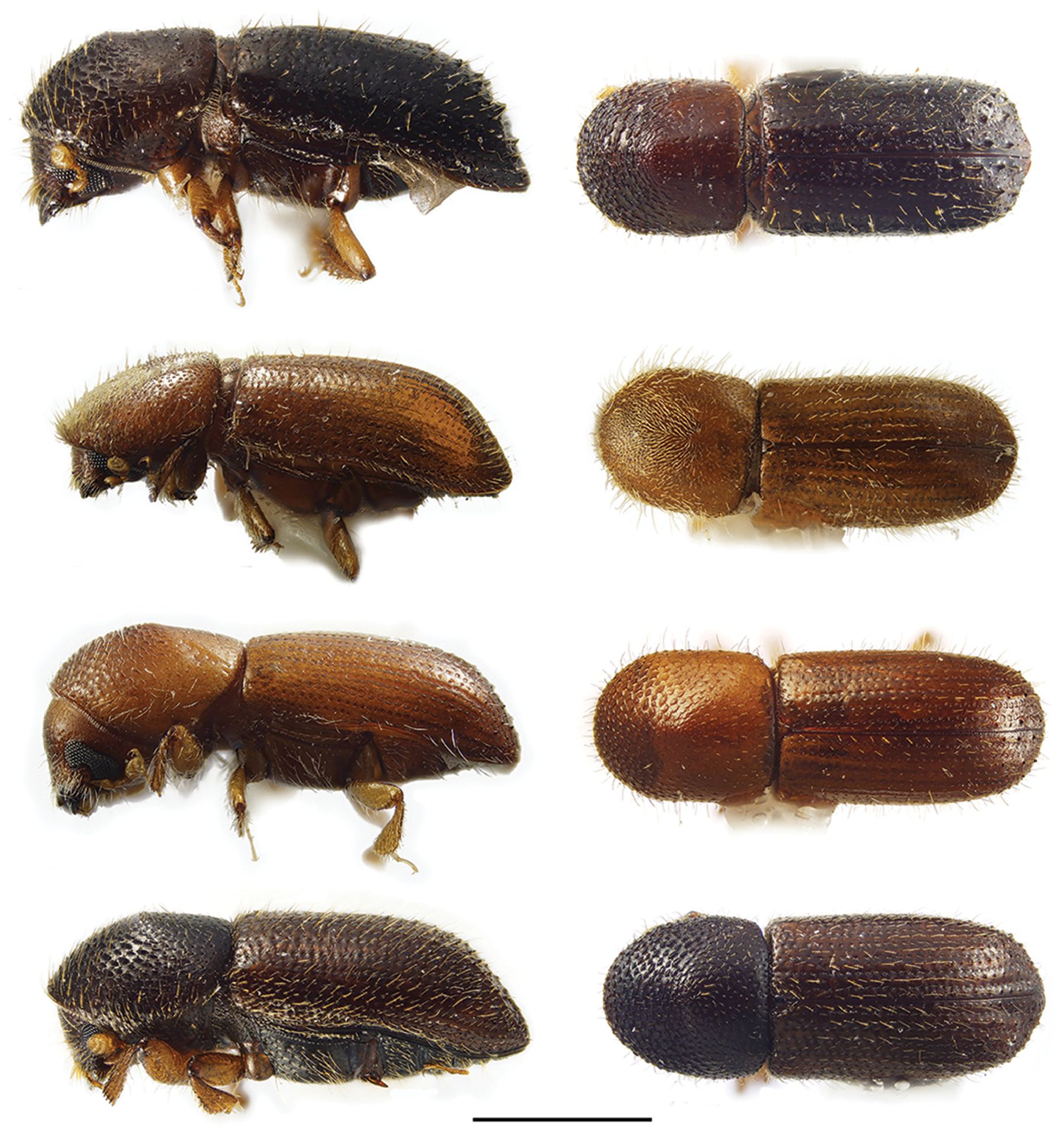
Images
Distribution
Africa; Europe and Northern Asia (excluding China); North America; Southern Asia; specifically recorded in Austria. Presence in North America appears to reflect introduced rather than native range.
Diet
Ambrosia fungus cultivated on woody substrate; specifically Ambrosiella pfeilii has been documented as the fungal in laboratory rearing.
Host Associations
- Ambrosiella pfeilii - fungal partner cultivated for food in galleries
- Quercus robur - sawdust used in semi-artificial rearing diet
- Fagus sylvatica - sawdust used in semi-artificial rearing diet
- Douglas-fir (Pseudotsuga menziesii) - sawdust and resin used in semi-artificial rearing diet
Life Cycle
are laid over an extended period (observed up to 40 days after inoculation in laboratory conditions). Larvae develop normally, pupate, and emerge as . and of males occur later than those of some females. Total gallery system length correlates positively with offspring number.
Behavior
Mother beetles construct gallery systems in wood or artificial substrate, boring tunnels and ovipositing in response to available space and fungal food resources. When multiple male offspring occur in the same gallery system, they typically coexist in different developmental stages and separate branch tunnels.
Similar Taxa
- Xyleborus glabratusBoth are Xyleborus ambrosia beetles with fungal , but X. glabratus is a damaging in North America causing laurel wilt , whereas X. pfeili has not been documented as a significant pest
- Xylosandrus amputatusBoth are ambrosia beetles with mycangia for fungal transport, but X. amputatus belongs to a different with distinct gallery architecture and associations
More Details
Reproductive Biology
Xyleborus pfeili exhibits arrhenotokous : unmated females produce only male offspring, while fertilized females produce with strongly female-biased sex ratios. Mother beetles appear to adjust production based on tunnel size and available fungal food, laying female eggs first followed by at least one male egg per tunnel.
Laboratory Rearing
Successful rearing has been achieved using two-layer semi-artificial diets, with a lower layer containing Douglas-fir sawdust, potato starch, dried yeast, sugar, and water, and an upper layer of sawdust, sugar, and water. This structure greatly increases reproductive success compared to single-layer diets. (streptomycin and penicillin) reduce offspring production without preventing fungal .
Taxonomic Note
Some sources cite the authority as Ratzeburg (1837) based on earlier Bostrichus pfeilii description, though current accepted authority is Wood & Bright, 1992. iNaturalist records use the spelling Xyleborus pfeilii with double 'i'.
Sources and further reading
- BugGuide
- GBIF taxonomy match
- iNaturalist taxon
- NCBI Taxonomy
- Catalogue of Life
- Xyleborus glabratus and Euwallacea fornicatus - Entomology Today
- Xyleborus-glabratus - Entomology Today
- Forest Pest Invasions Can—And Should—Be Studied Before They Happen
- The Ambrosia Beetle Megaplatypus mutatus: Tiny but Destructive
- The Best Look Yet at the Tiny Fungus Storage Units Inside Ambrosia Beetles
- Why Are We Having a Record Outbreak of Exotic Fruit Flies in 2025?
- Reproduction of the ambrosia beetle, Xyleborus pfeili (Ratzeburg) (Col., Scolytidae), on semi‐artificial diet
- Effects of ingredients and structure of semi-artificial diet on the reproduction of an ambrosia beetle, Xyleborus pfeili (Ratzeburg) (Coleoptera: Curculionidae: Scolytinae)