
Xylosandrus amputatus
Dole & Cognato, 2010
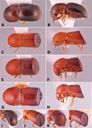
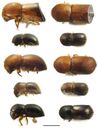
Xylosandrus amputatus is a of ambrosia beetle in the weevil Curculionidae, Scolytinae. The species has been used as a model organism in studies of mycangial structure, with micro-CT scanning revealing detailed three-dimensional anatomy of its fungus-storing organs. It is known from North America and Southern Asia. Like other ambrosia beetles in the , it engages in obligate mutualism with fungi, carrying in specialized internal structures called mycangia.
Pronunciation
How to pronounce Xylosandrus amputatus: //zaɪloʊˈsændrəs ˌæmpjuˈteɪtəs//
These audio files are automatically generated. While they are not always 100% accurate, they are a good starting point.
Identification
Micro-CT imaging studies have documented the mycangial structure of Xylosandrus amputatus, revealing hollow internal structures within the prothorax and used for fungal transport. The can be distinguished from congeneric ambrosia beetles such as Xylosandrus crassiusculus and Xylosandrus germanus by morphological characters, though specific diagnostic features for field identification are not detailed in available sources. The mycangium is associated with prothoracic musculature visible in 3D reconstructions.
Images
Distribution
North America (present); Southern Asia (present).
Diet
Feeds on symbiotic fungi cultivated within wood galleries. The does not consume wood directly; rather, it transports fungal spores in mycangia and inoculates gallery walls, with larvae and consuming the resulting fungal growth.
Behavior
Engages in fungus-farming characteristic of ambrosia beetles. Pioneering individuals excavate tunnels in wood and introduce symbiotic fungi carried in mycangia. The fungus grows on gallery walls and serves as the sole food source for offspring.
Ecological Role
Acts as a for fungal and potentially for pathogenic fungi. In the Xylosandrus, related have been documented carrying genera such as Ambrosiella, Fusarium, Botryosphaeria, and Diaporthe, though specific fungal associates of X. amputatus have not been individually characterized.
Human Relevance
The has contributed to scientific understanding of ambrosia beetle anatomy through its use in micro-CT imaging studies of mycangial structure. Its Xylosandrus germanus has been implicated in rapid apple decline in North American orchards, but X. amputatus itself has not been documented as an agricultural pest in available sources.
Similar Taxa
- Xylosandrus crassiusculusBoth are congeneric ambrosia beetles with similar mycangial structure and fungus-farming ; X. crassiusculus has been documented as a pest of peach trees in South Carolina and apple trees in North Carolina.
- Xylosandrus germanusBoth are congeneric ambrosia beetles with similar mycangial anatomy; X. germanus has been identified as a in rapid apple decline studies in North Carolina and a primary in New York and New England orchards.
More Details
Research significance
Xylosandrus amputatus was one of eight ambrosia beetle used in a comparative study of imaging techniques (micro-CT scanning, laser ablation tomography, and microtome sectioning) for visualizing mycangial structure. The 3D reconstruction of its internal anatomy demonstrated that micro-CT offers advantages in speed, specimen preservation, and three-dimensional spatial relationships compared to traditional methods, though microtome sectioning remains superior for cellular-level resolution of fungal contents.
Sources and further reading
- BugGuide
- GBIF taxonomy match
- iNaturalist taxon
- NCBI Taxonomy
- Catalogue of Life
- The Best Look Yet at the Tiny Fungus Storage Units Inside Ambrosia Beetles
- 3-D reconstruction of ambrosia beetle via micro-CT scanning - Entomology Today
- Xylosandrus germanus - Entomology Today
- Xylosandrus crassiusculus Archives - Entomology Today
- What Role, If Any, Do Ambrosia Beetles Play in Rapid Apple Decline?