
Cossoninae
Genus Guides
7Cossoninae is a of true weevils within the Curculionidae. Members of this subfamily are characterized by their small to medium size and association with woody substrates, including timber, leaf litter, and plant roots. The group exhibits considerable diversity in preference, with found in marine/coastal environments, forest leaf litter, and specialized such as sand dunes and the phloem of living trees. Many species possess reduced or absent (anophthalmous or microphthalmous) and exhibit endogean or cryptic lifestyles. The subfamily includes both economically significant timber pests and ecologically important decomposers.
Pronunciation
How to pronounce Cossoninae: /ˌkəʊsəˈnaɪniː/
These audio files are automatically generated. While they are not always 100% accurate, they are a good starting point.
Identification
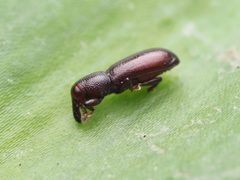
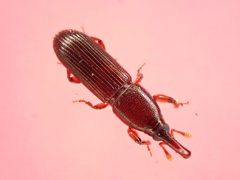
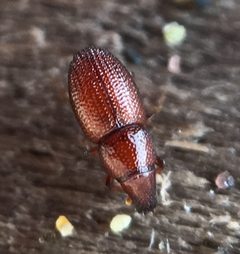
Cossoninae can be distinguished from other Curculionidae by the combination of: (1) presence of uncinate tibiae in many (though not universal); (2) often reduced or absent , particularly in species inhabiting leaf litter or decaying wood; (3) association with woody substrates including timber, leaf litter, or living/dead plant material; (4) small to moderate body size with compact, cylindrical form. Within Curculionidae, the subfamily is most similar to Molytinae and Cryptorhynchinae, from which it is distinguished by tibial structure and larval . Species identification requires examination of genitalia and detailed morphological features.
Images
Habitat
Highly variable across the . Includes: coastal/marine timber (Pselactus spadix); forest leaf litter (Caecossonus, Decuanellus, Lymantes); sand dunes (Omanocossonus sabulosus in roots of Calotropis procera); living tree phloem (Araucarius in Araucaria araucana); decaying wood and bark; and endogean (soil-dwelling) . Many species are cryptic, inhabiting spaces within wood, soil, or leaf litter.
Distribution
distribution with strong representation in the New World (North, Central, and South America, Caribbean islands), Old World (Europe, Africa, Asia), and oceanic islands (Cape Verde, Canary Islands, Madeira). Specific often exhibit restricted distributions: Caecossonus and Decuanellus in Caribbean and adjacent regions; Araucarius in Chile; Pselactus in Cape Verde; Barretonus in Macaronesia (Madeira, Canary Islands); Omanocossonus in Oman.
Seasonality
Variable by and . Timber-inhabiting species such as Pselactus spadix may be active year-round in suitable conditions. Species associated with living trees (Araucarius) likely synchronized with . Leaf-litter species activity patterns poorly documented but likely influenced by moisture and temperature. No comprehensive seasonal data available for the as a whole.
Host Associations
- Pinus sylvestris - larval developmentScots pine heartwood; laboratory for Pselactus spadix
- Araucaria araucana - larval development and feedingPhloem penetration and gallery construction by Araucarius
- Calotropis procera - larval developmentRoot-associated; for Omanocossonus sabulosus in sand dune
Life Cycle
duration highly variable. Pselactus spadix: approximately 24 months at 22°C, with five larval instars, lasting ~15 days, and development from 2nd instar to ~71 weeks. Some (Araucarius) can complete life cycle without emerging from wood. Many species exhibit extended adult longevity (Pselactus spadix: mean 11.5 months, males living significantly longer than females).
Behavior
Many exhibit cryptic, substrate-bound . Pselactus spadix can complete entire within wood without emerging. Araucarius species penetrate living tree phloem to oviposit, remaining with and larvae in galleries—behavior convergent with bark beetles (Scolytinae). Leaf-litter species (Caecossonus, Decuanellus) likely disperse via floating objects on water surfaces. Some species exhibit or other reproductive strategies, though data limited.
Ecological Role
Decomposers of woody material, particularly in coastal and forest . Araucarius contribute to decomposition of damaged or Araucaria trees. Some species are economically significant pests of timber (Pselactus spadix). Endogean and leaf-litter species contribute to soil nutrient cycling. The represents an ecologically diverse group with roles ranging from primary decomposers to specialized herbivores of living trees.
Human Relevance
Economic significance as pests of marine/coastal timbers (Pselactus spadix). Damage characterized by circular holes (~1.5 mm diameter) and tunneling that compromises structural integrity of timber. No other significant human interactions documented; not known as agricultural pests or beneficial in biocontrol.
Similar Taxa
- MolytinaeShares uncinate tibiae and leaf-litter with many Cossoninae; distinguished by different larval and
- CryptorhynchinaeSimilar compact body form and cryptic habits; distinguished by tibial structure and genitalia
- Scolytinae (bark beetles)Convergent in Araucarius which penetrate phloem and construct galleries; distinguished by weevil (geniculate , rostrum) versus bark beetle form
More Details
Taxonomic History
The has undergone significant taxonomic revision, with the majority of New World eyeless litter-inhabiting weevils now placed in Cossoninae (along with Molytinae and Cryptorhynchinae). The tribe Araucariini, formerly considered distinct, is now placed within Cossoninae based on morphological and biological evidence. Several have been transferred between subfamilies, including Howdeniola (to Cossoninae) and Bordoniola (to Raymondionymini).
Morphological Diversity
The exhibits remarkable morphological diversity, from fully eyed in exposed to completely eyeless (anophthalmous) or reduced- (microphthalmous) species in cryptic environments. This gradient of eye reduction reflects to subterranean, endogean, and wood-inhabiting lifestyles.
Biogeographic Patterns
Caribanean Cossoninae (Caecossonus, Decuanellus) show distribution patterns influenced by both geological history of the Caribbean basin and via overwater rafting on floating objects. Macaronesian (Barretonus) exhibit high endemicity with anophthalmous or microphthalmous species adapted to endogean lifestyles.
Sources and further reading
- BugGuide
- Wikipedia
- iNaturalist taxon
- NCBI Taxonomy
- Curculionidae | Beetles In The Bush
- Insecta | Beetles In The Bush | Page 5
- July | 2022 | Beetles In The Bush
- weevils | Beetles In The Bush
- Characteristics of Attack of Coastal Timbers by Pselactus spadix (Herbst) (Col.: Curc.: Cossoninae) and an Investigation of its Life History
- Review of Cape Verde Pselactus Broun, 1886 (Coleoptera: Curculionidae: Cossoninae) with description of a new species, larvae and notes on biology
- REVIEW OF THE NEW WORLD EYELESS WEEVILS WITH UNCINATE TIBIAE (COLEOPTERA, CURCULIONIDAE; MOLYTINAE, CRYPTORHYNCHINAE, COSSONINAE)
- A new, peculiar genus of Cossoninae (Coleoptera, Curculionidae) from Oman with description of a new species, larva and notes on biology
- Review of Cape Verde Aphanommata Wollaston, 1873 (Coleoptera: Curculionidae: Cossoninae) with Description of New Species, Larva and Notes on Biology and Distributional Patterns
- Review of Cape Verde <em>Aphanommata</em> Wollaston, 1873 (Coleoptera: Curculionidae: Cossoninae) with Description of New Species, Larva and Notes on Biology and Distributional Pattern
- The discovery of Barretonus (Curculionidae: Cossoninae) in the Canary Islands: barcoding, morphology and description of new species
- Rüsselkäfer (Araucariini, Cossoninae, Col.) mit einer Borkenkäfern (Scolytoidea) ähnlichen Brutbiologie an der Araucaria araucana (Mol.) Koch in Chile12
- Validation of the Names of Two Weevil Species Described by Skuhrovec et al., Review of Cape Verde Aphanommata Wollaston, 1873 (Coleoptera: Curculionidae: Cossoninae) with Description of New Species, Larva and Notes on Biology and Distributional Patterns; Diversity 2018, 10, 28